
For many first-time managers, stepping up into a coaching and management role can feel like a matter of ‘sink or swim’. Here’s how HR can coach them to thrive as people leaders.
When first-time managers step into their new role, one of the biggest challenges they often face is shedding their old ‘individual contributor’ mindset, says Shelley Johnson, leadership coach and founder of HR consulting firm Boldside.
“If I’ve been promoted from a high-performing individual contributor to a leader [or manager], the thing that made me successful as a high-performing individual contributor was that I had all the answers,” she says.
“The thing that’s going to make them successful as a [manager or] leader is a totally different set of skills. We often don’t do that transition well.”
Another common challenge is feeling overwhelmed by their new responsibilities and the need to impress, which can mean they sometimes neglect the leadership or coaching element of their new role.
This is where developing an ‘inboarding’ process – an onboarding process for internal talent – can make all the difference.
“Leadership is not an add-on to your role. It is the core role now.” – Shelley Johnson, leadership coach and founder, Boldside
Below, Johnson and Tania Lennon, director of the Strategic Talent Lab at IMD Business School, offer considerations for HR practitioners to include in an inboarding or new-manager training initiative.
The skills of the modern first-time manager
Before we explore some of the ways HR can support first-time managers, it’s worth exploring some of the ways the skills required to be an effective manager are shifting.
The role of the manager today is not just to deliver on results, but to create value, says Lennon.
As organisations continue to harness AI tools to optimise resource management and administrative tasks, the role of the modern manager is increasingly to help team members to work through ambiguity and find innovative solutions to the problems they face, she adds.
“The management agenda is probably going to be taken by AI… but that doesn’t mean humans don’t have a role,” says Lennon.
Lennon breaks down the role of the manager into two key focus areas – helping their teams deliver work and facilitating value creation.
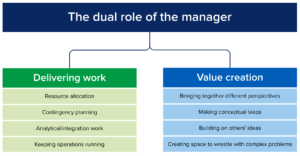
Value creation is where managers should be spending more of their time, she says.
This looks like offering training to ensure first-time managers are equipped to support teams to manage ambiguity, change and the increased pace of work and helping them see themselves as on-the-ground coaches rather than allocators of resources.
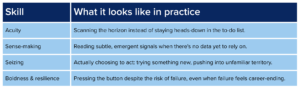
When recruiting managers without a lot of experience, or looking to promote first-time managers internally, Lennon suggests HR look for the following skills – drawing on Argyris and Schön’s theory on congruence and learning and David Teece’s concept of dynamic capabilities:
Shifting from team member to team leader
A common misconception, which Johnson calls out, is that becoming a manager is just an addition to an employee’s previous role.
“It’s a fundamental career change… what made you successful as an individual contributor is not what’s going to make you successful as a leader. When people see it as a career change, they realise, ‘I’ve got to learn a whole stack of new skills’.
“Leadership is not an add-on to your role. It is the core role now.”
“You were the best engineer, so now you’re going to manage all the engineers… It’s not a leadership/management development strategy. It’s the equivalent of a parent saying to a kid, you’ve been in the car for 16 years now. I’m just going to give you the keys and you can drive because you’ve been in a car.” – Shelley Johnson, leadership coach and founder, Boldside
In the absence of a formal leadership onboarding process, Johnson suggests HR arm first-time managers with the following skills as a starting point:
1. Help the team find the solution
Often first-time managers feel like they need to have all the answers because they think this is what got them promoted in the first place.
HR can help these managers by reminding them that their primary goal is to help the team find the solutions.
“This often means they don’t get that same dopamine hit [they were used to]. They’re no longer the one with all the best ideas who gets the stuff done. They coach their team to do that, which is a different sense of fulfillment and reward.”
Resource: 7 questions to make your coaching sessions more impactful, according to Michael Bungay Stainer (includes downloadable guide).
2. Ask curious questions
Asking better questions might sound simple, but it’s actually a learned skill that we often assume is innate in people.
“We get taught Pythagoras’ theorem and trigonometry at school, but no one teaches us how to ask questions – and questions are key to critical thinking,” says Johnson.
“If we want to be good critical thinkers, we’ve got to have a question-asking mindset. Not in an interrogative way but a curious way.”
Lennon says supporting employees to formulate their own solutions to roadblocks helps to create value over time, as the team learns to grapple with complex issues, rather than relying on their manager to put out every fire.
In practice, Lennon says this could look like managers asking:
- What’s the goal you’re hoping to achieve?
- What’s the roadblock holding you back?
- What do you think could help overcome that roadblock?
It’s very easy for first-time managers to fall into the trap of thinking they need to answer their team members’ questions straight away, says Johnson.
“One simple tip we tell first-time managers is that when you’re about to give an answer, ask three more open-ended questions instead.”
Resource: The 5 strategic questions leaders should be asking.
3. Actively listen
“I could ask good questions, but if I’m not genuinely listening, I’m not going to be an effective coach. It’s the combination of skills that make a great coach,” says Johnson.
Drawing on her mediation training, Johnson offers a hack to help managers listen actively and avoid jumping into the conversation too early – feel the back of your chair.
“When you learn forward in a conversation, you’re more likely to interrupt. By leaning back, you’re more likely to create space in the conversation.”
She highlights the importance of making sure you have enough time and space in the meeting to actively listen.
“Rushing kills listening,” she says. “If I need to have a really important conversation with a team member, but I’ve only allowed for half an hour and I know I’m going to need an hour because it’s a messy conversation, it’s going to bode poorly for my ability to listen.”
Instead, she suggests advising managers to consider the following before booking the time in their diaries:
- What is the nature of this conversation? Is it about offering feedback, sharing information or getting a status update on tasks? Each style of conversation will require different time blocks.
- Have I allowed enough margin for this conversation to actually ask the questions and have enough space to really listen to their responses?
Another skill to coach first-time managers on is how to get comfortable with silence.
When they ask their team member a question and receive a short response, and perhaps they sense something has gone unsaid, coach them to sit for a few moments in silence to signal to the individual that they can extrapolate, if they wish to.
“I could ask good questions, but if I’m not genuinely listening, I’m not going to be an effective coach. It’s the combination of skills that make a great coach.” – Shelley Johnson, leadership coach and founder, Boldside
Building a leadership onboarding process
Ideally, individual contributors promoted into a managerial role would be onboarded like new employees, says Johnson.
However, the current strategy many organisations use for onboarding/inboarding new managers is often ‘sink or swim’.
“You were the best engineer, so now you’re going to manage all the engineers… It’s not a leadership/management development strategy. It’s the equivalent of a parent saying to a kid, you’ve been in the car for 16 years now. I’m just going to give you the keys and you can drive because you’ve been in a car.”
Instead, she suggests a structured onboarding/training process that spans at least the first six months in their new role.
She says the capabilities to focus on could include:
- Leadership of the self – Before they can lead a team, they have to lead themselves. They need an awareness of their strengths and struggles. They need to know how they cope in stressful situations and where they have skills gaps.
- Leadership of the team – This includes foundational skills such as how to run good 1:1 sessions, how to lead a difficult conversation, how to set clear performance expectations, how to coach high performers, how to coach struggling performers, how to have career-based conversations, etc.
- Leading the organisation – Translating the strategy at the team level. Do they know how to ladder organisational goals down to a team level, so they make sense to a junior employee and offer that person clarity about how they contribute to broader organisational success?
Finally, a key capability Johnson is keen to highlight is helping first-time managers to set clear expectations of their team members and setting them up to have honest conversations when things haven’t gone well.
“You can’t have feedback conversations if you haven’t set clear expectations. They go hand in hand.”
Keep an eye out for AHRI’s downloadable guide on how to help managers navigate specific difficult feedback conversations with their teams, which includes example phrasing you can use in your coaching conversations.
🧰 HR’s career resource toolkit
- Download: A guide to coaching managers through difficult feedback conversations
- Learning: Develop the skills and confidence needed to manage people effectively by adopting a coaching mindset with this course from AHRI.
- Learning: Help your team to lead difficult conversations – or upskill yourself – with this course from AHRI.
- Watch: See how this HR leader helps leaders who are “not so good with people” in The Big Ask with Maresa Seabrook FCPHR.
- Read: Learn how to make the shift from contributor to coach in your own role in this article.
- Read: Take your one-on-one coaching skills to the next level with tips on team coaching in this article.



