While AI has the power to supercharge employees’ capabilities in previously unimaginable ways, it can also weaken critical skills that organisations have spent decades honing and coaching for – skills that will be considered mission-critical in the near future.
Today, we stand at the threshold of a transformative period. AI has the potential to accelerate progress across science, medicine, productivity and creativity. But, as with previous inflection points, the benefits of this transition will depend less on the technology itself than the cognitive capabilities of the people using it.
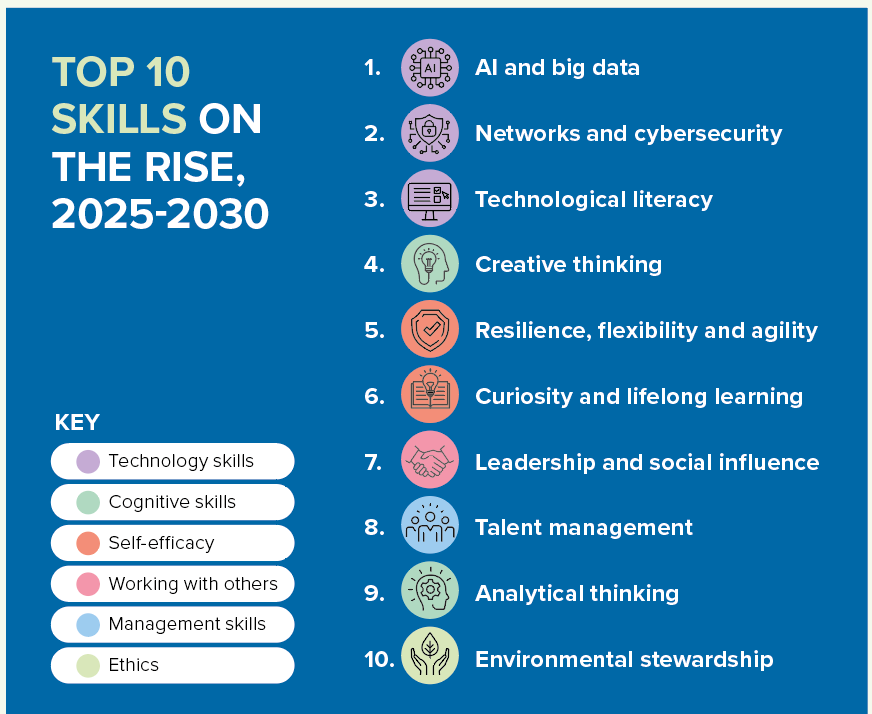
This call to action is highlighted in the World Economic Forum’s Future of Jobs report. It identified analytical thinking as the most important skill globally in 2025, with Australian employers placing even greater emphasis on it – 76 per cent cited it as a core workforce skill, compared with 69 per cent globally.
Looking ahead to 2030, both analytical thinking and creative thinking remain in the top 10 skills employers say they’ll need.
But, at precisely the moment organisations say they need more critical and analytical capability, employees’ sense-making, judgement and questioning skills are at risk of eroding.
While this is by no means an inevitability, it is a genuine risk for businesses that operate in environments where AI tools are over-relied upon, poorly governed or used as cognitive substitutes.
“What’s unknown is the long-term magnitude and trajectory of something like this,” says Catherine Newton MAHRI, HR Business Partner at The University of Melbourne. “The real question is whether we’re developing new compensatory skills as we’re forced to work in different ways.
“We may be using some skills less, but at the same time we’re starting to build others that we’ve never had such a strong need for. Whether workplaces will adapt their training and workflow design to preserve what’s truly critical is something we’re yet to see,” she says.
What are we putting at risk?
While research – including AHRI’s December 2025 Quarterly Work Outlook (AWO) – has helped debunk the myth that AI will completely displace human roles, this does not mean the transition will be without cost.
What is at risk may not be jobs themselves, but some of the most valuable and distinctly human skills that underpin effective work.
Gartner predicts that throughout 2026, half of organisations will start to require AI-free skills assessments due to generative AI-related skills atrophy. AHRI’s March 2026 Quarterly Australian Work Outlook report, which collected sentiment from more than 600 HR and business decision-makers, found that 19 per cent of respondents say critical thinking and problem-solving skills will be critical for enabling performance in an AI-driven workforce over the next two to three years. Yet only seven per cent said the development of critical thinking was a training priority for their organisation.
There’s compelling research to reinforce how important this will be, such as the oft-cited MIT ChatGPT study. In this study, about 50 participants aged 18-39 were put into three groups and asked to write high-school level essays over a period of months.
One group could use a search engine, another could use ChatGPT and the other group couldn’t use either. Using EEGs to record brain activity, the researchers found that those using ChatGPT “consistently underperformed at neural, linguistic and behavioral levels”.
The paper, which was released prior to being peer-reviewed due to the authors’ sense of urgency to release the insights to the public, concluded that over a period of months, those using ChatGPT to write their essays became mentally lazier.
According to a report from The Times, those writing essays without any aids recorded higher activity in the parts of the brain which aid functions such as memory consolidation, creativity, emotional processing, mental coordination and focus. The group that was allowed to use a search engine also returned higher brain activity.
What’s perhaps more concerning is that when those who used ChatGPT were then asked to write without it, their brains showed a dip in their cognitive capacity (active neural connections dropped from 79 to 42).
Memory recall also weakened, with 83 per cent of ChatGPT users unable to recall something they had written just minutes beforehand, compared to just 10 per cent of people in the other two cohorts.
“People are always going to engage with tools in whatever way best meets their needs,” says Newton. “In most cases, that means saving time. If the outcome is a written essay and the tool can produce that essay, why wouldn’t someone use AI?
“Learning isn’t the essay – it’s what happens through the process of making the essay. If the goal is learning, the process of getting there is what should be assessed. When it isn’t, people won’t care about the process, and those skills won’t develop.”
“We may be using some skills less, but at the same time we’re starting to build others that we’ve never had such a strong need for. Whether workplaces will adapt their training and workflow design to preserve what’s truly critical is something we’re yet to see.” – Catherine Newton MAHRI, HR Business Partner, The University of Melbourne
The same logic applies within organisations, says Newton.
“If capability decline genuinely matters because it will affect performance over time, organisations will act – but only if the goalposts shift to reflect where the real risk sits. The MIT experiment is a good example of the fact people aren’t prepared to engage critically with AI unless there’s a mandate to do so.”
Dr Grant Blashki, practicing GP, Associate Professor at The University of Melbourne and advisory board member of the AI and Health Alliance, highlights the neuroscience behind this.
“If there’s no friction and no cognitive effort, the risk is atrophy. The old saying ‘use it or lose it’ has a clear neurological basis,” says Dr Blashki.
Over-reliance on AI can erode the quality of human judgement, from how difficult messages are crafted to how new ideas are generated. Trust, respect and originality are all built through deliberate human effort, and in a world where AI excels at reproducing established patterns, the ability to sit with complexity and surface new insights may become one of the most important differentiators for high-performing teams.
“In an HR role, for example, you might need to communicate a policy change that will disappoint some people. Doing that well means acknowledging the frustration people may feel, while still delivering a clear message that feels human and lands appropriately, even if the news itself isn’t popular,” says Newton.
“If we outsource that work to AI, we start to erode the ability to make the countless micro-decisions involved in editing our own writing – asking ourselves whether a sentence sounds too corporate, whether a word might feel dismissive, or whether the explanation answers why people should care. Those are all forms of critical thinking.
“We risk skipping the work required to wrestle with tone, audience and clarity.”
Collaborative problem-solving is also at risk, Newton adds.
“Organisations don’t build sustainable competitive advantage through siloed individuals who each hold discrete skills. Having someone who is ‘skilled in X, Y or Z’ on their own isn’t enough. Advantage emerges at the organisational level – when diverse teams grapple with problems together and build shared mental models as they work through complexity.”
When idea generation is outsourced first and refined later, teams may lose the cognitive stamina required to sit with ambiguity, explore unexpected connections and generate original thinking together.
Those human capabilities don’t develop automatically – they have to be exercised. If they aren’t, we risk losing a uniquely human strength and, over time, weakening the collaborative skills organisations depend on.
Red flags to watch out for
So how can you tell if an employee or team might be overrelying on AI?
Newton suggests keeping an eye out for the following signals:
1. Teams struggle to explain their reasoning or methodology
“That’s a signal that skill decay may be occurring. From there, the question becomes: what capabilities does the team require and which specific skills are we most concerned about protecting or rebuilding?”
2. Teams struggle with transferring their understandings
“When new people join a team, [an existing employee’s] ability to transfer knowledge and understanding is telling. If they can describe tools and processes, but struggle to explain the thinking behind them, that’s a red flag. It suggests there isn’t enough critical thinking happening in their day-to-day work.”
3. There’s a lack of transparency around how and when AI is being utilised
“Clear governance around AI use – including when and how it is used, and transparency about its role in the work – is essential,” says Newton. “Well-designed workflows that explicitly acknowledge the tools being used help build an organisation-wide understanding of how AI is shaping decisions and outcomes.
“Without that visibility, AI use remains largely hidden, making it difficult to assess whether it is having a positive or negative impact.”
Developing a new, human-centric approach
How should HR respond to this shift in capability building? To an extent, it’s about going back to basics, says Newton.
“First, we need to be clear on what skills we need. That alone is a significant piece of work, because the landscape is evolving so quickly. If we’ve identified collaboration as critical, for example, what are the component skills that sit underneath it? And how do we articulate those clearly enough to redesign learning pathways in a way that makes sense to people?
“That may mean more targeted training around how we steward AI appropriately, so we don’t erode foundational capabilities.”
This could include building in explicit checkpoints to review AI outputs, she says, or establishing clear norms about when generative AI should or shouldn’t be used in a process. Over time, learning pathways may need to incorporate these stewardship skills as core capabilities in their own right.
Learn how ANZ Bank is training its workforce to use AI strategically in this case study.
A key aspect to practicing – and therefore protecting – critical thinking skills lies in rethinking how performance management structures are created, says Newton.
“What people focus on is shaped by what is rewarded – such as the capabilities a role values, and the KPIs that are set,” she says. “If skills like evaluation and critical thinking aren’t reflected in those measures, people won’t be motivated to prioritise them.”
That has clear implications for learning and development.
“If people aren’t equipped to properly verify AI outputs, integrate them thoughtfully and act as effective stewards of these tools, capability gaps will widen. Ongoing training is essential, and leaders need to be deliberate about reinforcing these priorities through both performance measures and development investment.”
Mentorship will play a role in making this happen, she says.
“Experienced employees play a critical role in transferring contextual knowledge, evaluative judgement and critical thinking skills that are built over time,” she says.
“Ensuring that this knowledge flows from more experienced practitioners to others in the organisation is essential. These aren’t new practices – they’re fundamentals – but in an AI-enabled workplace, it’s more important than ever that organisations keep doing them well.”
Champions of human capability
As well as risking a hollowing out of the workforces’ skills, over-reliance on AI is risky because Australia doesn’t yet have strong sovereign AI capabilities.
“This becomes a risk if circumstances deteriorate and systems or people are heavily dependent on AI,” says Dr Blashki.
This is why HR need to maintain their role as the champions of human capability at work, he adds.
“Even though the best chess player in the world is now AI, chess remains popular. People still watch on because they’re fascinated by how humans think, decide and perform,” he says.
“We need to be more explicit in recognising that people genuinely want human challenge and a sense of meaning in their lives. We’ll need to deliberately design workplaces – and societies – that offer people healthy friction and real connection. That will be one of the defining leadership challenges ahead of us.”
A longer version of this article first appeared in the Feb-March edition of AHRI’s member magazine.
Develop the necessary skills to build and sustain a high performing work team and tap into the full potential of team members with this course from AHRI.