Quarterly Australian
Work Outlook
- March Quarter 2026

Quarterly Australian
Work Outlook
- March Quarter 2026
March 2026
The report for the first quarter of 2026 points to a moderation in employment growth expectations, with hiring activity easing from recent highs. While overall employment intentions remain positive, employers are taking a more cautious approach amid economic uncertainty and rising inflation expectations. Organisations remain strongly committed to skills development, particularly in technical, leadership and AI capability, with investment in training continuing to rise. The report also highlights ongoing challenges for HR leaders, including persistent leadership capability gaps and renewed wage pressures despite weak productivity growth.
Summary of Key Findings
Despite higher inflation expectations, there is limited scope for inflation-matching pay increases due to sluggish productivity growth
Findings in this report highlight a clear relationship between investment in training and stronger financial outcomes
Only 20 per cent of Australian workplaces reported that their training plans and strategic workforce plans were integrated to a large extent
The survey reveals that 69 per cent of employers actively exclude people with certain characteristics when recruiting staff
For media enquiries, please contact:
Madeleine Hanley
Head of Media Relations, FleishmanHillard
M +61 423 366 918 | E [email protected]
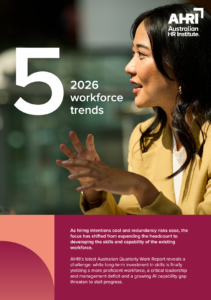
Five 2026 workforce trends
As hiring intentions cool and redundancy risks ease, the focus has shifted from expanding the headcount to developing the skills and capability of the existing workforce.
AHRI’s latest Australian Quarterly Work Report reveals a challenge: while long-term investment in skills is finally yielding a more proficient workforce, a critical leadership and management deficit and a growing AI capability gap threaten to stall progress.
labour market This quarter saw a marked decline in hiring plans, as fewer organisations reported intentions to recruit in the next three months. Curiously, redundancy plans also decreased during this period. This trend deviates from the usual indicators of a softening labour market.
It suggests that employers may be hitting a ‘pause’ button and reevaluating their needs, expenses and employee makeup amid growing economic uncertainty.