Over a third of Australian workers currently feel “too busy to deliver meaningful results”. Here are some tips to help you coach employees to manage their mountain of work, such as embracing cross-functional delegation and using AI to download your thinking.
No one has any time to think anymore.
The work pile just keeps getting bigger.
I don’t have the resources I need to get this done.
This is the unfortunate reality for many people at the moment. Workloads continue to expand, teams and resources shrink and the hours in the workday remain the same.
In Korn Ferry’s latest Global Workforce Insights report, 62 per cent of global respondents said their workload had increased “significantly” in the past two years (58 per cent in Australia); 45 per cent said they felt “too busy to deliver meaningful results” (39 per cent in Australia); and 44 per cent felt they were stretched too far beyond their capabilities at work (38 per cent in Australia).
We have the means to work more efficiently and effectively than ever before, yet we’ve never felt busier.
“For a lot of businesses, there has been restructure after restructure, change after change. There may be fewer layers and fewer resources in the organisation, yet the volume of what you’re expected to deliver keeps ticking up,” says Melody Wilding, executive coach and author, who has written about workload management for Harvard Business Review.
“It’s a unique challenge and people don’t really know how to navigate it, or they navigate it in unproductive ways: ‘I’ll just extend my hours. I’ll just work harder. I’ll keep asking more of the team.’ And the team keeps burning out. It becomes a vicious cycle.”
The fundamental issue, says Wilding, is that businesses are continuously adding work without thinking about what needs to be subtracted.
In many instances AI – which was touted as the killer of busywork – has actually made workloads harder to get through, she says. We’ve seen a range of research that outlines the time lost to correcting hallucinations and AI slop.
“It’s more of a design issue than anything else,” she says. “It’s understandable when every layer is being pressured by the layer above to deliver a higher volume. That trickles down constantly, from shareholders or the market to the C-suite, and then to the people below them, and below them.”
While, in an ideal world, task subtraction would be the best way to lessen the load, the average employee isn’t always in a position to take things off their plate. So what can they do instead?
Wilding shares five tips to help both you and your team to better manage their mountain of work.
1. Coach people to receive work differently
The leaders Wilding works with often paint a similar picture: ‘People aren’t telling me when they can’t do the work. They say ‘yes’ when I ask, then deliver subpar work, or they can’t follow through on it.’
There are many reasons for this, such as fear of not being seen as a team player, the desire to impress and being part of an overly hierarchical culture.
“We can’t always make unilateral decisions about what can go, or what we can stop doing. A big skill gap is the ability to manage up. Employees are usually in a service mindset: I’m here to execute, I’m here to deliver on what they need, accommodate them and help them get their goals over the finish line. They fall into more of an execution, ‘yes-person’ role rather than a consultative, trusted advisor.”
Part of being seen as a trusted partner is asking different questions when someone gives you a project to work on, she says.
“People usually ask things like: ‘What would success look like?’ or ‘What’s our top priority here?’, which everyone is used to hearing, so you’ll get a very stock answer – usually a laundry list that doesn’t give you much insight.”
“When we say yes to everything, we think we’re going above and beyond and showing we’re a team player. But what I often see is that these people will receive feedback that they don’t know how to prioritise, make tough trade-offs, have hard conversations or bring people along.” – Melody Wilding, executive coach and author
Instead, she suggests asking “pattern-interrupt” questions.
“One of my favourites is ‘What are the metrics, the outcomes, the data you discuss most with your key stakeholders?’ At the end of the day, that’s what they’re accountable for. That becomes a filter for your own choices, as well as for what you report on.”
Another question she likes to ask is: ‘What separates us getting this done from excellent performance?
“We all know getting something done and getting something done well are two different things.”
Sometimes, a task just needs to be done well enough, she says.
“Asking these questions also gives you the opportunity to contract around the answers. ‘What I’m hearing is that this is most important, so that’s where we’ll place most of our attention. As a result, we’re going to slow down on, or deprioritise, this other thing, and this is the scope of how we’ll approach it.’
“It gives you grounds to negotiate, because you’ve got agreement from the other person. There’s buy-in, and there’s a commitment bias on their part: they said yes. It gives you a precedent.”
Receiving work in this manner moves you from being perceived as an order-taker towards being seen as a partner, she adds.
“You’re shaping what comes next instead of being on the receiving end of ‘do this, do that’. You’re involved in informing the strategy behind it.”
2. Download your thinking process to your team
When a team is drowning in work, it can be common for less experienced managers to jump in and “save their team”. As a result, they end up adding more work to their own pile.
“We call this over-functioning, which is when you take on more responsibility than is yours. You have that knee-jerk reaction to fix, to volunteer, to solve. This is necessary to a point. However, it can be taken too far, where people develop dependency on you.”
A way for busy managers and leaders to avoid this is to practice “downloading their thinking” when they are working through a complex task or taking on a certain piece of work.
This not only gives their team useful information to learn how to do a certain task, but it also gives them more autonomy to take on certain tasks with greater ease, without having to move everything up the chain of command whenever they’re feeling overwhelmed. You are, essentially, passing authority over specific tasks downwards rather than letting it bottleneck at the management/leadership level.
“[Managers] know they need to hand things off to their team,” she says. “They’ll say, ‘Okay, this is where you find this file. Then you do this. Then you do that.’ But they don’t hand off the logic, the rationale, the context, or the history behind how they’re thinking about something.”
Wilding uses AI transcription tools to fit this into her own hand over process. She’ll spend 5-10 minutes talking about how she thinks through certain processes and then asks the AI to turn it into an SOP or guide.
“Right now, for example, I’m getting ready to go on maternity leave, and I’m coaching my associate coach through how I run certain parts of calls and why I do things the way I do. Why do I make certain decisions on the spot? Why do I take a client in one direction versus another? Those are discernment and judgement choices that she wouldn’t know from the outside, and she may have a different opinion about them.”

Another way to pass on this often intangible knowledge is to get your team members to interview you, she adds.
“Whoever is going to take over this task can ask you questions about edge cases that might come up. Or they can review a past meeting and ask, ‘Why did you choose this option over that option? What factored into that?’ You might have information about the history of relationships that wouldn’t be apparent from the outside.”
All of that information needs to be downloaded to that person, or a team, so they can make better decisions about how they’ll approach certain work.
3. Learn how practice cross-functional delegation
Not everyone has a team to delegate to – or perhaps their team is already at capacity. Wilding says people often forget that they can delegate across a business – to other teams or subject matter experts.
“When we think about delegation, regardless of your level of seniority, you want to ask: Can I define the what and the why, and get partnership on, or hand off, the how?:
“By the what, I mean the end result. What is the outcome? What does success look like? And the why: why is this urgent, important, relevant to the business? Why are we even doing this?
“Then find partnership on the how. That can mean handing off an entire workflow to someone else. It could also mean having someone help you get something 25, 40, 60 per cent of the way there. You ask a team member to gather some data for you, or to put together the skeleton of a slide, for example.”
When practicing cross-functional delegation, Wilding says it’s important to show the work you’ve already done.
“Nothing is worse than someone coming to you and saying, ‘I need you to do this,’ or ‘I’m really stuck on this,’ and you feel like they’re dumping something on you. So explain what you’ve done so far. ‘We’ve already explored this software platform, and we’re really at an impasse. So now, head of IT, what we need is your consultation, helping us research what other platforms we have as options.’
“It’s about showing you’ve done your legwork and inviting them into the process, rather than just dumping an issue on them.”
Wilding also suggests finding a genuine ‘What’s in it for them’ angle to work into your ask.
“If you’re going to ask for some resources from their team, consider if this might help grow some capability on their team. I know some people who’ve positioned it as, ‘This is a fantastic opportunity for this person to get exposure to another part of the business.’ Will this enhance their reputation? Will it give them a new capability or skill? Will it give them exposure they haven’t had before? That can make the ask more compelling for the other person.”
4. Be discerning about when you meet to talk about the work
It’s often the endless meetings that we set up to talk about the work that end up making a project feel more unwieldy than it needs to be.
“In terms of helping people make decisions independently, think about what level of line of sight you need in a project at a given time. It may change over the course of the project. Think of it as a two-by-two: frequency versus depth of detail.”
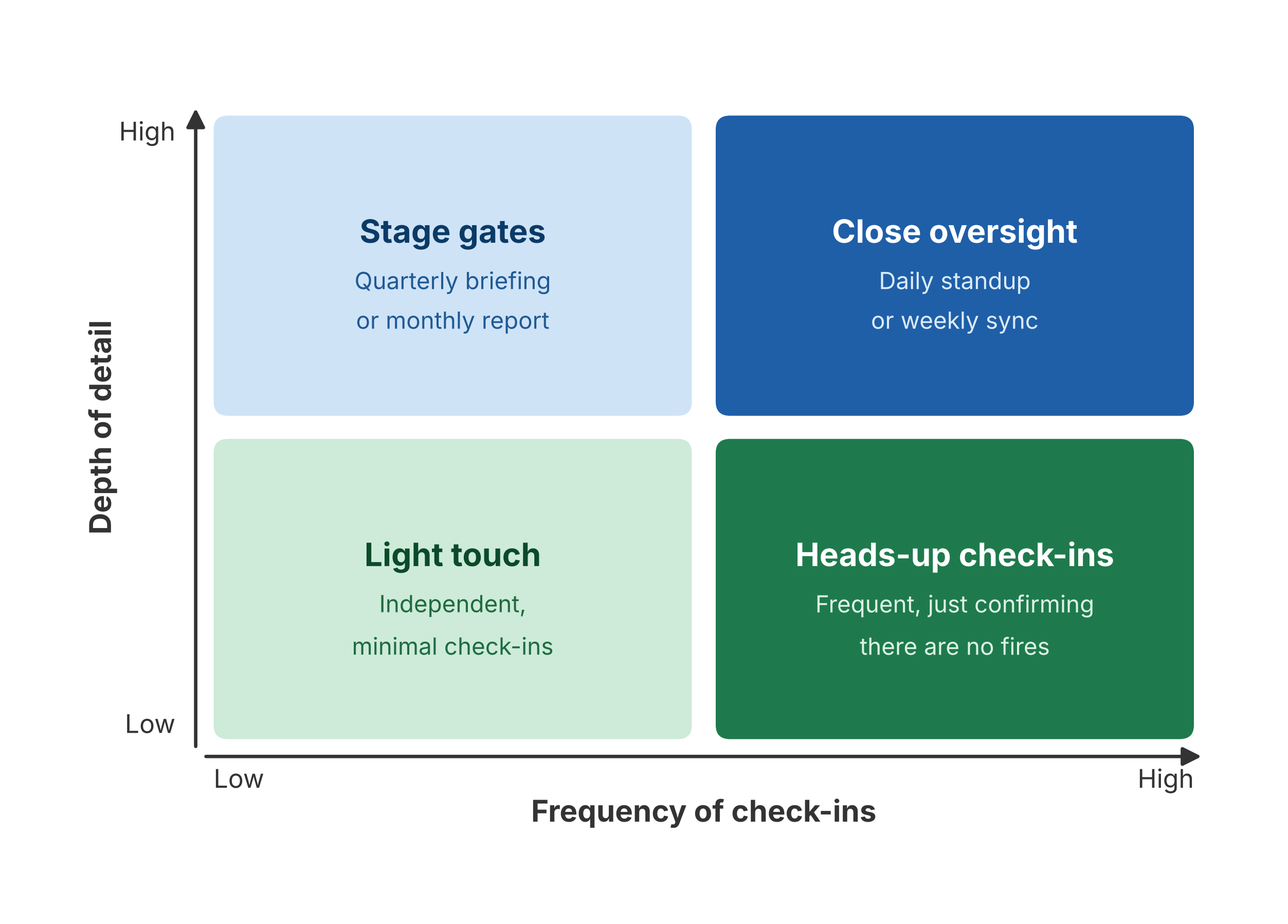
“High frequency and high detail is the project where you might have a weekly or even daily sync with your team, because for whatever reason it’s very visible and developing very quickly,” she says.
“Then you have the other three quadrants. Something may be high detail but lower frequency, where there are major stage gates you need to be involved in, like a quarterly briefing or a monthly report, but the person can otherwise be much more independent.
“Or vice versa: you may want to meet with someone more frequently, but you just need a heads-up that nothing’s wrong and there are no fires to put out.”
Adopting a framework like this can be a good way to triage everything on your plate.
5. Learn how to become a ruthless prioritiser
For early and mid-career professionals, it can feel like saying “no” to a request to take on more work can put their reputation or progression opportunities at risk. But, when it’s done with respect and professionalism, Wilding says the opposite is sometimes true.
“When we say ‘yes’ to everything, we think we’re going above and beyond and showing we’re a team player. But what I often see is that these people will receive feedback that they don’t know how to prioritise, make tough trade-offs, have hard conversations or bring people along.
“That can put a ceiling on your ability to advance or be given more responsibility, because what’s required at the next level is being able to make those trade-offs and to be, in many ways, a ruthless prioritiser,” says Wilding. “That hits home with a lot of people who are afraid to give up their helpfulness because they don’t realise there’s a shadow side to it. It can put a cap on their own development.”
Ruthless prioritisation might look like:
- Saying “yes, but here’s what needs to move.”
Instead of a flat refusal, show the trade-off. Say to your stakeholder: “I can take this on, but it means X will slip. Which matters more?”
It shows you understand the priorities and keeps the decision with the person who owns them. - Decide what matters before the requests arrive.
Agree your top two or three priorities with your manager at the start of each quarter or project. Having a shared list makes it easier to judge each new request against it, and when you need to say ‘no’, you have a North Star you can point to, which explains why you can’t take it on. - Say no early, and offer an alternative.
A quick, respectful “no” or “not now” is better than a “yes” that turns into a missed deadline. Suggest a later start date, a smaller version of the task, or a colleague who has capacity.
🧰 HR’s career resource toolkit
- Article: Are we creating a generation of botsitters?
- Course: Strategic HR Leadership
- Podcast: Is your workforce quietly cracking? with Michelle McQuaid
- Article: How to respond to the rise of the ‘infinite work day’
- Article: What is time confetti?
- Course: Leading difficult conversations
- Course: Effective partnership: overcoming stakeholder resistance