When work feels “chaotic, fragmented” and like it never ends, what deliberate practices do we need to put in place to protect employees’ wellbeing and maintain sustainable, high-performance cultures?
Around one in four workers are online from 6 am reviewing emails to align their priorities for the day, while 29 per cent are diving back into their inboxes at 10 pm to wrap up their work.
There has also been a 16 per cent year-on-year increase in employees taking meetings into the evening – predominantly due to global and flexible team environments – and approximately one in five employees are actively working through their weekends.
These insights from Microsoft’s 2025 Work Trend Index tell a bleak story: work truly feels like it is never-ending.
Beyond work bleeding into evenings and weekends, Microsoft’s data shows the average modern workday is increasingly defined by constant interruption.
Employees are interrupted every two minutes during core working hours by meetings, emails or notifications, adding up to an average of 275 interruptions a day. They are also fielding 117 emails each day and 153 Teams messages.
At the same time, work itself is becoming less structured. Microsoft’s research shows 57 per cent of meetings now happen on an ad hoc basis rather than being scheduled in advance, making it harder for employees to plan their time or protect periods of deep work.
On top of this, half of all scheduled meetings are taking place during average peak performance hours, based on most people’s natural circadian rhythms.
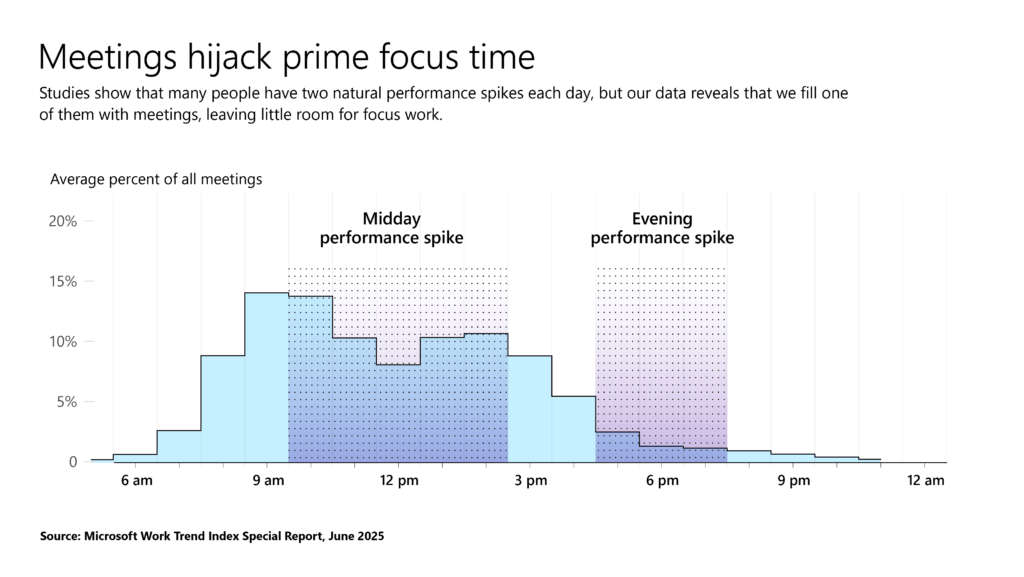
The result is a workforce at risk of digital overload, burnout and disengagement. Nearly half of employees globally (48 per cent) and more than half of leaders (52 per cent) say their work feels chaotic and fragmented, while 80 per cent of the global workforce report lacking the time or energy to do their work.
These experiences reflect a deeper shift in how work is organised, according to Carol Gill FCPHR, Associate Professor of Organisational Behaviour at Melbourne Business School.
“Extended and fragmented workdays have existed for some time, particularly within global workforces and organisations operating across multiple time zones,” she says. “What has changed is the scale, visibility and normalisation of these patterns.”
Below, Gill explains how this shift impacts both organisational performance and employee wellbeing, and what leaders can do to counter the cost of constant interruption.
What’s driving the infinite workday?
As outlined above, workdays increasingly have no clear start or finish time. Work-related chats outside the nine-to-five workday are up 15 per cent year on year.
Microsoft attributes this in part to an increase in cross-time zone work. Nearly a third of meetings now span multiple time zones – up 35 per cent since 2021.
While this poses an obvious risk to employee wellbeing, Gill says boundaryless workdays are not inherently negative.
“For both employees and employers, there can be real benefits,” she says. “Greater flexibility can enable employees to better integrate work with personal responsibilities – such as caring duties or school pickups – while organisations may benefit from increased productivity, broader coverage for global teams and improved customer responsiveness.”
She adds that it is important to distinguish between remote or hybrid work and the concept of the infinite workday, as the latter requires clearer demarcation.
“Although they are often discussed together, they are not synonymous. That said, both can generate similar risks – most notably continuous work without adequate downtime, blurred boundaries between work and personal life, and an increased likelihood of burnout if not carefully managed.”
The key for HR is to support managers to design work in ways that establish clear boundaries and expectations.
“Well-designed systems have the potential to make flexible work more sustainable for both individuals and organisations,” she says. “Autonomy over how and when work is organised aligns with a fundamental human need for control and self-determination, and this should not be overlooked in the discussion.”
Design the foundations of an effective wellbeing program with AHRI’s ‘Implementing Wellbeing Initiatives’ course.
A systems approach
Many employers are implementing new productivity tools in the hope of saving time. In its report, Microsoft highlights AI time management tools as a potential solution to the infinite workday.
However, Gill stresses that individuals should not be held accountable for fixing infinite workdays, as these often stem from systemic problems.
The idea of changing the structure of work through task specialisation, she says, is reminiscent of Taylorism.
“If the issue were simply one of personal time management, the solution would be straightforward. In reality, organisations operate through formal and informal systems – performance expectations, communication norms, reward structures and leadership behaviours – that often make sustainable work patterns difficult to achieve.
“These systemic factors deserve greater attention. I don’t think anyone believes it is possible to return to nine-to-five models for the knowledge workforce.”
“Extended and fragmented workdays have existed for some time, particularly within global workforces and organisations operating across multiple time zones.” – Carol Gill FCPHR, Associate Professor of Organisational Behaviour, Melbourne Business School.
For example, many of the tools used by organisations are designed for speed and availability rather than sustained focus, which can perpetuate employees’ feelings of a never-ending workday.
There is also a disconnect between leaders and employees in this area. Working from home means less visibility, and many employees are using AI tools without telling their employers. This makes it crucial to engage in thorough consultation as systems are refined and redesigned.
“There is an opportunity [for HR practitioners] to enable consultation, negotiation and clarity between employees and leaders,” says Gill.
“Performance management systems, alongside clearly articulated and enacted organisational values, could play a critical role in setting boundaries, aligning expectations and supporting more sustainable ways of working.”
Three tips to manage the infinite work day
Here are some additional ways to address the issues Microsoft outlines in its report, including seamlessly never-ending workflows, constant disruption and chaotic approaches to work.
1. Ensure all managers understand the legislative boundaries around the Right to Disconnect
It is worth noting that while Microsoft’s data captures global perspectives – including Australia – many of the countries where the data was collected do not have legislative protections for out-of-hours contact, as Australia does with the Right to Disconnect (RTD), in place from August 2024.
While most organisations will be well into ensuring compliance with these new rules, it remains useful to regularly assess your organisation’s risk profile in relation to the RTD.
This includes collecting data on usual work hours and patterns of work, ensuring third parties (such as clients or customers) are not making it difficult for employees to switch off after their contracted hours, and confirming arrangements are in place to compensate employees for out-of-hours communication where applicable.
Explore our previous article outlining three ways to comply with the RTD for more practical guidance.
AHRI’s research shows the majority of employers (58 per cent) believe the RTD has improved engagement and productivity across their workforce, suggesting that ensuring managers follow these guidelines delivers bottom-line benefits while also protecting employees’ long-term mental health and wellbeing.
Read AHRI’s article about an employer who was sued for $780K for an alleged breach to an employees’ right to disconnect.
2. Put the onus on meeting owners to introduce structure:
Meetings without an agenda or clearly defined desired outcomes simply add to the noise. In a previous article on making meetings work better for your team, AHRI outlined some things to keep in mind, such as taking a closer look at your company’s meeting culture and identifying the key problems.
For example, you can coach meet holders to review their current agendas for each meeting and ask them questions such as:
- What’s the point of this meeting? It might seem obvious but how often do you step back and consider why you are getting together in the first place?
- Are these the best attendees? Meetings are likely to be ineffective and inefficient if the right attendees aren’t present – potentially meaning subsequent meetings are required in order to get the job done.
- Is this meeting too long? Most meeting slots are 60 minutes, but they don’t always need to be. In fact, many teams will fill up a full hour, even if key items are covered off in less time. Consider what would happen if you shortened the meeting to 30 minutes, or even 15?
- Does this meeting overlap with another? Sometimes separate meetings will serve a similar purpose, with only slightly different attendees. Consider whether they could be merged to streamline and save time.
- How can you optimise the meeting? Consider preparing for the meeting asynchronously by sending a talk track (video overview) or document upfront for review – and thereby shorten the time.
- Is it a zombie meeting? Recurring meetings can be valuable to ensure momentum and consistency, but sometimes they continue to happen long after they’ve served their purpose. Is it time to remove this meeting from the diary?
Learn how Amazon creates detailed frameworks for ‘silent meetings’ in this case study.
3. Embrace asynchronous communication
Another way to stem the infinite workday is to deliberately shift from real-time to asynchronous communication as the default (noting that there is often a need for real-time, collaborative meetings).
Asynchronous work gives employees greater control over when they engage, helping to protect focus, reduce interruptions and create clearer boundaries between work and non-work time.
For HR, this starts with helping managers to reset expectations. Make it explicit which channels are for urgent issues, and which are designed for considered, non-immediate responses.
For example, Teams messages may be reserved for time-sensitive matters, while project updates and decisions are documented in shared platforms where people can respond during their working hours. Without this clarity, “always on” tools will continue to drive “always available” behaviour.
Small design choices can also have outsized impact. Instead of generic email signatures that say “sent outside business hours”, encourage teams to include response-time norms in project kick-offs – such as expected turnaround times for emails, documents or messages. Some organisations are also experimenting with message headers (for example, “For action today” or “For review this week”) to reduce unnecessary urgency and anxiety.
Crucially, leaders must model these behaviours. Clearly written updates, well-structured documents and fewer reactive messages signal that thoughtful, asynchronous contribution is valued.
When combined with strong performance expectations, asynchronous communication allows flexibility without chaos – supporting both wellbeing and sustained performance in an increasingly boundaryless world of work.
Design the foundations of an effective wellbeing program with AHRI’s ‘Implementing Wellbeing Initiatives’ course.