
The Productivity Commission’s Interim Report on Building a Skilled and Adaptable Workforce presents four notable opportunities for HR practitioners.
Australia’s overall economic ranking declined from 7th to 16th in a global ranking of international competitiveness conducted by CEDA, with business efficiency – including measures such as productivity, management practices and labour market performance – falling from 22nd to 37th.
While addressing Australia’s lagging productivity has long been a priority for policymakers, government officials and business leaders, the latter half of 2025 could see discussion and analysis start to create action.
Earlier this week, the Productivity Commission (PC) released the fourth of five interim reports that together outline its proposed national agenda to lift Australia’s productivity performance.
The latest paper – focused on building a skilled and adaptable workforce indicates that HR professionals will be at the forefront of this agenda, with employer investment in skills and people management capability set to receive far more attention from policymakers.
The decade ahead
The PC highlights that more than 90 per cent of jobs projected over the next decade will require a post-school qualification. Yet, many organisations continue to encounter recruitment bottlenecks and talent management challenges due to persistent skills shortages – issues that, if left unresolved, risk constraining economic growth and organisational performance.
AHRI’s latest Quarterly Outlook report (June 2025) underscores the urgency of this challenge, revealing that 38 per cent of organisations reported recruitment difficulties in the June quarter.
“This was an increase from 30 per cent in the previous quarter. However, our upcoming September quarter report shows that this number is coming down, sitting at 33 per cent,” says AHRI’s CEO Sarah McCann Bartlett.
“We see a confluence of factors at play – skills and experience mismatches in the talent pool, heightened wage expectations in a competitive market, and the reduced permanent migration program cap for 2024-25.
“These dynamics collectively create a barrier to the development of higher productivity workplaces.”
“This is our generation’s industrial revolution, which is why embedding AI education throughout secondary, tertiary and working life is essential.” – Sarah McCann Bartlett, CEO, AHRI
Australia’s long-term productivity agenda hinges on accelerating the development of future-ready workforce skills, increasing the uptake of strategic workforce planning, improving people management capability and more effective talent acquisition and retention strategies.
With these themes in mind, we turn to the key recommendations put forward by the PC.
Boosting people management capabilities
A key recommendation from the PC is the proposal to establish SME advisory services offering support for work-related training on a trial basis.
The Productivity Commission has also put forward the idea that this service should provide support on management practices to help bridge the gap in managerial capability between Australian and its international counterparts.
This aligns closely with AHRI’s own advocacy for bespoke support that provides expert advice on appropriate training in leadership and people management skills, plus guidance on the availability and quality of providers operating in the field.
Such a bespoke offering would represent a departure from the current public offering, which tends to provide support on the fundamentals of owning and operating a business and general skill development rather than management capability.
“Australia has a people management skills deficit, which is an understated cause of Australia’s longstanding problem of relatively low productivity,” says McCann-Bartlett.
“It is very encouraging to see the Productivity Commission attach so much importance to leadership and management capability in Australia, which need to form the core of such advisory offerings.
“It’s also appropriate that these resources are targeted at SMEs, who often don’t have the capacity or capability to identify and address their skills needs. Targeted support in people management skills is vital to narrow management capability gaps and enhance productivity.”
As highlighted in Bloom et al. (2016), variations in management practices drive approximately 30 per cent of differences in total factor productivity both within and across countries.
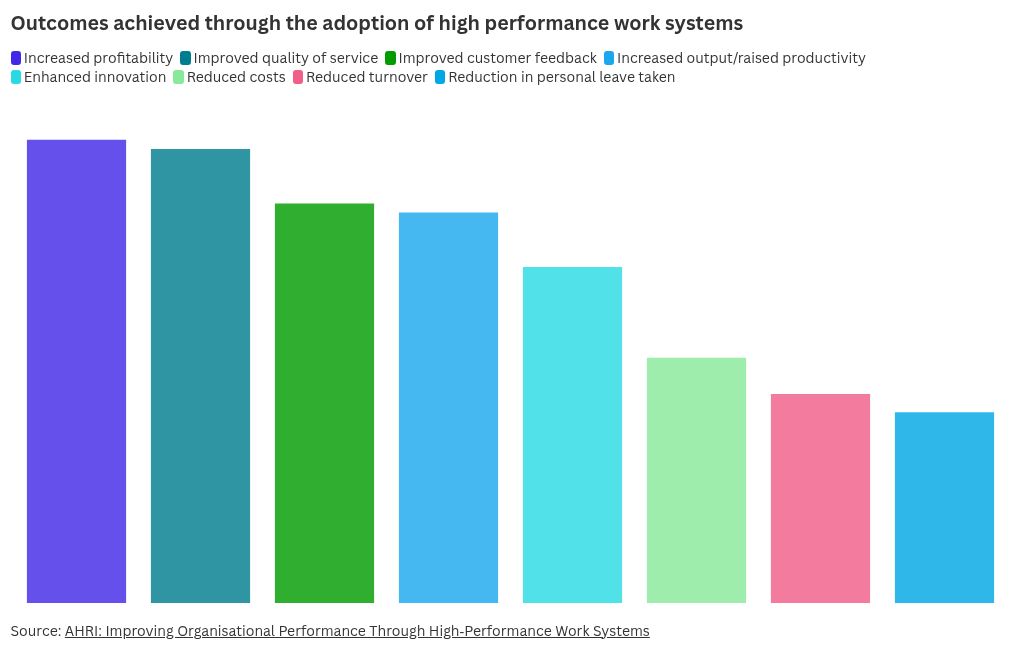
Separate AHRI research broadly corroborates this by demonstrating a clear relationship between the adoption of effective HR practices – through the high-performance work systems (HPWS) model – and stronger business performance.
“We found that more than three-quarters of high-performing work organisations in the private sector report better-than-average financial performance for their industry – almost double the rate of organisations that haven’t adopted key high-performance practices.”
Other perceived benefits of introducing HPWS include improved quality of service (cited by 50 per cent of employers), improved customer feedback (44 per cent) and increased productivity (43 per cent).
Related reading: Learn how QBE is implementing high-performance work systems in this HR case study.
While this forward-looking approach sets a compelling vision for a more adaptable and resilient workforce, organisations must still contend with the reality that many current employees are not yet equipped to meet emerging workforce challenges.
“Our skills research from late 2024 found that nearly one in five employees were perceived as not being proficient in their roles, which is having significant impacts on organisational productivity. This underlines the urgent need to unlock more work-related training, which as the Productivity Commission points out, is currently stagnating,” says McCann Bartlett.
Targeting training incentives to unlock participation
Another PC recommendation is to design work-related training incentives – such as tax credits – specifically for SMEs.
Training demand is set to rise over the next five years. At the same time, training participation has stagnated and remains concentrated in larger firms. Incentives aimed at SMEs could increase participation by focusing support where it’s most needed.
Time constraint emerges repeatedly as one of the top barriers preventing employees from engaging in training. Incentives that free up that time are especially powerful – and they would work best when complemented by advisory support that helps businesses identify the right training opportunities.
“When SMEs are supported to invest in targeted training, the benefits cascade through the business – lifting capability, productivity and competitiveness. Incentives, paired with tailored advisory services, give smaller firms the tools and time they need to build future-ready workforces,” says McCann Bartlett.
Recognition of prior learning and learning credits
The PC says Australia’s current credit transfer and RPL system is “fragmented, inconsistent and complex”, likely acting as a barrier for many students and early career professionals who have not pursued traditional tertiary education pathways.
The PC recommendation to remove barriers to recognition of prior learning – be that through formal degrees, micro-credentialling or work experience – is another welcomed move, says McCann Bartlett.
“Traditional learning pathways are being disrupted. The once-linear route from high school to university is giving way to more flexible journeys, with many entering the workforce through work experience or micro-credentials. Our national systems must adapt to support this shift.”
For HR leaders, proposed reforms to recognition of prior learning (RPL) and credit transfer could significantly improve workforce mobility and skills development.
“Australia has a people management skills deficit, which is an understated cause of Australia’s longstanding problem of relatively low productivity.” – Sarah McCann Bartlett, CEO, AHRI
The PC is proposing a national database of credit and RPL decisions, managed by the Australian Tertiary Education Commission, that would enable individuals and employers to better plan career and training pathways.
Starting with credit transfer records and expanding to include informal and international experience, the system would help create a more agile, better-qualified workforce.
Beyond expanding the talent pool available to employers, there is also an opportunity to enhance the composition and quality of talent entering the workforce.
“The Commission noted that an enhanced credit transfer and RPL approach could also unlock greater diversity and inclusion within organisations, as Aboriginal and Torres Strait Islander students, those from low socio-economic backgrounds and people living and studying in regional areas are more likely to use VET as a pathway to higher education.”
Enhancing foundational skills
The PC’s interim report emphasises that for reform to deliver lasting impact, it must begin early – addressing not only the capability gaps in today’s workforce, but also strengthening the talent pipelines that will define Australia’s future competitiveness.
Research from NAPLAN shows that nearly one in three Australian school students do not meet basic proficiency benchmarks for literacy and numeracy. This lack of foundational skillset is filtering into the workforce.
As the AFR reports, research has found that nearly three-quarters of businesses see a lack of basic numeracy and literacy skills having “adverse effects” on their businesses, with some citing simple tasks such as completing workplace documentation as a common challenge for workers.
To address this, the PC recommends a national lesson plan repository, which would establish a central digital platform for sharing high-quality lesson plans to schools in all states and territories.
As part of this, the PC is also recommending a nation-wide approach to education about technology and AI, citing that the current state-based approach could lead to inconsistent outcomes and some states and territories outpacing others.
“Early education and proficiency in AI will be critical to building future-ready workforces,” says McCann Bartlett. “In just a few short years, AI has already transformed the way we work. Imagine the changes we’ll see five or ten years from now.
“This is our generation’s industrial revolution, which is why embedding AI education throughout secondary, tertiary and working life is essential.”
Hear from Deputy Chair of the Productivity Commission, Alex Robson, in this thought-provoking webinar from AHRI on Productivity, Engagement and the Changing Workplace. Register to attend on 28 October.
Drivers of organisational performance
For HR leaders, these recommendations spotlight actionable levers that tie HR capability directly to organisational performance and productivity.
“These recommendations recognise that HR is a critical driver of organisational performance and national productivity,” says McCann Bartlett.
“By investing in leadership capability and targeted skills development, we can equip businesses, particularly SMEs, to compete more effectively and deliver stronger economic outcomes.”
HRM will be bringing you insights directly from HR leaders following next week’s Economic Roundtable, where many of these topics will be discussed in depth. Stay tuned for further details.


