To keep pace with a world of work in flux, some CPOs are moving beyond the classic Ulrich HR operating model. Four HR leaders explain how they are structuring their functions for the future.
It has been almost three decades since US academic Dave Ulrich introduced his operating model for the HR function. Since then, his “three-legged” approach – comprising business partners, centres of excellence (CoE) and shared services – has become the default way of doing things for HR departments globally.
Ulrich’s operating model has proven remarkably robust. But the world of work has transformed since the mid-1990s and continues to do so. Hybrid working, the rise of AI and the expectations of majority-millennial workforces are testing the limits of some traditional HR models.
In response, some HR leaders are asking themselves: if the nature of work is changing so dramatically, should the way HR organises itself also evolve?
In this feature, AHRI speaks to four leaders who have chosen either to modify the Ulrich model or to adopt a new process.
The Agile HR model
Lisa Burquest CAHRI, Chief People Officer, Virgin Australia
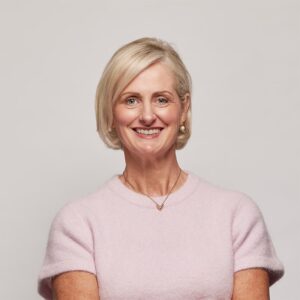
Lisa Burquest CAHRI, Chief People Officer, Virgin Australia
Few industries suffered as profoundly as aviation during the coronavirus pandemic, and Virgin Australia was no exception.As restrictions eased and air travel resumed, Lisa Burquest was tasked with re-energising a weary workforce and restructuring internal processes while her colleagues in the C-suite attempted to rebuild a sustainable business.
“Because every part of the business was transforming, [our HR team] had to be quite hard-nosed about what would really make a difference in the immediate term,” she says.
“Adopting agile ways of working allowed us to be very thoughtful, targeted and prioritise quite ruthlessly.”
The agile model uses Ulrich’s model as its starting point. But instead of allocating 100 per cent of a department’s resources to CoEs, shared services and business partners, it keeps some employees in reserve to be deployed on HR projects conceived in cross-functional brainstorming sessions.
“The agile way of working – setting your strategy, identifying your focus and priorities, then deploying a team – is something I really believe in,” says Burquest.
“It allows for more blue-sky thinking, and you’ve got a more diverse set of people who are involved in setting strategy. Whereas if you use a pure CoE model, and your strategy grows from different CoEs thinking individually, then you miss things, and you don’t get that cross-fertilisation.”
Moving forward, Burquest intends to continue working agilely while retaining elements of the Ulrich model.
“The CoE structure is valuable because you want to have deep capabilities within your organisation, and structurally it makes sense to gather that group together in a function so they can feed off each other,” she says.
“But they should be part of a broader planning set – not just working within their CoE, but working in unison with the business. That approach is what has got us through the past three years.”
“I treat centres of excellence like product organisations. They should build products and launch them with a go-to-market strategy.” Bob Toohey, Chief People Officer, Fidelity National Information Services
The HR as a product model
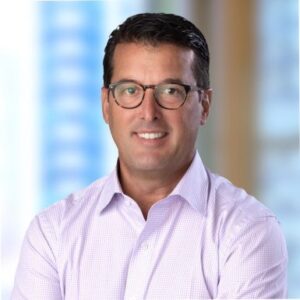
Bob Toohey, Chief People Officer, Fidelity National Information Services (FIS)
How would productivity and workplace culture be affected if HR thought of the responsibilities it oversaw – talent acquisition, training and so on – as products rather than services?
Bob Toohey has spent recent years finding out, first as CHRO at US insurer Allstate and more recently as CPO at financial technology company FIS.
He says a ‘product thinking’ mindset has helped him conceptualise solutions that managers and workers – referred to as ‘customers’ – are enthusiastic about. The approach can also help HR effectively articulate ROI.
“I like to say to leaders: ‘You can do everything in your life on Amazon. Your iPhone works seamlessly. But all too often, when you go to work, you can’t hire someone or find out how many employees you have with the same ease.’ Product thinking aims to fix that.”
Importantly, Toohey uses the same basic structure as Ulrich to organise his department and to design, test and deploy products.
“I treat centres of excellence like product organisations,” he says. “They should build products and launch them with a go-to-market strategy.”
Business partners, meanwhile, take on the job of ‘selling’ products to customers.
“HR as a product is a mindset shift that you convince your leaders of,” he says.
The way to do that? Gather good data.
“If you can tie it back to the business result and demonstrate that satisfied ‘customers’ are high-performing workers, you’ve succeeded,” says Toohey.
Want to learn more about Bob Toohey’s approach to HR as a Product model?
Read this case study.
The Ulrich+ model
Scott Mischke CPHR, Chief People Officer, Parliamentary Workplace Support Service (PWSS)
As a member of the PWSS’s inaugural leadership team, Scott Mischke CPHR needed to move quickly.
“The agency was established in late 2023 in response to the Set the Standard review, which took place following reports of bullying, harassment and sexual assault at Parliament House,” says Mischke.
The agency’s remit was to be the central HR engine for Commonwealth parliamentarians and their employees, and to run a complaints resolution and support service for all parliamentary workers.
“In order to address the review’s findings of ‘fragmented and ineffective HR systems, as well as a lack of standardised policies and processes’, we needed to create a modern HR function that would support people, processes and a pos

Scott Mischke CPHR, Chief People Officer, Parliamentary Workplace Support Service (PWSS)
itive workplace culture,” says Mischke.
“Addressing the lack of consistent HR practices and employment frameworks within the complex ecosystem was a matter of urgency. It was important for the PWSS to be recognised as a trusted organisation that was capable of supporting workplace culture change.”
Mischke decided a streamlined version of the Ulrich model – focusing solely on centres of excellence and shared services – was the best approach.
“As we are an extra-small agency, leveraging shared services enabled us to keep our resourcing focused on the client experience,” he says. “We then established a centralised CoE model to rapidly drive maturity of practice and implement standardised policies, behaviour codes and strategic advice to support employee performance.”
This ultra-lean approach, born of necessity, has enabled the PWSS to become fully operational – both as an HR department and as a 24/7 counselling service – in just two years.
Mischke says the agency will be looking for innovative ways to apply and evolve this model.
“It is always going to be challenging for us to use business partners because we need to remain apolitical. Having dedicated practitioners looking after different political parties could lead to perceptions of bias.
“It’s a delicate balance, but we will continue to mature our model in response to the needs of this unique workplace.”
Are you ready to boost your credibility as a certified HR practitioner? Becoming a CPHR is the ultimate endorsement of your HR capability and is a globally recognised mark of excellence. Start your journey to Certification.
AI-enabled HR model
Amy Coleman, Executive Vice President, Chief People Officer, Microsoft
It’s perhaps not surprising that tech giant Microsoft was an early adopter of AI to help manage its internal processes. What is remarkable is how quickly and substantially AI has reshaped the company’s HR function.
In early 2023, Microsoft HR introduced an employee-facing AI-enabled chatbot. The tool saved Microsoft 20,000+ hours in its first year of operation alone, says Amy Coleman.
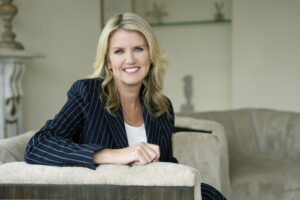
Amy Coleman, Executive Vice President, Chief People Officer, Microsoft
The chatbot forms part of a three-stage process designed to respond to employees’ HR questions. Initially, employees access an internal website and type questions which are cross-referenced against a knowledge database.
“An employee might want to take a leave of absence, for example. They’ll type that in and get access to a policy.”
This means the HR team isn’t getting bogged down in sourcing and relaying the same information over and over again.
“We want to focus on things that take emotional intelligence, judgement and humanity to do.” – Amy Coleman, Executive Vice President, Chief People Officer, Microsoft
As employees’ questions become more complex, so too does the technology solution, says Coleman.
“Say you want to take a sabbatical and you’re also getting ready to go on maternity leave. It’s a bit more of a compounded problem. That’s when you [might] go into the second level of the funnel.”
That second level is the AI-enabled chatbot, which steps in if an employee can’t find satisfactory answers on their own.
“It’s like a virtual assistant that can start to reference some of our policies,” says Coleman.
The third stage is where humans step in.
“If you weren’t able to get an answer to your question at stages one or two, now you talk to someone in HR and we then look at how those people can apply AI to answer your question faster and give you the right information.”
The efficiencies created by AI have allowed Coleman and her team to focus more on high-value tasks, such as coaching leaders.
“We want to focus on things that take emotional intelligence, judgement and humanity to do,” she says.
Note: This Microsoft excerpt was taken from a previous interview that HRM conducted with Amy Coleman when she visited Australia in 2025.
This article first appeared in the Feb/March 2026 edition of AHRI’s HRM Magazine.