In a world where we can no longer be sure whether we’re talking to a real person or AI; where we can’t really tell if an image is real or not; and where the ‘truth’ often feels subjective, how can businesses hold onto their hard-earned trust?
“Hold up three fingers in front of your face.”
That was the request I saw recently in a video on ways to tell if the person speaking to you on a video call is, in fact, who they say they are and not an AI generated version of themselves. Having a code word was another suggestion.
Not too long ago, we assessed body language and tone when communicating and we relied on data, facts and figures. Today the goalposts have shifted dramatically. We now need to assess whether we are speaking and communicating with real human beings.
It sounds absurd, yet this is our new reality. As truth becomes increasingly subjective, the ‘human’ element has become a hard-earned commodity – one that’s becoming significantly more difficult to ascertain.
As we increasingly use AI in both our professional and personal lives, the issue of trust is one that the HR profession needs to explore in depth – and quickly.
Are we equipping leaders with what they need?
There have been so many leadership models over time that it’s impossible to capture them all. And, personally, I question whether any of them truly equip us to lead in these times.
We are operating in an era of global conflict and complex challenges that manifest locally in unpredictable ways. Today, those in leadership roles are expected to respond in real-time, navigating the external crisis for their organisations while simultaneously internally processing the impact on themselves.
This dual burden requires a level of emotional agility and resilience – critical precursors to engender trust in a team and broader organisation.
Twelve years ago, Bennett and Lemoine wrote a Harvard Business Review article titled ‘What VUCA (short for volatility, uncertainty, complexity and ambiguity) Really Means for You’ and shared that, in their view, it had “become a trendy managerial acronym”, and an all-encompassing way of saying “It’s a crazy world.” Fast forward to today, and it feels quite the same.
More recently, the acronym BANI is being used – Brittle, Ambiguous, Non-Linear and Incomprehensible. It seems fitting in this age of AI, yet we are still asking the same of leaders that we always have; project confidence, have all the answers, know all the stuff.
In an age where the only thing we can truly know is that change is a constant, I posit that it’s time to shift our thinking. We need to learn how to sit with discomfort, lead with vulnerability and embrace the fact that we’re emotional beings in uncertain times. We need to do that, while at the same time building trust. That is how we add value and help to prepare for the future.
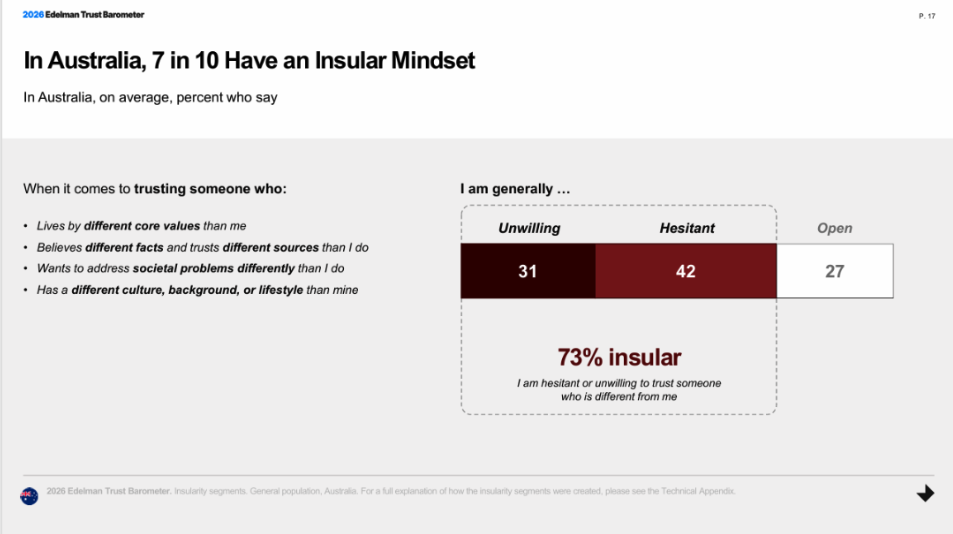
In Australia, 73 per cent of respondents were generally unwilling or hesitant to trust someone who had different core values to them, believed different facts… or had a different culture, background or lifestyle.
Australia’s trust levels are shifting
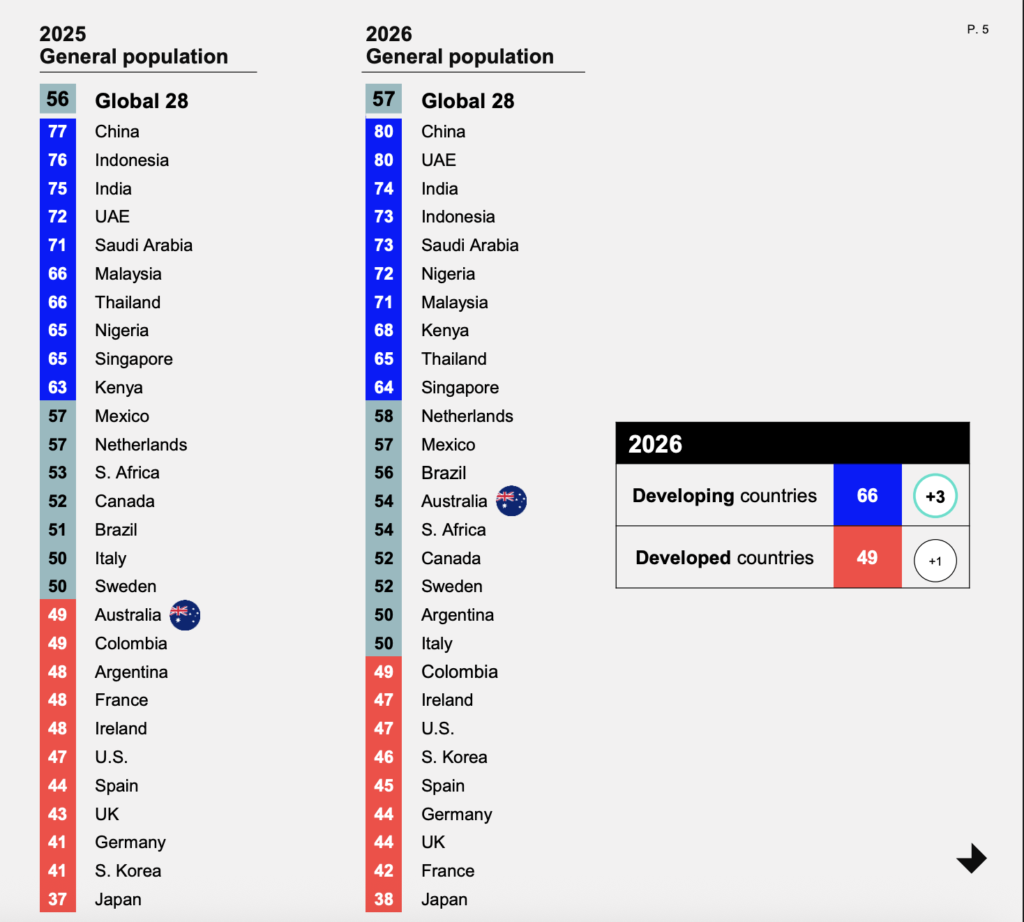
The 2026 Edelman Trust Barometer report identifies that Australia’s overall level of trust has improved by five points – moving us from the ‘distrust’ category into the ‘neutral’ category.
While the data suggests we are doing better than other developed economies, we still remain below the global average of 57, and our developed nation counterparts are significantly underperforming.
There are some strong themes in this years’ Edelman report that stand out to me:
1. Trust is local
During the COVID-19 pandemic, there was an increased level of trust in organisations (Edelman Trust Barometer, 2020), with people trusting their employer to a greater degree.
We see the same level of trust in the employer in this 2026 report, with people also trusting their colleagues and local networks.
However, distrust is brewing in government, media and global actors, such as big tech.
Our organisations are now primary trust holders, which is an enormous responsibility for those of us in HR.
The Edelman report poses suggestions that businesses can leverage to help hold onto this trust:
- Bring people into the workplace to interact with others who are different to them.
- Partner with unexpected organisations to initiate cross-cultural or cross-political conversations. You might want to consider supporting a not-for-profit and/or volunteer together.
2. Insularity is increasing
Interestingly, Australia is three points higher than the global average (70) on insularity.
This insularity seems counterintuitive to the focus on trusting colleagues. Insularity, in the report, is defined as people feeling hesitant or unwilling to trust people who are different to them to a significant degree.
In Australia, 73 per cent of respondents were generally unwilling or hesitant to trust someone who had different core values to them, believed different facts, trusted different sources, wanted to address societal problems differently or had a different culture, background or lifestyle.
For organisations with a diverse cross section of the Australian population in their teams, this potentially brings about significant challenges, or a potential risk of conflict.
It certainly has the potential to impact performance and business results if 73 per cent of people are “hesitant or unwilling to trust someone who is different” from them.
The report for Australia suggests that:
- 42 per cent of respondents would change departments rather than report to a manager with different values
- 33 per cent of respondents would reduce the effort they put into helping people with different political beliefs to succeed.
This doesn’t just lead to cultural risk. It can result in economic, business results and performance risk.
The opportunity that I see for HR practitioners is continuing our work in culture, building and supporting connection and belonging.
When we connect with the people in our immediate environment, and they are different to us in some way, we open the possibilities for curiosity, and recognising our similarities rather than differences.
3. Trust is diverging by economic development
In countries developing economically, the average trust barometer average was 66. In China and UAE it was 80. Compare that to economically developed countries which averaged 49.
One of the ways to interpret that is that trust is growing where there is a greater level of economic optimism, and it’s stagnating in those countries where systems may feel stuck.
The organisational benefits of trust
Rachel Botsman – well known for her work on trust, including her book, Who Can You Trust? – defines trust as a “confident relationship to the unknown,” arguing in her Ted talk that trust and uncertainty are intrinsically linked.
If you have high trust, you can navigate and be more comfortable with uncertainty.
Research suggests that high-trust organisations experience reductions in turnover and higher productivity. Add to that a 74 per cent reduction in chronic stress for employees and it is an easy win. What would happen in your organisation if chronic stress dropped by even just five per cent?
Separately, research also shows a high correlation between high-trust cultures and innovative cultures. Trust enables people to take risks by having a confident relationship with the unknown.
Botsman talks about the importance of friction, tension and discomfort in a healthy workplace culture, with trust being the enabler of those. She outlines the need for leaders to demonstrate capability, meaning competence and reliability, alongside empathy and integrity. Are these the areas we focus leaders’ attention on in our organisations?
What HR practitioners could be doing differently
Unsurprisingly, uncertainty has a cost – a neurological one. It often creates stress which reduces our working memory and our cognitive ability.
What if we focused on building trust through a people-centred approach, designing for relational safety. Continued developing people leaders who are skilled in having constructive conversations and holding space for emotions.
We could coach leaders on how to speak about uncertainty rather than mask it or bluff their way through it.
We could build the systems needed by organisations, supporting leaders to recognise that respect and empathy are neurologically foundational to trust.
As HR leaders, we, alongside the managers and leaders in our organisations, have a major contribution to make in the areas of developing trust, at all levels inside the organisation.
This is a major opportunity that could lead to developing a whole new capability area in HR. We’ve talked about trust for years, but not the neuroscience of trust. And not trust in the context of these highly uncertain times.
Dr David Paul has been working at the intersection of trust and neuroscience for 30+ years and in his upcoming keynote at the AHRI NSW State Conference, he will be discussing: ‘Leading Through Ambiguity: What neuroscience teaches us about leading when certainty is no longer an option’. You can learn more here.
Desleigh White FCPHR is a coach and HR consultant at People Matter Coaching and HR, and she is also a member of AHRI’s NSW State Council.
Take the steps to enhance your career and help to set the standard for the HR profession by pursuing your CPHR post nominal and becoming a Certified HR practitioner. a href=https://www.ahri.com.au/certification-and-training/hr-certification>Start your HR Certification journey today.