Australia’s graduate job market stabilised in early 2026 – with postings well above pre-pandemic levels – after softening over the previous two years. So far, evidence that artificial intelligence is influencing graduate hiring trends is tentative rather than conclusive.
Key points:
- Graduate job opportunities fell almost 15 per cent last year, but there are signs of a modest rebound in early 2026.
- While graduate opportunities in jobs highly exposed to AI have declined more than average, the timing suggests that AI adoption is not the primary driver.
- Jobseeker searches for graduate jobs remain low, suggesting that graduates still find it relatively easy to find work.
Australian employer demand for graduates eased last year – the third consecutive annual decline – but has rebounded modestly in early 2026, shows recent data from Indeed.
Hiring in occupations highly exposed to artificial intelligence fell more sharply than in other occupations, though the timing is too early for artificial intelligence to be the primary culprit. Indeed’s data also shows no signs that jobseekers are finding it more difficult to find graduate work, with jobseeker activity unchanged in recent years.
Graduate recruitment often differs from conventional hiring. The hiring process often begins 6-12 months before candidates start, meaning changes in graduate demand today may reflect how employers expect Australia’s economy to evolve.
For university students, the final year of study is often a tricky balancing act between studying and job hunting. Some secure a job early – waiting out the academic year until their new career begins – while others scramble to find suitable work towards the end of the year. Competition is often intense, with employers vying for top talent and graduates pursuing the most lucrative or prestigious opportunities.
For employers, graduate recruitment is an investment in your business’s future, snagging top-level talent that may take time to develop, but could become the leaders of tomorrow. Recently, however, that dynamic has shifted, with growing speculation that artificial intelligence can replace entry-level workers, even those with skills that would normally be in high-demand.
Graduate demand steady in early 2026, following a decline last year
In 2025, graduate job postings fell almost 15 per cent compared to a year earlier, with opportunities down 35 per cent from their peak in 2023. While graduate demand has cooled from its post-pandemic high, recent graduates need not despair.
Last year, there were still 1.5 times more graduate job postings than in 2019, and early signs suggest graduate demand has stabilised in 2026. In the March quarter, graduate postings rose 6.4 per cent compared with a year earlier, suggesting graduate demand should again exceed pre-pandemic levels.
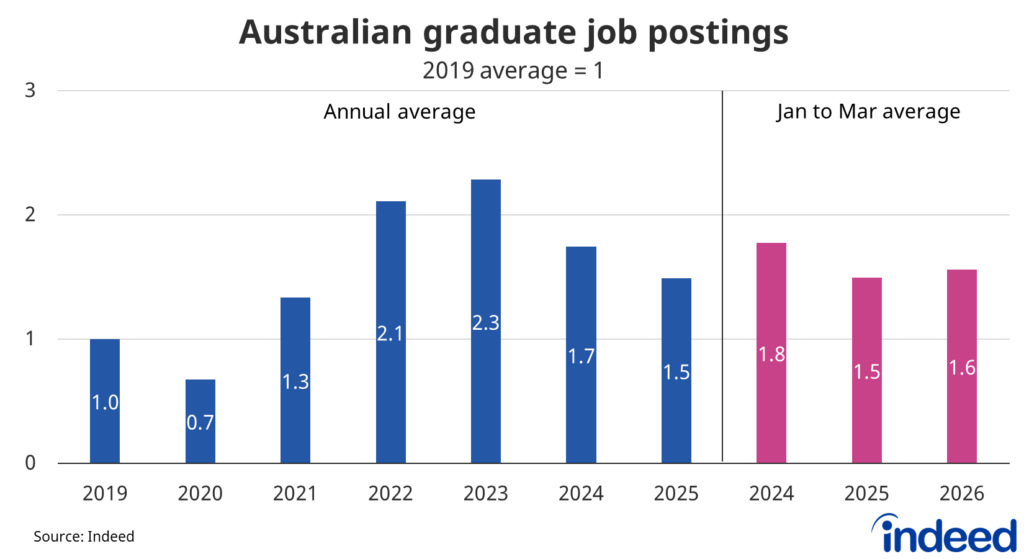
Bar graph shows that graduate-related job postings were 14.7 per cent lower in 2025 than the year before. In the March quarter 2026, graduate opportunities are tracking similarly to the same period last year.
A key risk to that assessment is ongoing geopolitical tension, particularly conflict in the Middle East. An economic slowdown, both in Australia and globally, risks spooking employers and reducing hiring activity. It’s too early to see any impact in Indeed’s data, but the longer the conflict persists the greater the risk of a slowdown.
Historically, younger workers and entry-level roles are more exposed to cyclical swings in economic conditions. These groups tend to have less experience and be less productive than other workers, making them an easy target for businesses looking to cut costs or reduce headcount. Graduating into a recession or downturn can also lead to persistently weaker labour market outcomes, than for those who graduate into an economic boom.
Graduate hiring has slowed considerably in Victoria
Graduate hiring trends are broadly similar across the country, with one exception: Victoria. In 2025, graduate job postings in Victoria were 23 per cent below their 2019 baseline, the only state to have dipped below that level. This likely reflects reduced graduate hiring among government departments and organisations in response to ongoing fiscal spending issues.
By comparison, in New South Wales graduate postings are still 37 per cent above pre-pandemic levels, with Queensland and South Australia up 70 per cent and 84 per cent, respectively. And in the case of Western Australia and Queensland, there were more opportunities last year than the year before.
In early 2026, graduate demand appears to have increased across every state, including Victoria. However, Victorian postings continue to track well below pre-pandemic levels.
Graduate recruitment dominated by engineering
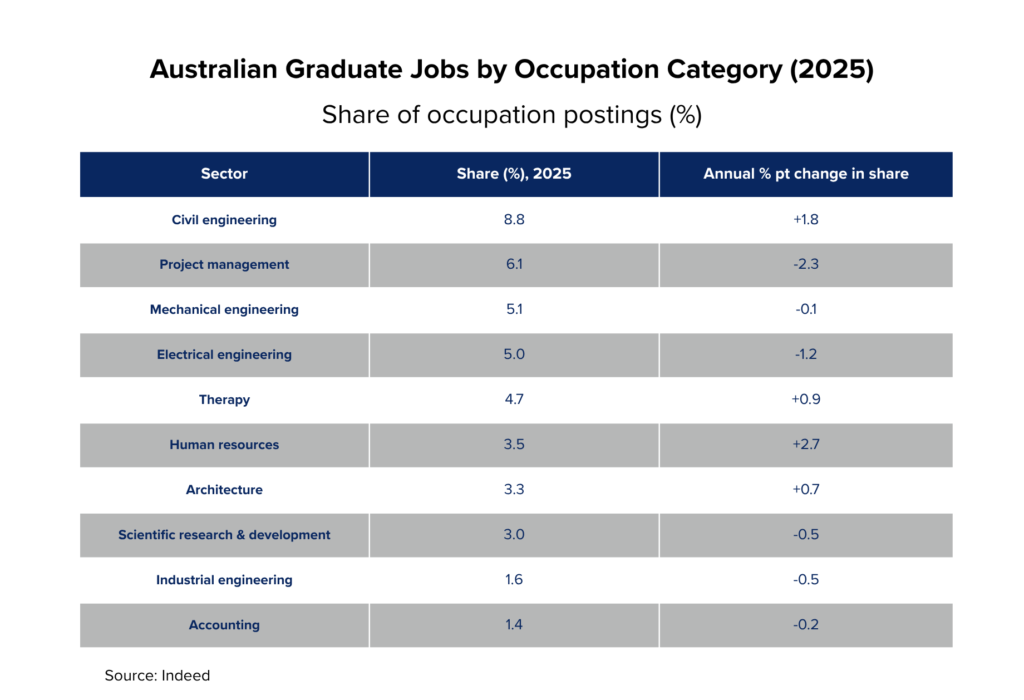
In 2025, graduate roles accounted for 8.8 per cent of all civil engineering job postings, ahead of project management (6.1 per cent), mechanical engineering (5.1 per cent) and electrical engineering (5.0 per cent). Other sectors with notable graduate hiring included therapy, human resources, architecture and scientific research.
Graduate hiring intensity – the share of occupation job postings that are graduate roles – increased in a third of occupations last year, compared to the year before. In 2025, 3.5 per cent of job postings in human resources were graduate opportunities, up around 2.7 percentage points from 0.8 per cent a year earlier. Employers seeking civil engineering talent also increased hiring, with their graduate postings share rising 1.8 percentage points.
That was offset by reduced hiring intensity in project management and electrical engineering, down 2.3 percentage points and 1.2 percentage points, respectively.
However, not all graduate recruitment occurs online. In-person placements are a common pathway for some occupations, particularly in healthcare, weighing on those occupations’ graduate posting share.
Graduate job postings also feature a mix of large-scale graduate programmes – where a single job posting may reflect dozens of jobs – and more tailored, role-specific opportunities. The approach used may influence how highly an occupation ranks compared to other jobs.
Graduate hiring patterns are slowly returning to normal
In response to strong economic conditions and widespread skill shortages, employers adjusted their graduate recruitment approach in 2022 and 2023. Many roles during that period became evergreen, remaining open throughout the year rather than targeting specific periods, such as March or April.
From 2019 to 2021, graduate postings peaked 91 per cent higher – as a share of total job postings – than its annual average. That dropped to an average of 33 per cent in 2022 and 2023 as hiring was spread out more evenly across the year.
Over the past two years, there are signs that hiring patterns are gradually reverting, with graduate postings peaking 55 per cent above its annual average. While still below historical norms, this indicates that the hiring frenzy of a few years ago is well-and-truly over.
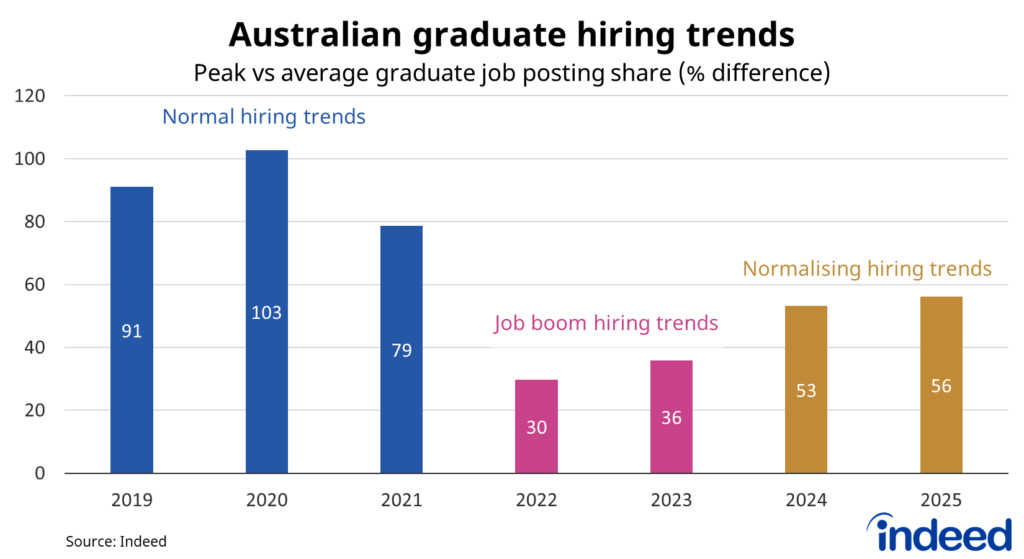
Bar graph shows that graduate postings peaked around 55 per cent above its annual average in 2024 and 2025, compared to just 33 per cent higher during 2022 and 2023.
Has artificial intelligence affected graduate recruitment?
There is growing speculation that artificial intelligence has limited entry-level or graduate opportunities, based on the thinking that these tools can often do a somewhat adequate job at the many routine tasks that are the bread-and-butter of entry-level workers.
In Australia, the composition of graduate hiring has certainly changed in recent years, however, the evidence isn’t strong that artificial intelligence is to blame.
In 2025, around 36 per cent of graduate job postings were in occupations with high exposure to AI – as defined by Indeed’s 2025 AI at Work report. That’s down from around 40 per cent in both 2023 and 2024. Overall, the volume of graduate job opportunities in high-exposure occupations last year was almost 30 per cent below 2019 levels, having halved since their peak in 2022.
At first glance, it would be easy to blame artificial intelligence for these trends. However, the drop-off in graduate postings for high-exposure occupations began in 2023 prior to widespread adoption of AI tools. Company AI implementation back then was limited – surely inadequate to replace entire tasks, let alone workers – and therefore unlikely to affect recruitment trends.
At best, you can point to trends from 2025 to suggest that there was perhaps a minor impact as AI adoption increased. However, that’s complicated by graduate postings in highly exposed occupations rising in early 2026, compared to a year earlier. Based on the recent relationship between March quarter graduate postings and annual postings, it points towards healthy demand this year.
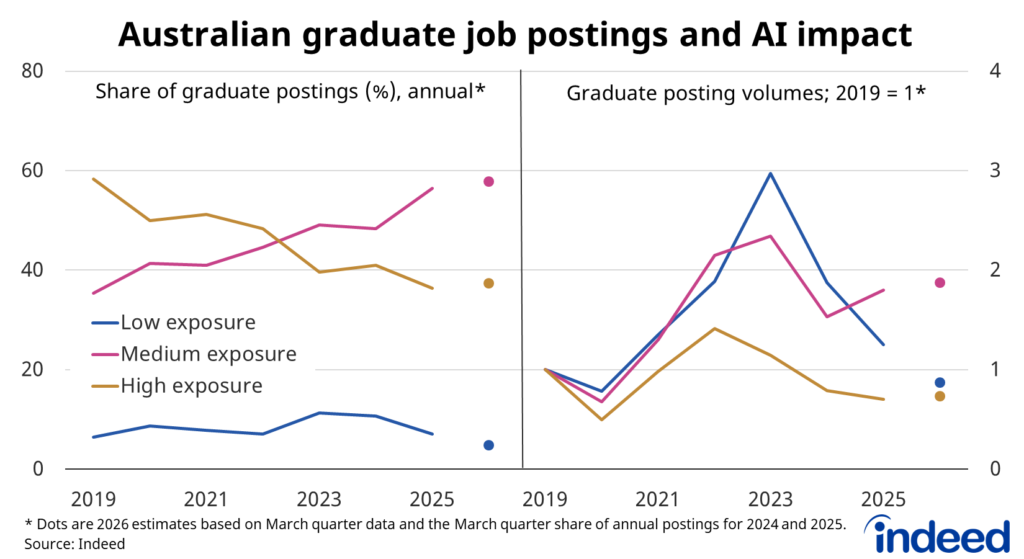
The first panel shows that 36 per cent of graduate postings are in occupations that are highly exposed to AI, down from 40 per cent in 2023 and 2024. The second panel shows that in 2025 postings in highly exposed occupations is almost 30 per cent below 2019 levels.
By comparison, medium exposure occupations account for a growing share of graduate opportunities, reaching 56 per cent in 2025. Many of the occupations in this group, which includes engineering, are expected to experience considerable AI-driven transformation, even if not to the same degree as highly exposed occupations. Strong graduate demand in these occupations reinforces the view that AI has not significantly reduced graduate hiring.
Graduate postings in low exposure occupations are relatively uncommon (7.1 per cent of graduate postings in 2025). Within these occupations, apprenticeships or direct placements are often favoured over graduate programmes, particularly for tradies or medical professions.
Notably, apprenticeship opportunities – typically jobs with low exposure to AI – have also declined considerably, down 46 per cent in 2025 compared to their 2023 peak. This suggests that broader economic factors, such as a somewhat sluggish economy or even a hangover from post-pandemic over-hiring, are driving trends rather than artificial intelligence.
No signs that recent graduates are struggling to find work
Another indication that graduate demand remains healthy is that jobseekers’ search activity remains low. It’s a sign that there continues to be relatively low friction in the graduate job market. Graduates continue to find jobs quickly, requiring fewer job searches, than was the case in the years before the post-pandemic job boom.
A candidate who lands a graduate job in April will search less than a jobseeker who doesn’t find success until September. In recent years, there have been more graduates who experience the former and fewer left frustrated by a long and protracted job search. Last year was no exception.
In 2025, just 0.4 per cent of Australian jobseeker searches were for graduate roles, unchanged from both 2023 and 2024 but down from 0.6 per cent in 2022 and 0.8 per cent in 2021. So far, recent trends are holding in early 2026.
If the economy does slow considerably this year, impacting business confidence and hiring, then we’d expect to see jobseeker activity pick-up as the recruitment process becomes more frustrating and jobseekers become more desperate. So far, that hasn’t been the case.
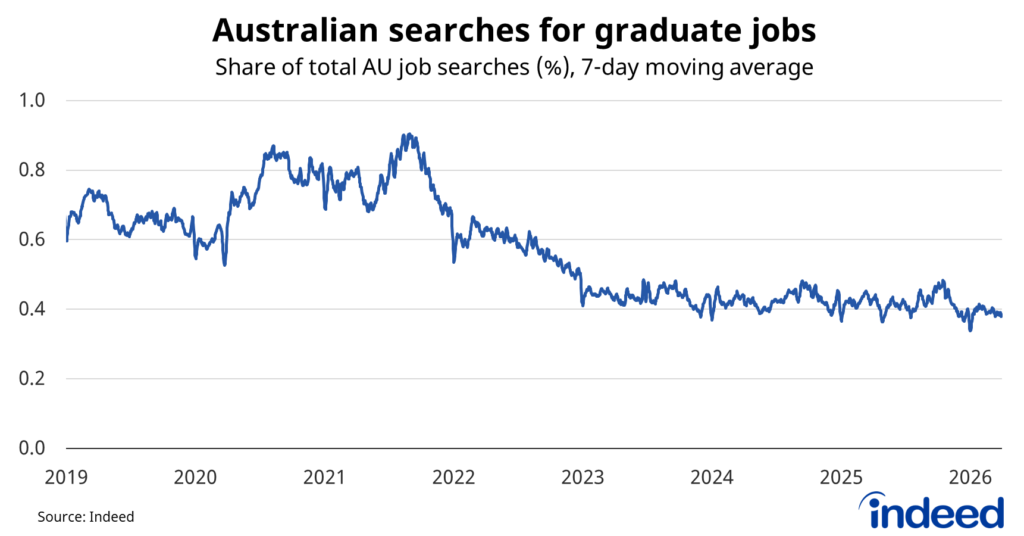
Line graph shows that graduate searches, as a share of total Australian searches, have consistently been around 0.4 per cent over the past few years.
Looking ahead
Australia’s post-pandemic job boom has benefited recent university graduates. For the past few years, it’s been an ideal time to enter the workforce and begin your career. While the hiring frenzy from 2022 and 2023 is over, graduate demand remained healthy last year and is tracking a little stronger in early 2026.
Artificial intelligence may be beginning to influence graduate hiring trends, but any impact appears modest. There is also no evidence that jobseekers are collectively finding it more difficult to land a job. Jobseeker searches for graduate jobs have remained low through early 2026, consistent with trends over the past few years.
Looking ahead, graduates face some challenging headwinds over the remainder of the year. Ongoing geopolitical and economic uncertainty, including higher inflation and rising interest rates, may leave some employers reluctant to expand headcount. Graduate recruitment requires long-term planning and that’s difficult to do in the current economic environment.
Given that, we anticipate that graduate demand may soften over the course of 2026, consistent with softer economic growth, despite a strong start to the year.
Callam Pickering is a Senior APAC Economist at Indeed.
Learn how to incorporate business strategy into your workforce planning and mitigate future risk with AHRI’s AHRI’s Advanced Workforce Planning course.