As disruption accelerates, traditional career paths and static job frameworks are giving way to agile, skills-first strategies. Speakers at day two of AHRI’s National Convention and Exhibition share how HR are championing the evolution of workforce development.
For many business leaders, change is still managed as a compliance exercise – planned at the top and rolled out in rigid waves. But on day two of AHRI’s 2025 National Convention and Exhibition, thought leaders urged HR to seize a different role: designing environments where change is less exhausting and more empowering, driven by learning and agency.
In a keynote session on ‘learning to love change’, bestselling author and change leadership expert Richard Gerver argued that our resistance to change isn’t rooted in stubbornness. Instead, it’s a response to uncertainty, overload and a lack of agency.
“We think people are anti-change, but I don’t think they are,” he says. “We’re happy to change, if we feel we have some control over the change we’re going through.”
This is crucial to remember at a time when disruptive technologies like AI are triggering what Gerver calls a “cycle of denial, anger and despair”.
Faced with ambiguity and a lack of control, he says many people are defaulting to familiar patterns, such as dismissing new tools as “passing fads”, pushing back against change or simply becoming too worn out to keep adapting.
To continue enhancing professional growth and workforce development through a period of disruption, he argues that organisations need to make space for learning that begins with curiosity, not certainty.
He draws a contrast between adults, who are often paralysed by a fear of getting something wrong, and children, who naturally respond to change with curiosity and a willingness to learn and experiment.
“As we get older, the currency of cleverness becomes logic,” he says. “But you learn nothing new by getting something right. You only ever learn something new [because of] a mistake or the realisation that you don’t know something.”
It’s a mindset Gerver believes HR practitioners should actively cultivate in the workplace – not through complex solutions or trying to drive efficiency from the top down, but by giving people permission to be curious.
“As we get older, the currency of cleverness becomes logic. But you learn nothing new by getting something right.” – Richard Gerver
Reflecting on the value of curiosity at work, he recalls conducting an interview with Barry Barish, a Nobel Prize-winning physicist whose team detected gravitational waves for the first time in 2015.
Before the project began, Barish received over 3,500 applications from experts with top credentials wanting to join his team, which only had space for just over one hundred people. Rather than focusing on expertise, Barish hired candidates based on two traits: “the courage to challenge the beauty of the proof” and “the ability to ask ‘stupid’ questions”.
This, Gerver argued, is a model for the kind of learning cultures organisations need now – ones that value psychological safety, diverse experiences and continuous questioning over neat answers or polished credentials.
To empower workforce development, he says we must help employees feel safe to explore, challenge and learn in ways that are not only efficient, but also meaningful and transformative.
Learn more from Richard Gerver on supporting your teams through change in this episode of AHRI’s Let’s Take This Offline podcast.
Moving beyond traditional development pathways
The workforce landscape is shifting at speed. From supermarket floors to construction sites, business and HR leaders face the common challenge of equipping people with the skills needed to thrive in uncertainty.
At a panel discussion on tackling skill and labour shortages, Ben Morris CPHR, General Manager of HR at Mirvac and Liam Mahon, Head of People and Culture at Coles, shared how their organisations are navigating this challenge.
Collectively, their experiences indicate that skills, not roles, are fast becoming the currency of organisational success.
Mahon says Coles recognised that “the traditional recruitment and succession planning that we used to do doesn’t work.” In its place, Coles is building structured, skills-based career pathways supported by targeted learning.
“It’s not just about identifying talent – it’s about embedding career pathing into learning,” he says.
This includes leadership development programs, such as a mini MBA delivered in partnership with Deakin University, alongside secondments and stretch assignments designed to build capability, such as commercial acumen, across the business
This approach, he says, ensures team members are prepared not just for today’s roles but for future leadership responsibilities.
“It’s not just about identifying talent – it’s about embedding career pathing into learning.” – Liam Mahon, Head of People and Culture at Coles
For Mirvac, the challenge is anticipating the skills needed to deliver on long-term strategy.
“Construction is evolving rapidly – whether it’s technology, sustainability or productivity pressures. We need to build for tomorrow while engaging and retaining people today,” says Morris.
Mirvac has responded with two initiatives. First, it hosts a year-long micro-credential course that functions as an “in-house university”, developing commercial and leadership capability among employees that have been identified as displaying a high potential for growth.
Second, a ‘Learn from the Experts’ series, where internal specialists share knowledge across disciplines – from AI in construction to finance fundamentals – in bite-sized webinars. The initiative has delivered more than 40 sessions and is “democratising learning” across the organisation.
These examples show how workforce development can shift from a reactive pipeline problem to a proactive strategy for growing capability and confidence at every level.
Rethinking talent frameworks
As organisations move away from rigid career ladders and static job descriptions, many are finding that their legacy talent frameworks no longer fit the shape of today’s workforce.
While frameworks like the nine-box grid (below) have long been a staple for mapping performance against potential, their effectiveness depends heavily on managerial interpretation.
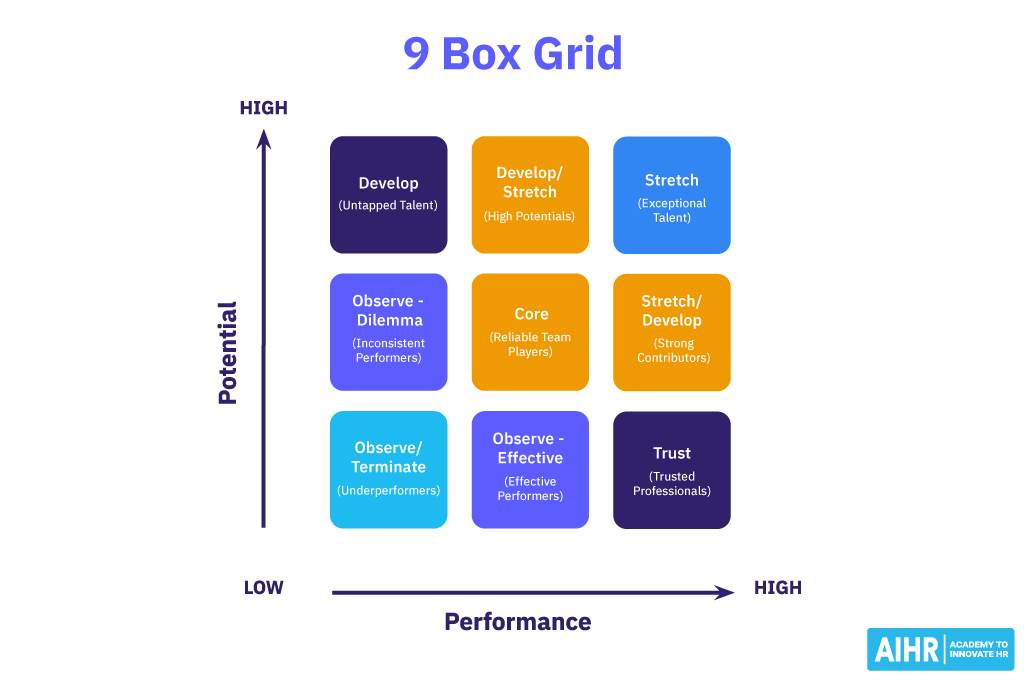
Source: AIHR
Coles uses HR-led facilitation to ensure the nine-box grid is applied effectively.
“That framework then shows you who your high-potential people are. They might be a great performer, but it’s the potential we’re trying to focus on.”
Mirvac has taken a different path. Morris explained that the organisation deliberately stepped away from the nine-box grid after discovering it wasn’t providing sufficient clarity.
“We found out that managers just couldn’t quite compute the [difference] between performance and potential, and so we went away from nine-box. Instead, we now look at the extent to which someone is in the right role today, and the extent to which they have both the potential and aspiration to take on more senior roles,” says Morris
By reducing the complexity, Morris says leaders have been able to engage in more candid, forward-looking discussions with employees.
The broader lesson, the panellists suggested, is that HR leaders need to critically assess whether their talent tools are driving genuine insight or simply preserving outdated processes.
Simplified, purpose-aligned models that focus on aspiration and development readiness can create far more value than complex grids, which sometimes fail to capture the nuance of human ambition.
Learn effective workforce planning strategies to help equip your organisation for the future with this short course from AHRI, as well as this advanced short course.
Adapting workforce development for the age of AI
Artificial intelligence is no longer a fringe experiment in the workplace. From workforce design to the employee experience, AI is already actively transforming how many organisations operate.
Kate Bravery, Global Leader of Talent Advisory at Mercer, urges HR leaders to take a proactive role in shaping AI adoption with a focus on people, not just processes.
Citing Mercer research, she highlights the “proximity paradox”: the more employees engage with AI, the greater their fear of job loss. This anxiety is compounded by a lack of transparency – just one in five employees say their manager has spoken to them about the impacts of AI on their job or organisation.
“Most people think managers don’t know where to start, and fears are high. That’s not a recipe for innovation,” says Bravery.
To move beyond fear and uncertainty, HR must lead conversations about redesigning work with transparency and openness to employee input, and ground them in psychological safety.
“Doing the work around work redesign really does open up the opportunities,” says Bravery.
“We’re seeing examples in healthcare where they don’t have enough nurses [in America]. They’ve been able to unlock 70 per cent capacity by re-looking at the job and saying, ‘What really requires nursing skills and what can be done by delivery or administrative [talent]?’ And then you start to think, “If you can [give these people] a language model with medical expertise, what more could they do?”
Importantly, deliberate governance is needed in order to scale AI solutions effectively, says Bravery.
Too often, AI oversight sits solely with legal or data security teams, but this narrow focus can stifle innovation.
“You need to have a formal structure – AI governance boards – and you’ve got to be careful they don’t end up just being your [usual] legal or data security people, because then you might be too risk-averse. You’ve got to balance the [governance] and risk-taking, particularly where we’ve got productivity challenges in this country. Having the right balance of internal people and experts and business people on those boards is important.”
Bravery was unequivocal in her message: AI is not just another tool to be managed. It represents a structural shift in how work is designed and governed.
“We are about to witness the biggest transfer of power from humans to machines in the workplace. It’s going to demand intentional work design and real progress towards skills-powered organisations,” she says.
The winners will be those organisations that treat AI not as a bolt-on efficiency play, but as a catalyst to redesign work, unlock capacity and future-proof skills. In this new era, the role of HR is not to manage the risks of technology from the sidelines, but to lead the transformation at the very heart of the business.