For HR practitioners who find themselves stuck at a mid-career crossroads point, a senior practitioner offers a range of thought-provoking questions to help you plan your next move.
The mid-career phase often brings HR professionals to a critical crossroads. Do you continue the vertical climb toward senior leadership, broaden your horizons with lateral moves to diversify your skillset, or double down on a niche to become a definitive subject matter expert?
While this period can feel full of uncertainty, it’s also a window of immense professional opportunity. As part of AHRI’s career series webinar, three seasoned HR leaders who have successfully navigated these transitions share their firsthand advice for those currently weighing up their next move.
Mid-career professionals can often feel trapped by their own competence, says Caitlin Guilfoyle CAHRI, Independent Strategic Adviser, Forae.
“They become the person who gets things done, who solves the immediate issues, they’re really good at responding to whatever’s in front of them and they manage quite high operational loads.
“They’re super reliable, which is very valuable, but it can also make it harder to step back and think, ‘What do I actually want to be known for? How do I start to be intentional about the work that I do?”
Below, Guilfoyle shares several key questions to consider when intentionally redesigning your career, helping you move forward with clarity and purpose.
1. Is my work still aligned with my values?
Mid-career professionals often slip into the trap of chasing the next promotion without stopping to consider whether the path they’re on still aligns with their values and goals, says Guilfoyle.
“HR professionals are often looking for the next title or promotion when their next move may actually be thinking differently. So [that might be] a strategic project, a broader stakeholder opportunity, something that looks a little bit outside of what their current structure and reality is.”
Want more insights into designing a career with your personal values in mind? Listen to this episode of Let’s Take This Offline where executive and personal coach Kemi Nekvapil shares how she helps people to design values-aligned careers.
Guilfoyle also suggests looking for opportunities to stretch in adjacent functions that might expand your view of what you can do/where you have valuable transferable skills.
A good place to start, however, is to assess the skills you will need to achieve this and where your current gaps may be.
The Australian HR Capability Framework offers a comprehensive view, broken down by career stages (exclusive for AHRI members) defines capabilities, skills, knowledge and behaviours required to deliver a great employee experience and drive strong organisations.
By taking the Australian HR Capability Analysis (exclusive to AHRI members), you can measure your capability against the AHRCF’s standards, and gain a detailed report identifying strengths and areas for growth, and targeted recommendations for development programs. This enables you to confidently take the next steps in your HR career.
2. What career chapter am I currently in?
Guilfoyle has looked at her HR career in three broad chapters.
She started in an in-house HR role, working across government and industry roles, where she gained a lot of her foundational HR skills. Next, she moved into HR workforce and future of work consulting, which offered her exposure to o complex global organisations and problems, workforce strategy and large-scale change.
“Now, I’m in my third career chapter: a portfolio of people-related work across leadership, coaching, modern work and strategy. That pivot from the second to third chapter was the most interesting – and important – because it was the first time I made a very conscious career decision.
“If you constantly feel there is a misalignment or pull on your values, your energy, and future direction, it’s likely a sign to explore a more significant career change.” – Caitlin Guilfoyle CAHRI, Independent Strategic Adviser, Forae
“I stopped asking, ‘What is the next logical role? What’s the next step I can take in the current role I’m in? And to start asking, ‘What’s the kind of work that I actually want to do. What’s the impact that I want to have?’
“The challenge at that stage was the lack of certainty; I couldn’t see exactly what the next year or two would look like. However, what I did have was a clarity of values and a clear vision of the impact I wanted to make. It required a willingness to step off the pre-defined path and become truly intentional about what I wanted from my career.”
While every career story is unique – and there is certainly no one-size-fits-all roadmap – visualising different trajectories can help clarify your own.
To provide a sense of the possibilities, consider these three common ‘chapters’:
| Questions to consider | |
| Chapter one: Building the foundations |
|
| Chapter two: Getting the exposure |
|
| Chapter three: Niching down |
|
This diagram is a non-extensive example of the types of questions that can help to determine your specific career chapter and what could be on the horizon.
3. Am I growing, or just performing?
In order to identify when it’s time to take a leap into a new chapter, Guilfoyle says it can be useful to reflect on whether you’re growing and shifting in your job, or staying in place (despite being a consistent high-performer).
“There were points where I felt I’d reached my capacity for growth within [a certain role]. Just before I transitioned into consulting, I looked around and asked: ‘Who am I going to learn from, and what else is there for me to pick up?’ When the answer was that there wasn’t much left to gain in that environment, I knew it was time to move. I realised that if I wanted to keep growing, I had to be willing to change my surroundings.”
This is not to suggest there is anything wrong with being a consistent high-performer. For many, a period of stability and reliability is exactly what is required to align with the values they have set for their career (e.g. work not taking up too much space).
But for those specifically seeking progression, staying within a ‘competence trap’ for too long can lead to stagnation. As Guilfoyle notes, it is easy to become the person who simply “keeps everything moving” without being intentional about what you actually want to be known for.
4. What work gives me energy?
Make sure you pay attention to the work that leaves you feeling engaged, curious and motivated, says Guilfoyle.
“If you constantly feel there is a misalignment or pull on your values, your energy, and future direction, it’s likely a sign to explore a more significant career change,” she says.
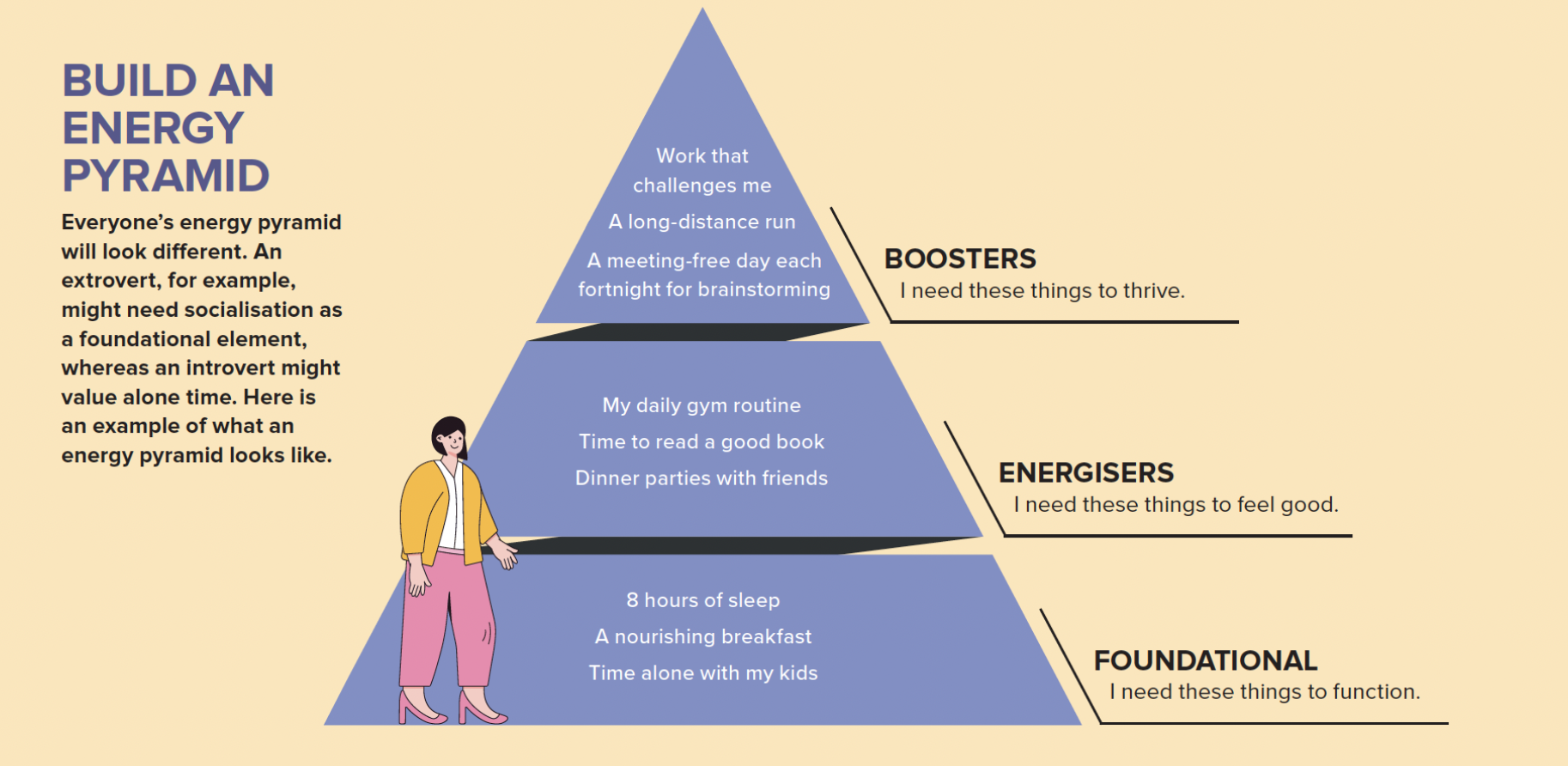
Download a printable energy pyramid template and a checklist of questions for managers to ask their people in 1 on 1 meetings to assess energy levels.
5.Who’s advocating for me when I’m not in the room?
A key part of career progression is getting a clear understanding of the shadow that you cast in your organisation. What are people saying about you when you’re not in the room? Are you known as the problem-solver? The person who ‘just gets it done’? The creative mind?
It’s important to “be intentional about [your personal] brand and reputation”, says Guilfoyle. HR professionals, she says, are often focused on supporting the business or individuals to work on their own reputations – because they’re often “known as the people who support others”. It’s important to turn that attention to yourself, says Guilfoyle.
“Intentionally shape [your professional brand] with others – your networks and sponsors, because your reputation speaks before you walk in the door.
“Mentors helped me make sense of [my career] decisions, gave me different perspectives and looked more deeply into the decisions and challenges I had and also my own assumptions about the world outside of what I was operating in at the time.”
6. What skills will still matter in the near future?
Finally, aligning your professional development and career aspirations with where the market is moving is a strategic way to set yourself up for success.
While Guilfoyle says she’d need a “crystal ball” to say exactly what this will look like, she hypothesizes on a few no-regret bets that HR practitioners looking to reshape their careers could make today:
- Career progression will be less linear and more skills-based. Now is the perfect time to embrace micro-credential and micro-learning opportunities to expand your skill set beyond what was taught to you in your tertiary studies.
- Prepare for roles that don’t yet exist: The traditional HR operating model is set for a significant transformation over the coming years, says Guilfoyle.
“We can no longer rely on familiar structures or established positions to dictate our next move; in an AI-driven world, simply waiting for a role to open up is no longer a viable strategy, as that role may simply not exist in the future.
“To maintain credibility in a rapidly evolving landscape, HR professionals must look beyond their core discipline and build expertise in adjacent fields. Technology, commercial acumen, and data ethics are no longer optional. They are essential components of modern workforce transformation.”
As organisations integrate AI, HR should lead the strategy around people-related risks – from capability gaps to psychosocial safety. Understanding these intersections, alongside the principles of human-centred leadership, will be the hallmark of the future-ready practitioner, she says. - Hone your communication, trust, stakeholder influence and ethical decision-making skills.
- Don’t underestimate the value of your network.
“Invest in your relationships before you need the next opportunity. Sometimes when people are thinking, ‘I need to make a change,’ [and they have invested in their network], all of a sudden action starts to happen.
“Regardless of whether you think you need to change now, consider what you can do to align yourself and prepare yourself better for the future. I constantly and consistently think about building my skills and building my relationships.”
🧰 HR’s career resource toolkit
- Webinar: HR Career Series: Navigating, Evolving and Leading Your HR Career (on-demand for AHRI members. Access your member dashboard).
- Australian HR Capability Analysis (exclusive to AHRI members)
- AHRI Digital credentials
- Printable energy pyramid template