When artificial intelligence contributes to organisational redundancies, a tailored communication strategy is essential. An expert shares a practical framework to help HR leaders navigate these conversations with clarity and care.
Headlines about AI-fuelled job losses are no longer speculative – they’re becoming a lived reality for many organisations.
Large multinationals are openly acknowledging that significant portions of their operations are now handled by AI, which is reshaping the nature of work at scale.
Ironically, even the companies at the forefront of developing or integrating this technology are beginning to shift into self-preservation mode. Subtle moves toward unionisation in parts of the tech sector reflect growing anxiety about the long-term impact of AI on job security.
“Businesses often underestimate the potential loss because they’re so focused on the potential gains [of AI],” says Krishni Srikanthan, Principal at strategic communications consultancy Narraterra.
While she acknowledges the many gains AI can offer, Srikanthan warns of a significant potential loss: trust – among impacted employees, those who remain and key stakeholders such as customers and shareholders.
“There’s already this sense of distrust around AI technology – people don’t know what’s real and what’s not. AI itself is something that can compromise trust, but so too is the way you talk about it.”
As AI-driven job losses become more common, HR practitioners and business leaders must be equipped with communication strategies that convey care and minimise long-term risk.
Srikanthan offers a practical framework to guide these conversations with transparency, authenticity and empathy.
Find your organisational voice
Redundancies are an unavoidable reality in a cost-conscious market. While any redundancy conversation is going to require a considered approach, there are extra nuances to consider when they are driven by AI.
For example, there could be an accompanied sense of existential dread. Unlike economic cycles, which imply a rebound, AI-driven job loss can feel permanent. The message isn’t “your role is no longer needed right now,” but “your skills may no longer be needed at all.” That’s a fundamentally different emotional hit, potentially triggering long-term anxiety about relevance and employability.
AI implementation isn’t a one-off event – it’s iterative. This makes it harder to identify a clear end point to the change, meaning communication needs to be more dynamic, honest and sustained.
For this reason, traditional change communication tactics may fall short in helping people process the scale and permanence of the change – both for those directly affected and those who remain.
Srikanthan has designed a tool called the ‘Conversation Design Framework’, which she says is about “creating space for voice, for story, and for conversation that flows both ways. It’s how you move from noise to resonance, and from message to connection.”
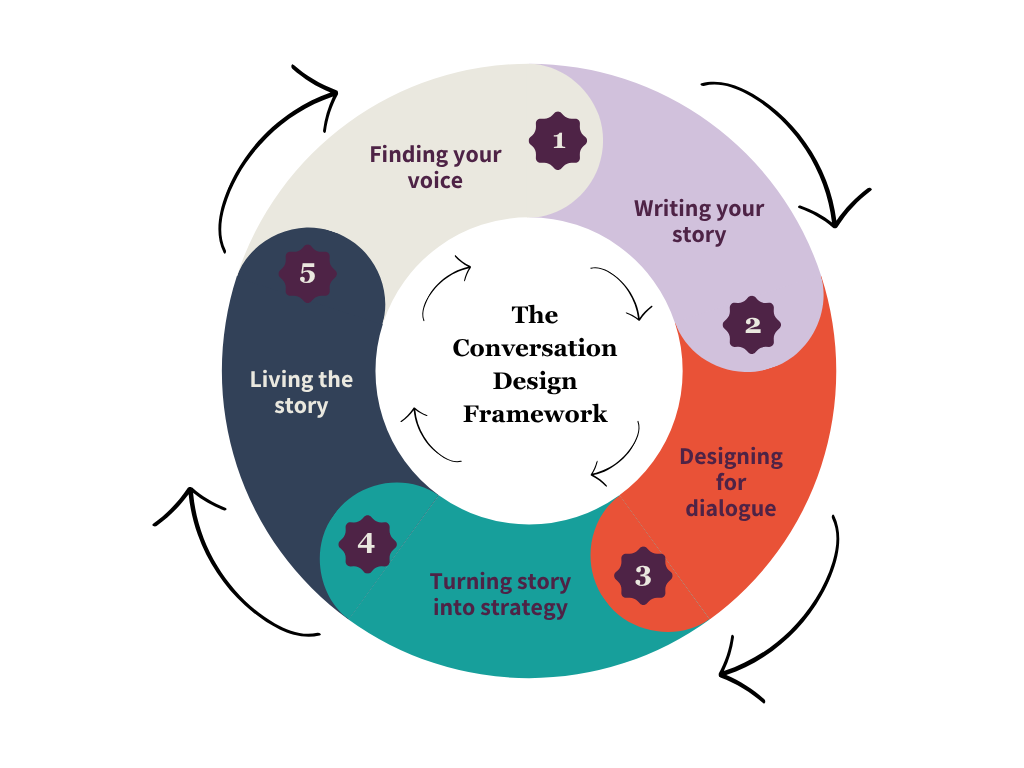
Image source: Narraterra
The framework begins with the idea of identifying your organisational voice, which ensures difficult messages are communicated with a sense of collective ownership, rather than feeling like top-down directives imposed by leadership.
“It’s very easy to think, ‘I’m the leader of this business, so it’s my voice that matters.’ You might be the spokesperson, but it shouldn’t be your voice that you’re putting out there. You need to hear the voices of the collective and then shape that to create a single voice of the business.”
Srikanthan suggests speaking to people at different levels of the organisation to learn more about how your organisational voice should sound.
“Understand what they think of the business, how they talk about the business with other people, how they describe what they do. What do they see the business’s purpose as? It’s gathering stakeholder insights.
“Businesses often see these as moments in time, rather than a continuous curve. Once you’ve implemented AI and then made people redundant, it doesn’t end there.” – Krishni Srikanthan, Principal, Narraterra.
“Then take that to the leaders and say, ‘This is what people are saying and how they’re saying it,’ and craft your strategic brand narrative from that.
“If you can identify the way people speak and the language they use, that gives you guiding principles to communicate with them in a way that will resonate.”
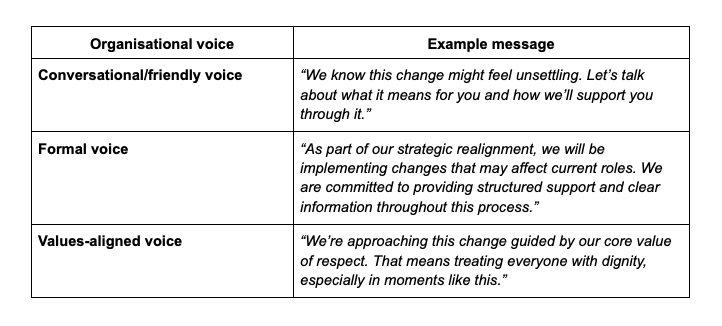
For example, here’s how the same message might sound in different types of organisational voice:
Learn how to approach difficult conversations with confidence with with this short course from AHRI.
Co-design and belonging communications
Next, you would design for dialogue, which is all about co-design.
“I specifically put that in before the strategy phase,” says Srikanthan. “Often [business leaders] develop their communication strategy and only then communicate it with people. But that can just feel like the business is testing something on them [rather than involving employees meaningfully]. It doesn’t feel authentic.”
Instead, invite input from your people.
“Where businesses often go wrong is not sharing information with people until they’ve already made a decision. Employees then feel blindsided – they don’t feel part of the journey. They don’t feel invested in it. They don’t buy into the new direction that the company is taking.”
This is where belonging communications can come in handy. Where traditional, business-centric communications tends to focus on directive language, belonging communications place the key stakeholder (in this example, employees) at the centre of the message.
Belonging messaging is framed to show how employees are part of something bigger, helping them understand the ‘why’ behind the change, and how their role contributes to shared goals.
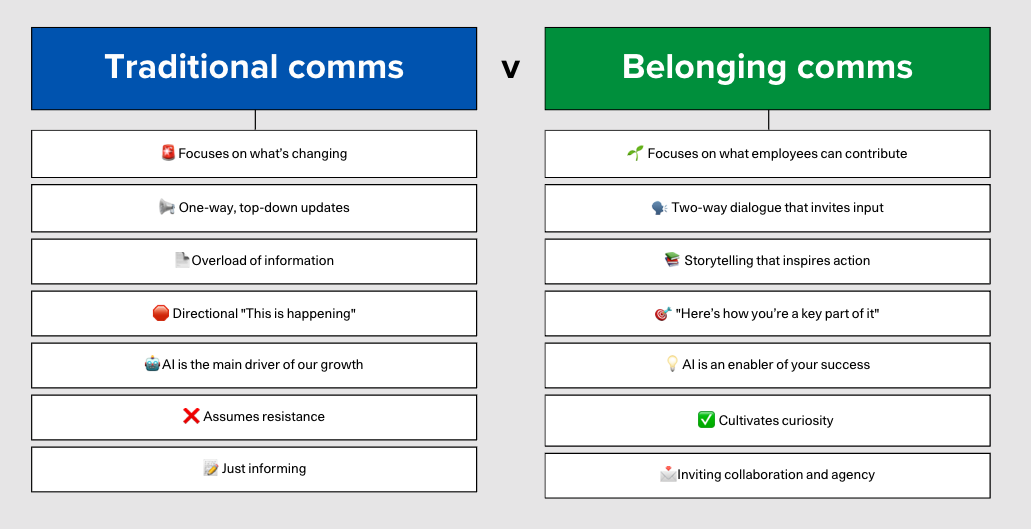
Image: Mahlab
For example, a traditional message about AI-related job loss might say: “Due to the implementation of new AI systems, several roles will be made redundant effective next month.” This framing is transactional and top-down, which can trigger fear and defensiveness.
In contrast, a belonging communications approach might say: “As we integrate AI into parts of our business, some roles will inevitably change. We want to support you through this transition – whether that’s by helping you explore new internal opportunities, reskilling pathways or listening to your concerns as we move forward together.”
It doesn’t need to be perfectly polished messaging, says Srikanthan.
“People just want to be involved in the process. They want to feel like they have a voice. They want to feel like they’re being heard.
“Connection is built through vulnerability, not perfection. The best thing leaders can do is lean into vulnerability and remember that we’re just people speaking to other people.”
Shifts in language and thinking
It’s important to pause and reflect before entering these conversations to challenge the natural instincts that might otherwise guide your approach. A mindset shift is often required, says Srikanthan.
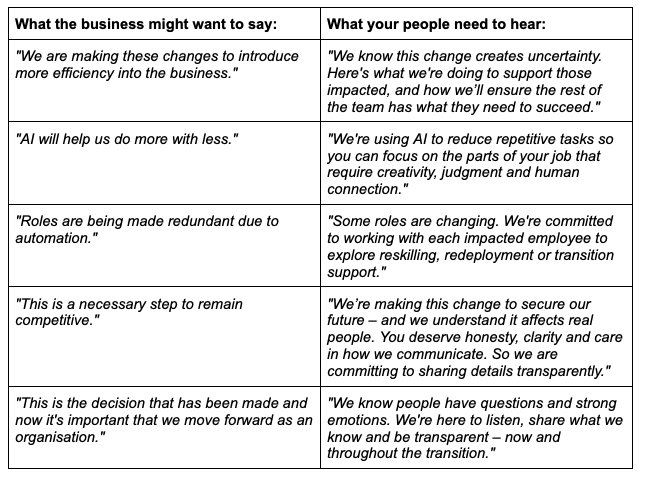
“[When thinking about delivering bad news], businesses are driven by ‘what we need to say’. Instead, you should flip it to ‘what our people need to hear’.”
For example, that might look like making the following shifts:
Don’t forget the communication aftercare
Waves of uncertainty, grief or resistance are inevitable during complex change. That’s why communication can’t stop once the new AI tool is launched or the restructure is complete. Ongoing, two-way engagement is key.
That’s why Srikanthan has designed her framework as a cycle.
“It’s a process of moving from clarity to connection, and then back again.
“As your business is evolving, consider whether your values align. Is your purpose something that still drives the business? Has the organisational voice shifted since you’ve made these changes?”
Questions like this should be considered early and often.
“Not communicating effectively after a change has been implemented is where things can go wrong. Businesses often see these as moments in time, rather than a continuous curve. Once you’ve implemented AI and then made people redundant, it doesn’t end there.”
There can be elements of survivor’s guilt – often months later – that are critical to address, as research suggests businesses can face performance dips of up to 20 per cent, a 36 per cent decline in organisational commitment and a 41 per cent decline in job satisfaction as a result.
“The other conversations you want to be having are around upskilling and reskilling. Do your people have the skills and capabilities to use these new tools? Think about this early on, so people [who remain] are engaging with these tools.”
Leaders need to be visible, actively listen and tune into what’s not being said, she adds. Informal feedback channels – like regular check-ins or listening posts – can surface early signals and guide when a more structured response is needed.
When these conversations are continuous, follow-up moments (like a six-month check-in) won’t feel performative – they’ll be part of an agile, responsive approach to change.
Develop the important skills to have tough conversations with this short course from AHRI.