As leadership benches shrink, learn how DHL Express Australia sets itself apart through a dedicated commitment to succession planning.
Only 15.4 per cent of employed Australians have been with their current employer for over 10 years, according to ABS data. What does it take, then, to encourage employees to stay not just for one decade, but almost two?
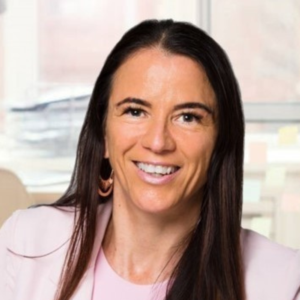
Veronica Evison, Vice President of Human Resources AU/PNG, DHL Express Australia
Veronica Evison, Vice President of Human Resources AU/PNG at DHL Express Australia, who has done just that, says the key is consistent investment in professional development.
“I wouldn’t have stayed for 19 years if I didn’t have [that].”
From HR Business Partner to Vice President, Evison’s career path at DHL has spanned both roles and borders.
Moving from New Zealand to Australia and climbing the ranks across her career, she credits her success to two things: DHL’s commitment to fostering the growth of employees and her own openness to the opportunities the company afforded her.
“Development is not just encouraged, it’s part of our culture,” adds Nonna Pasion, Senior Manager, Talent Management and Learning & Development at DHL Express Australia.
“We believe great leadership at every level is essential to sustaining our culture and driving success. That’s why succession planning goes beyond business-critical roles to include all people leaders,” she says.
Below, Pasion and Evison unpack how their division’s long-standing succession planning approach sets DHL Express apart, both within the broader company and across the industry.
1. Supporting leaders to foster talent development
Organisations need good leaders to build strong future leaders, and DHL’s involvement and support of people leaders across the business is clear evidence of that, says Pasion.
The organisation’s leadership development programs include:
- The Manager Excellence Academy, designed for senior leaders
- The Supervisory Excellence Academy, tailored for frontline supervisors
Running over a period of 12 to 18 months, these programs build core leadership capabilities, including: communication, coaching, relationship building, inspirational leadership and leading high‑performance teams.
The skills are developed through structured modules that progressively guide supervisors and managers through each capability. The programs are delivered through a blended approach that combines facilitated learning, on-the-job challenges and application, post‑session assessments and one-on-one coaching.
In 2025, 30 supervisors from Australia successfully completed the Supervisory Excellence Academy and celebrated their graduation in Kuala Lumpur, joining 156 colleagues from across the region.

Nonna Pasion, Senior Manager, Talent Management and L&D, DHL Express Australia
“This… strengthens our leadership bench, supports internal mobility and reinforces our commitment to growing talent from within,” says Pasion.
But how do you get leaders on board with the time investment required to facilitate succession planning for not just your executive team, but the whole people leadership cohort?
Gaining buy-in started with clarity and purpose, says Pasion.
“We positioned succession planning as a business critical initiative locally in Australia through clear communication from the senior leadership team and by embedding it into our country priorities and roadmap,” she says.
The company’s succession planning approach was cascaded from the Global DHL Group and applied consistently across all regions and countries.
2. A consistent cycle of planning and review
Succession planning conversations are part of the broader talent and performance cycle, not standalone events, says Pasion.
The company’s annual performance cycle looks like this:
- Year-end performance reviews: HR collects data from employees and managers on aspired roles, mobility preferences and availability. “We’ve got that data in place so managers can make informed recommendations before succession conversations start,” says Evison.
- People leaders are assigned a succession planning task: HR reviews all the teams’ plans, identifies potential successors and assesses their readiness. “We talk about what the development gaps are so we can give the manager all the feedback they need,” says Evison.
- Panel reviews with senior leaders for each function: These sessions validate plans, assess successor strength and provide feedback to managers. HR looks at their skills and areas that need development to ensure the right support is in place. “Then, when [managers] do have those conversations with employees to close the loop, it is a meaningful conversation… They’ve got really specific action items that the employee can take for their development plan, and they can give them a good indication of how ready the business feels they are.”
Outside of this, employees also receive one-on-one coaching, quarterly reviews and mid-year reviews, providing them with multiple moments throughout the year to realign their goals with their managers.
“At DHL Express, we believe great leaders lead with four dimensions: head, heart, guts and bite.” – Nonna Pasion, Senior Manager, Talent Management and Learning & Development at DHL Express Australia
3. Bolstering the talent pipeline with tangible tools
“Succession planning has created a culture where employees feel empowered to own their careers, knowing they have support from managers and leadership,” says Pasion.
To support employees in their professional development, the DHL Express HR team has created and implemented several tools:
Individual Development Plan (IDP)
One tool they use to enable this is the Individual Development Plan (IDP).
While it’s not compulsory for employees to set up their IDPs, 94 per cent have done so, according to an internal survey.
By April, employees have set up their IDP for the year following their year-end performance review.. Taking on board the feedback from the previous year, they’re able to capture practical steps to uplift their skills.
“It’s an evergreen document.We encourage people to review it regularly,” says Evison.
“I have a standing 15-minute check every two weeks to tick off anything I’ve closed in my IDP or to review if I want to add anything.”
When hiring managers are reviewing internal talent, they will also often ask candidates to present their IDP and outline how they’ve used it to prepare for the promotion or role shift, she adds.
“That just really reinforces to our employees how seriously we take development and how much we want to make sure they’ve put plans in place to be the strongest candidate for that role.”
The 70:20:10 rule
Development activities are not limited to formal training programs, says Evison.
“We make sure that most of your development [70 per cent] is on the job – you’re learning as you’re doing. Then, 20 per cent comes from coaching and feedback, and the final 10 per cent is through learning and training,” says Pasion.
Learning can happen through formal education including classroom sessions, online learning and external training, or through informal professional development, such as listening to a relevant podcast or reading an influential book, says Evison.
My Talent WorldCareer Marketplace
All goals and development activities are captured in DHL’s learning management system, Career Marketplace (CMP).
“Once you put your IDP into the system, the manager, employee and HR get visibility,” says Evison.
The CMP platform provides access for all employees to view and apply for job vacancies, learning recommendations, career mapping, IDPs and complete talent processes like coaching session data and performance reviews, says Pasion.
In doing so, it supports learning, performance management and increases visibility of internal talent, she adds.
Certified training programs
DHL boasts an array of development opportunities. All divisions of DHL have their own ‘Certified’ programs.
For DHL Express, two key programs they have developed internally are the Certified International Specialists (CIS) and Certified International Manager (CIM) programs.
With a supervisory curriculum for frontline leaders and a manager curriculum for senior leaders, the programs involve an 18 to 24-month journey spanning classroom-based training courses and module-based online learning, which cover all the key skills and attributes that make a DHL leader.
“At DHL Express, we believe great leaders lead with four dimensions: head, heart, guts and bite,” says Pasion.
This looks like:
- Head – Driving success through a focused use of your strengths and an unrelenting pursuit of results.
- Heart – Creating a culture of trust by making people feel empowered and motivated toward a shared purpose.
- Guts – Maintaining a positive mindset and staying focused on clear objectives, even in the face of challenge, change and uncertainty.
- Bite – Having the will to win, which means being determined to succeed collaboratively and driving growth with an entrepreneurial spirit.
Underpinned by this framework, these programs have been successful in growing several leaders within the organisation and are part of a border suite of training programs on offer to DHL employees, adds Pasion.
For instance, for early career HR professionals looking to grow their leadership capacity, the team is currently working on a local Future Leaders program as well, involving a two-day immersive experience to help aspiring leaders cultivate the attributes and competencies which DHL expects, she says.
“The program combines facilitation with scenario‑based learning, networking opportunities and interactive panel discussions to provide a practical and engaging development experience.”
DHL’s ‘Passport to Success’
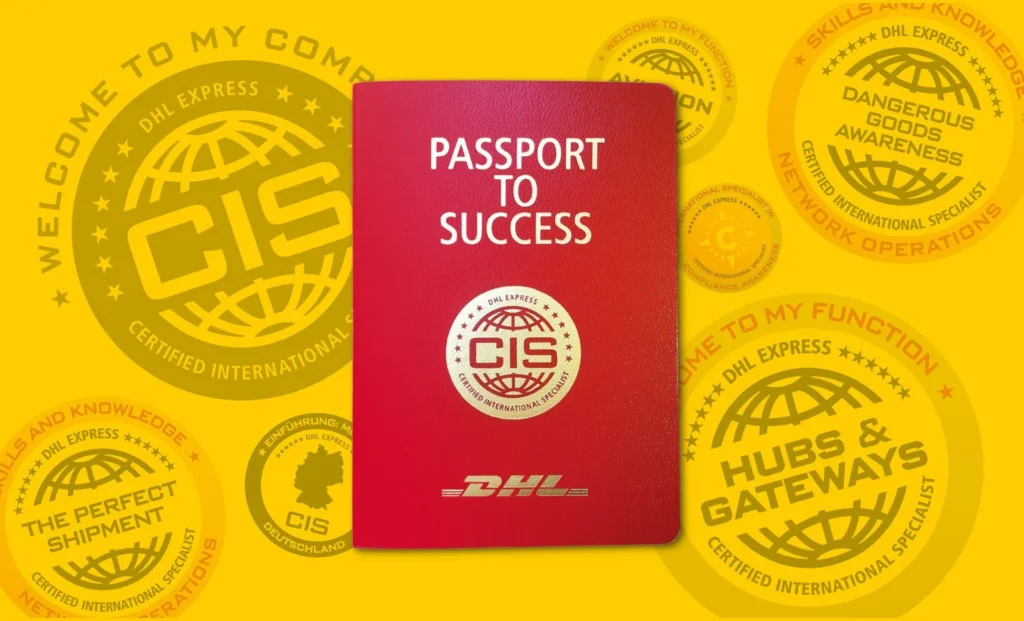
Certified International Specialist (CIS) Passport
To motivate employees to engage with the professional development opportunities, DHL Express also uses the Certified International Specialist (CIS) Passport, initially created by the Global Certified International Specialist Team.
The CIS Passport captures the learning journey of each employee by encouraging them to collect a stamp each time they attend training or receive awards, such as ‘Employee of the Quarter’.
The passport has proven popular amongst many DHL Express employees past and present.
“One of our DHL couriers was delivering a shipment to an ex-employee. When the ex-employee saw the DHL courier, he showed him his DHL passport that he kept from his time with DHL,” says Evison.
4. Overcoming mobility resistance with stretch assignments
One of the biggest challenges DHL has faced in succession planning has been that employees are usually waiting for senior leaders to leave their positions in order to progress, and often, they’ll need to relocate to access those vacancies, but they are often resistant to do so.
To mitigate this issue, they have tried to invest in interstate and international stretch assignments. Evison herself was engaged in a stretch assignment during her early career.
In 2011, she was asked to relocate to Brisbane and step up as a project manager for a new call centre.
“I didn’t have any idea of how to manage a project of that scale with that kind of investment – because it was millions of dollars,” she says. “My manager at the time said to me, ‘It’s okay, Veronica, we’re going to support you. Don’t you ever feel like you’re going to fail because you’re going to get the support.’
She says the experience enabled her to build strong project and stakeholder management capabilities, navigate relationships with senior internal stakeholders and external vendors, and develop financial acumen which provided key foundations in her leadership journey.
She attributes the success of this assignment to the support of her manager and the Head of IT, who sent her on a Project Management course and coached her through the process.
In her opinion, it speaks to the willingness of DHL Express to support employees to take on big projects which carry a high risk of failure.
Good succession planning is a shared responsibility
These discussions are never about promises, says Pasion.
“The message is simple: we see your potential and we’re here to support you in becoming a strong candidate for future opportunities.”
Having support from the top has been key to the development of many of DHL’s leaders today.
“I’m so appreciative of the great leaders I’ve worked with that have supported my journey at DHL. Our previous manager Linda; she was very inspirational and motivational, always giving great developmental feedback, supporting me to do my MBA,” says Evison.
“We’re only two examples in HR, but there are so many more examples across the organisation… The fact that our senior leadership team – our CEO and all his direct reports – have all been growing from within, is a testament to the strength of our strategy,” adds Pasion.
Gain the essential coaching and leadership skills needed to build and sustain a high-performing work team with AHRI’s course.