There are many variations of HR operating models out there, but most are missing four critical links needed to elevate the HR profession to the next level.
Dave Ulrich’s 1996 HR operating model – Business Partners, Centres of Excellence, Shared Services – was the right answer to the right question for its era. It was designed for a world where humans executed the volume. That world is changing.
In the past eighteen months, frameworks from major consulting firms, independent analysts and practitioners have converged on a shared conclusion: the three-legged stool is no longer fit for purpose in an AI-enabled enterprise.
The Shared Services layer is the first and largest target of AI automation. When it goes, the structural logic of the model changes with it. The function needs a different architecture. Not a retitled version of the existing one.
This conversation is the most important the HR profession has had in a generation. The direction these frameworks point toward is correct. But there is a gap at the centre of almost every model published: the implementation layer. Each framework describes a destination worth building toward, but none explains what must be true before you can get there.
That’s the problem this article addresses. A note before going further: the argument applies primarily to large and complex organisations – those carrying workforce data across multiple systems, managing significant compliance obligations and operating at a scale where AI deployment carries meaningful risk. Smaller organisations face a different set of constraints and may find a simpler path forward.
What the HR field is getting right
The profession is arriving at similar conclusions from different directions. That is worth acknowledging before offering a different perspective.
Wowledge’s Human Readiness model is the most operationally detailed framework published in this space. Its work distribution model – mapping what goes to AI, what goes to the external ecosystem, what stays with the HR team and what embeds in the business – is the most specific practitioner guidance available.
The Optimisation Paradox framing is precise: simultaneous pressure to reduce HR headcount while increasing strategic impact is not cyclical. It’s structural.
McKinsey’s updated operating model names People Technologists as a structural pillar of the function itself, and its research estimates that two-thirds of current HR tasks can be largely automated. Both instincts are right. What the same research assumes, however, is an integrated, standardised data foundation already in place.
In most enterprises, it is not. Deloitte’s HR Reimagined positions agentic AI as a workforce participant, not a tool, with human accountability embedded before agents act. Mercer’s Operating by Design abandons process-based departments for Outcome Delivery Teams with direct P&L accountability.
Josh Bersin has argued since 2023 that HR needs to be redesigned as an operating system, not an operating model – a system that runs, not a structure that describes. His HR 2030 vision extends this into agentic architecture.
Volker Schrank’s Bionic HR framing goes further still: 90-95 per cent of back-office complexity is handled by agents, with humans shifting from execution to orchestration.
All of these are directionally correct. The profession is converging on the same structural shift from different starting points. The question of where workforce variance is absorbed is important, but it is secondary to the question of whether the system underneath it can be trusted. The destination is not in dispute. What is missing is the road.
“AI can only systematise what is already systematic. High variability and undocumented processes do not disappear when you automate them. They become embedded in the automation and the inconsistency scales.”
The four missing links
Every framework in this conversation assumes four things. All of them must be true before any model can work. None of the published frameworks designs for them.
First, the data must be trusted. As I’ve written about for AHRI previously, most enterprises carry workforce data across multiple systems – HRIS, payroll, rostering, time and attendance, finance – with conflicting definitions, no agreed system of record and reconciliation running on spreadsheets. AI does not fix this. In fact, it amplifies the issue.
The EY Responsible AI Pulse Survey found that only a third of companies have the responsible controls in place for their current AI models, despite nearly three-quarters having AI integrated into initiatives across the organisation. The gap between deployment and governance is not a matter of pace. It is structural.
Second, every AI-influenced decision must be classified before deployment. Several frameworks state correctly that human accountability must remain for every agent decision. None specifies the mechanism. A governance principle without a classification mechanism is not governance. It’s intent.
Every decision an AI system influences needs to be classified before it acts: AI-informed, where AI provides context and a human decides; AI-assisted, where AI recommends and a human approves before execution; or human-led, where AI is not appropriate for this decision. Each requires a named human owner, a defined review mechanism, and an audit trail.
Third, processes must be documented and standardised before they can be automated. HR processes carry enormous variability. The same onboarding process runs differently across business units, geographies and managers.
AI can only systematise what is already systematic. High variability and undocumented processes do not disappear when you automate them. They become embedded in the automation and the inconsistency scales. We ran into this with robotic process automation a decade ago. AI is doing the same thing with better graphics.
There is a temptation accelerating with the availability of AI development tools to build on top of broken foundations rather than through them.
Most People functions enter this conversation carrying years of underinvestment: fragmented systems, siloed data, legacy tech debt and processes held together by institutional memory and spreadsheets.
The temptation is to layer AI on top of this rather than address it. Vibe-coding an agent is fast. Fixing a data foundation is not.
When an agent is built on a broken foundation, the result is what practitioners are calling the agent graveyard: agents that pass the demo, survive the pilot, get the budget approval and then quietly degrade because the system underneath them was never ready.
The agent keeps running. The world around it changes. The gap between what the agent thinks is happening and what is actually happening widens with every passing month. That is not an AI failure. It’s an operating model failure.
Fourth, the transition must be sequenced, not announced. The EY AI Pulse Survey Wave 4 found that 83 per cent of senior business leaders say AI adoption would be faster if they had stronger data infrastructure in place. Data is the gate. Not ambition. Not investment. Not headcount.
The sequence is not optional. It is the strategy: data integrity first, then process documentation and standardisation, then workflow redesign, then decision governance, then operating model. The org chart is the last thing you design.
Designing work, not just automating it
A key challenge for HR leaders is designing operating models so that AI reduces work rather than intensifying it.
The organisations I have seen get this right do not start with the AI tool. They start with the workflow. They ask which tasks exist solely because no system was designed to handle them, and then they design the system.
The principle is straightforward: absorb workforce variance at the lowest effective layer. If a manager is answering the same policy question for the hundredth time this quarter, that is not a human conversation — it is a system design failure.
AI can resolve it at the workflow layer, freeing the manager and the HRBP for the conversations that genuinely require human judgement. The trap most organisations fall into is deploying AI on top of broken workflows rather than redesigning the workflows first. That does not reduce work. It accelerates the wrong things.
As routine work becomes increasingly automated, HR’s role also shifts in three important ways.
Firstly, HR becomes the architect of how workforce decisions get made, not just the executor.
Second, the focus shifts from reporting on workforce data to owning its integrity; the CHRO becomes accountable for the quality of the evidence the organisation uses to make people decisions, not just the insights that emerge from it.
Third, HR has the opportunity to move from reactive business partnering to anticipatory workforce strategy. When HR is no longer consumed by operational throughput, it has the capacity to sense where workforce risks are forming before they become visible to the business.
A proposed foundation layer
With these gaps in mind, I’ve developed a foundation layer designed to underpin any of the existing models. The AESP & Gibbs Operating System organises around three layers rather than roles and reporting lines.
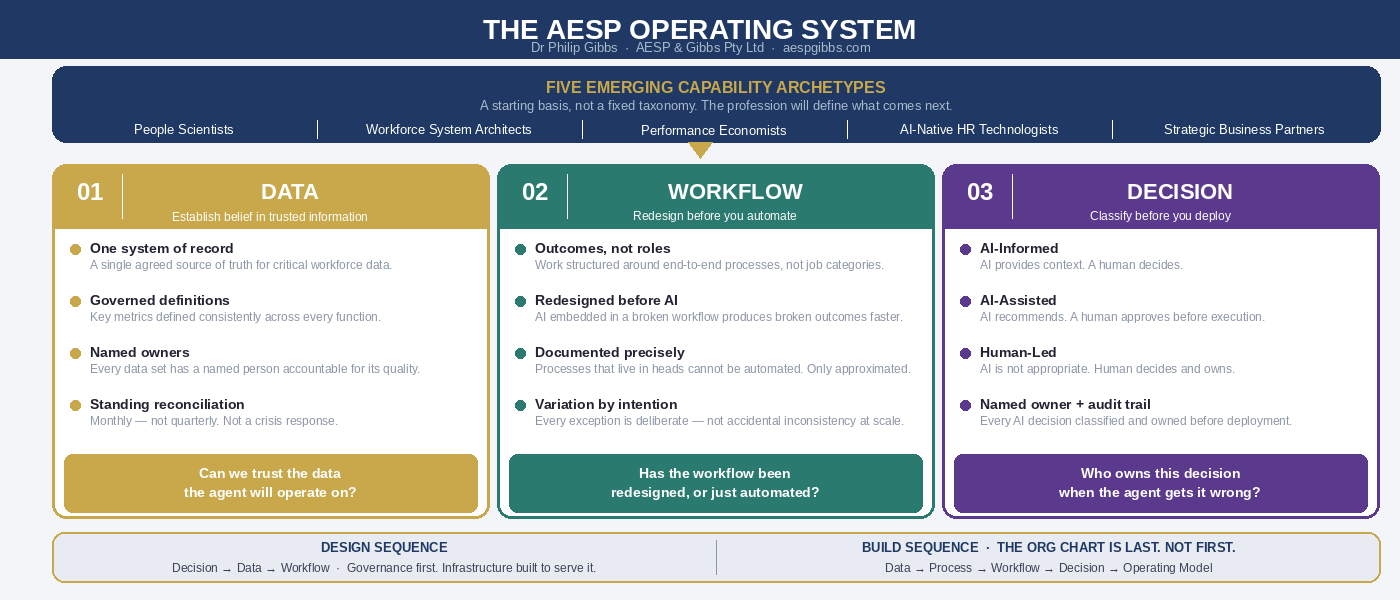 1. Data. One agreed system of record. Governed definitions. Named owners. Reconciliation as a standing practice, not a quarterly exercise. The foundation that makes everything else possible. The key question is not whether the data exists – it almost always does. The question is whether it can be trusted. If the data is not trusted, the decisions built on it are not trusted.
2. Workflow. Work structured around outcomes and end-to-end processes, not role categories. Redesigned before AI is introduced. AI embedded in a broken workflow produces broken outcomes faster. Every workflow handed to an AI agent must first be mapped end to end, documented precisely, and standardised to a level that makes variation intentional rather than accidental.
3. Decision. Every AI-influenced decision is classified before deployment. It has a named owner, a review threshold and an audit trail. This adds a governance layer that makes AI accountable, not just operational. Governance is designed first and the infrastructure is built to serve it.
Above this foundation, five capability archetypes offer a starting point for how the HR function might evolve: People Scientists who build proprietary workforce intelligence; Workforce System Architects who design human-AI work systems; Performance Economists who understand the economics of human and AI capability combined; AI-Native HR Technologists who build and operate the people technology infrastructure; and Strategic Business Partners who are measured on business outcomes, not HR activity.
These are a starting basis, not a fixed taxonomy. The profession will define what comes next.
A direction, not a series of experiments
Something else is happening alongside the framework conversation – and it is happening faster.
In late 2024, Moderna created a Chief People and Digital Technology Officer role, merging its HR and technology leadership. Its CPO immediately began redesigning every team around one question: what is best done by people, and what should be automated.
In September 2025, Harvard Business Review asked whether companies should merge their CHRO and CTO roles entirely. In March 2026, Microsoft overhauled its HR function and created a dedicated Workforce Acceleration team focused on human-agent collaboration. Its Chief People Officer, Amy Coleman, wrote internally: ‘The pace of change is exceeding what our current operating model and decision rhythms were built for.’
“The organisations moving fastest on AI have stopped treating workforce strategy and technology strategy as separate problems. They are not asking whether People should be in the room when technology decisions get made. They are redesigning the room.”
In April 2026, Atlassian expanded its CPO role to Chief People and AI Enablement Officer, absorbing internal engineering and technology teams and growing the function from 700 to 3,500 people overnight.
This is not a series of isolated experiments. It is a direction. The organisations moving fastest on AI have stopped treating workforce strategy and technology strategy as separate problems. They are not asking whether People should be in the room when technology decisions get made. They are redesigning the room.
The structural moves are the visible part. The convergence of People and Technology into a single leadership mandate – with shared accountability for data, workflow and the decisions AI influences – is the logical next step for HR.
Most organisations have not started this work. The ones that have are not waiting for the perfect model. They are starting with the foundation.
A note on reality
No organisation I have worked with has completed this journey. Some are diagnostic. Some are redesigning capability. Some are mid-implementation. All are navigating real constraints – legacy systems, competing priorities, budget pressure and ongoing change that don’t pause while the foundation is being built.
This framework is not a prescription for a blank-slate redesign. It’s a sequencing argument.
The organisations making genuine progress are not waiting until conditions are perfect. They are starting where the data is worst, fixing the definitions that cause the most confusion at board level and building better governance one decision classification at a time. The sequence matters more than the speed.
Three questions for HR leaders
Before your next HR operating model redesign – or before your next AI deployment – there are three questions worth asking with genuine honesty.
Can we trust the data the agent will operate on? Not whether the data exists. Whether it is governed, reconciled and owned to a standard that makes it defensible when a decision goes wrong.
Who owns this decision when the agent gets it wrong? Not in principle, but in practice. With a named person, a defined review threshold and an audit trail that can be presented to a regulator or a board.
Has the workflow been redesigned, or just automated? AI accelerates what already exists. If what exists is fragmented, inconsistent and undocumented, acceleration is not transformation. It is amplification.
If the honest answer to any of these is uncertain, that is the starting point. Not the operating model. Not the org chart. The foundation.
The published frameworks describe a future worth building toward. The profession is converging on the right destination. What’s missing from the conversation is not vision – it is a sequence. The models that will survive implementation are the ones built on a foundation that can carry them – trusted data, redesigned workflows and classified decisions. Without that foundation, none of the models scale. With it, all of them become executable.
Dr Philip Gibbs is CEO and Founding Partner of AESP & Gibbs Pty Ltd, a firm that designs and builds how organisations operate with AI. Former Executive, People Analytics at NAB; Head of Workforce Analytics at CBA; Director of Organisation and People Analytics at GSK.
AHRI is currently undertaking research in this area. For any further information or interest in contributing to contact [email protected].
🧰 HR’s career resource toolkit
- National Convention and Exhibition: Connect with your HR peers and learn more about how HR is evolving to the new world of work at AHRI’s National Convention and Exhibition in August. Get your ticket today.
- Learning: Sign up for AHRI’s Embedding Responsible AI course to stay ahead of AI-driven change, keep your HR practices compliant and ensure your organisation is protected.
- Learning: Sharpen your strategic approach to HR leadership by exploring Certification. Pursue your CPHR.