What happens when workforce data stops being trusted? Learn how to eliminate ‘definition drift’ and system fragmentation by establishing a standing ritual of data reconciliation.
In February this year, technology markets erased hundreds of billions of dollars in value in a matter of days as investors reassessed which companies were genuinely positioned for AI-driven productivity and which were not. The trigger was not a change in headcount. It was a shift in expectations about operating models.
A statistic now circulating in boardrooms and investor briefings is striking: leading AI-native companies are reporting revenue per employee north of US$2.5 million. Some estimates place it closer to US$2.8 million per FTE. Traditional software and services firms operate at a fraction of that level.
The instinctive board response is predictable. If revenue per employee is the benchmark, headcount must be the lever. That interpretation is too simplistic, but it has produced a consequential shift for HR leaders: workforce data has stopped being an internal reporting exercise and has become capital markets evidence. That changes everything about what it means to present it with confidence.
The problem is rarely a shortage of data. It’s a shortage of data HR leaders can genuinely stand behind.
The fragmentation nobody talks about
Most large organisations don’t run their workforce on a single system. Payroll sits in one platform. The HRIS or HCM in another. Rostering in a third. Finance maintains its own headcount model, often built across spreadsheets that have evolved over years, maintained by people who have long since moved on.
Contingent workers flow through procurement and vendor management systems that HR may only partially see. Each system is internally coherent. The gaps sit between them.
When a board requests total workforce cost aligned to a revenue-per-employee calculation, data gets extracted from multiple systems and reconciled manually. Definitions vary. Timing differs. Coding conventions diverge.
The resulting number may look precise, but its integrity is often fragile.
Revenue per employee appears straightforward. In practice it’s sensitive to definition. Is the denominator headcount at period end or average FTE? Are contractors included? Are employees on extended leave counted? Is revenue gross or net? Minor definitional shifts can materially alter the narrative.
I have worked with HR leaders who walked into board presentations with headcount figures that, when scrutinised after the fact, didn’t reconcile with finance’s model by a margin that would have been comfortable to explain. This wasn’t because anyone was careless. Both teams were drawing from different source systems, neither of which had been formally designated as the single source of truth.
The numbers were not wrong, exactly. They were not the same numbers. In a board setting, that distinction matters enormously. The reputational consequence in that scenario is real. It’s modest compared to what happens when data fragmentation produces a compliance failure.
“For HR leaders who can’t confirm these systems are regularly reconciled and tested, the exposure is not hypothetical. Saying: “We believed our systems were accurate” is not a defence that holds with regulators or boards.” – Dr Phil Gibbs
When data gaps become legal events
Australia’s underpayment landscape has been transformed. What was once treated as an administrative error is now viewed through a criminal lens. The Fair Work Legislation Amendment (Closing Loopholes) Act introduced intentional wage theft as a criminal offence, and regulators have made clear that self-disclosure doesn’t guarantee immunity.
What most commentary on underpayment misses is that the majority of cases don’t originate in deliberate misconduct. They originate in misaligned data. Payroll calculates entitlements based on the employment conditions it has been told about. Rostering records the hours actually worked. The employment contract governs what was agreed.
When these three sources don’t speak to each other, when a role change isn’t reflected in the payroll system for weeks, when a roster records hours against the wrong award classification, when a contract amendment sits in a document management system that payroll has no visibility of, underpayment becomes structurally likely.
I have seen this play out in ways that surprised experienced HR leaders. In one organisation, a large-scale enterprise agreement variation was implemented across operations. The HR team was confident the changes had been communicated. What they had not confirmed was whether the payroll system had been updated to reflect the new conditions in full.
The misalignment wasn’t discovered for several pay cycles. The remediation bill, and the board conversation that accompanied it, was considerably more uncomfortable than it needed to be. The lesson was not that the HR team was negligent. The governance model assumed alignment rather than verifying it. Nobody owned the reconciliation step across HR, payroll and operations.
For HR leaders who can’t confirm these systems are regularly reconciled and tested, the exposure is not hypothetical. Saying: “We believed our systems were accurate” is not a defence that holds with regulators or boards.
What stronger governance looks like
The instinct in many organisations is to solve data quality problems with better technology – a new HRIS, an integration layer, a people analytics platform. Technology certainly helps, but it won’t resolve a governance problem.
Many organisations already undertake periodic payroll and system integrity audits – and that is a sound foundation. But the gap is rarely the absence of audit. It’s the absence of ongoing governance between audits: the standing reconciliation, the named ownership, the shared definitions that mean discrepancies are caught in a monthly cycle rather than a board meeting.
The organisations I’ve seen handling workforce data with confidence are focused on accountability. They have established clear ownership of people data. Not in a nominal sense, but with specific accountability for each data domain, named custodians and documented processes for what happens when discrepancies emerge.
“I have worked with HR leaders who walked into board presentations with headcount figures that, when scrutinised after the fact, didn’t reconcile with finance’s model by a margin that would have been comfortable to explain.” – Dr Phil Gibbs
Someone is formally responsible for ensuring that what payroll knows about a worker matches what the HRIS knows, and that both reflect what the contract says.They treat reconciliation across systems as a standing governance practice, not a crisis response.
They have tested their assumptions. Not assumed that integrations between systems are working correctly, but verified it. Not assumed that award interpretation is being applied consistently, but stress-tested it against real roster data.
The difference between a well-governed people data environment and a fragile one comes down to whether someone has actually looked.
The strongest environments involve close, ongoing collaboration between HR, finance and payroll, as a standing operating model. When these functions share definitions, reconcile figures regularly and escalate discrepancies through agreed protocols, the risk of material error reaches the board as a managed issue rather than a surprise.
To make this actionable, Nicole Vas and I have developed the Workforce Data Integrity Framework (see below). The framework moves through three stages. ‘Imagine’ establishes belief in the aspiration: leaders who trust their numbers, teams who feel seen, and People and Culture at the enterprise table. ‘Investigate’ replaces assumption with inquiry: diagnosing system fragmentation, assumption culture and definition drift.
‘Impact’ makes integrity real in decisions: data is our reputation. Build a culture of curiosity and reconcile as a standing ritual.
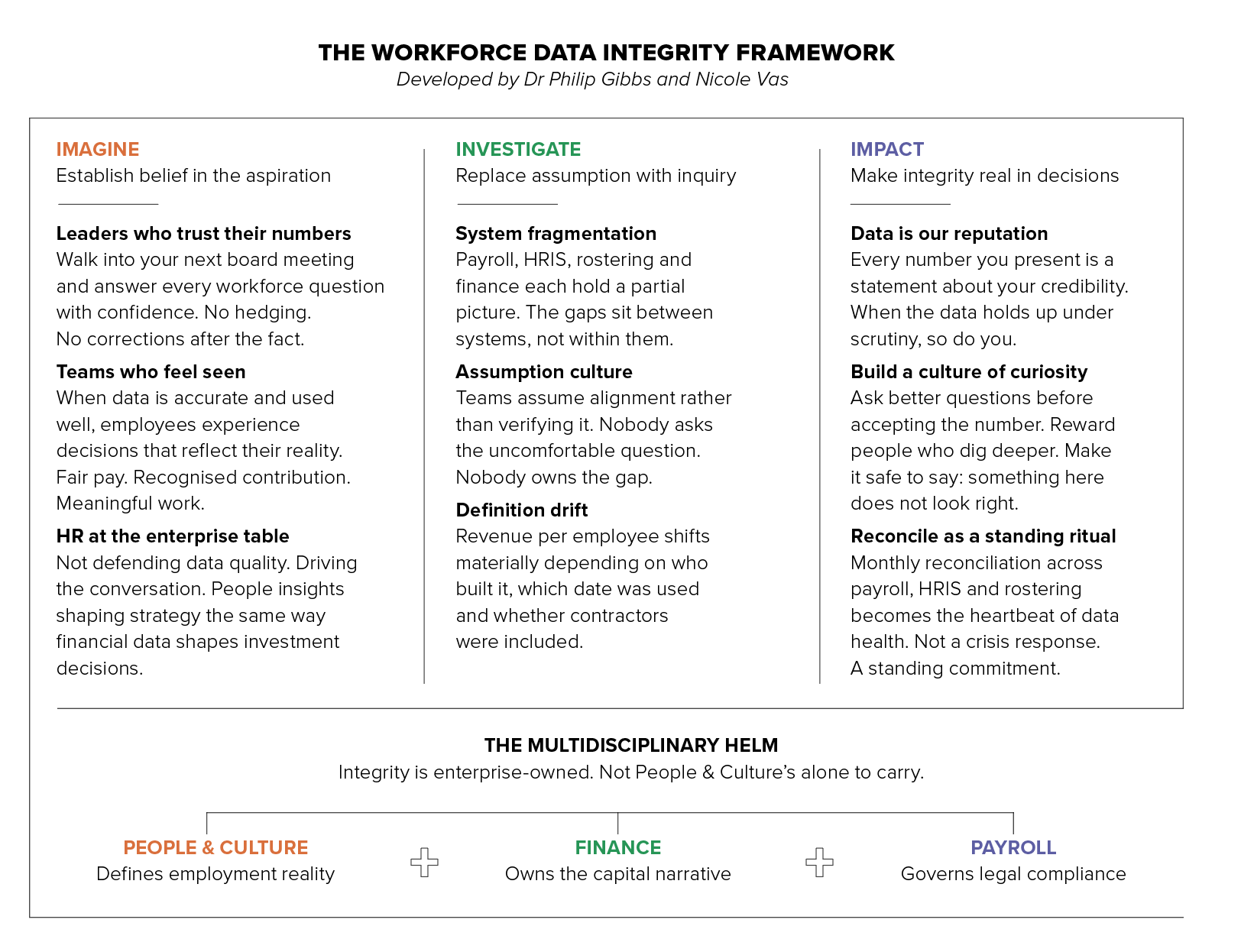
Underpinning all three is the multidisciplinary helm: People and Culture, Finance and Payroll, each with a defined role, jointly accountable for the integrity of the numbers.
Integrity should be enterprise-owned, not HR’s alone to carry. This is a capability question as much as a structural one – the intersection of HR, finance and systems governance requires people who can hold definitions, reconciliation and data ownership jointly, not functionally.
The question that defines your position
Revenue per employee is an indicator. It’s not a strategy. AI-native organisations achieve productivity because automation, system discipline and platform leverage are embedded deeply in the operating model.
Workforce size is a consequence, not the primary driver. Your task is to help boards interpret productivity metrics accurately. Be the person in the room who can say, ‘Here’s our number, here is how we define it, here is how it reconciles and here is what it does and doesn’t tell us.’
Experienced boards know the difference between a figure and an assured figure. When workforce metrics shift materially between executive meetings without clear explanation, trust erodes. When a CPO clearly states the metric, its definition, reconciliation and limitations, authority strengthens, even when the message is uncomfortable.
A good test to see where your organisation is at in terms of its data integrity and maturity is to ask yourself the following question: If your revenue per employee or your underpayment exposure were challenged publicly tomorrow, could you defend it with confidence?
If the answer is uncertain, the vulnerability is not technical. It’s structural. In an environment where workforce data has become enterprise evidence, that’s a risk the board cannot afford to carry – and neither can you.
🧰 HR’s career resource toolkit
- Learning: People analytics course (foundations level) – this introductory course demystifies data-driven decision-making in HR, catering especially to those who may feel they are “not data people.”
- Learning: People analytics course (advanced level) – elevate your workforce data management and analytical skills in a business context. This course offers a hands-on approach to leveraging and analysing HR, financial and business data.
A longer version of this article first appeared in the Apri, May, June edition of AHRI’s member magazine, The HR Agenda. Become a member today to get access to this quarterly publication.
Dr Philip Gibbs MAHRI is a digital, data, analytics and workforce transformation leader. He is the Co-Founder of Agile HR Analytics, a chartered psychologist and has spent over two decades at the intersection of data, technology and human behaviour, transforming complex challenges into innovative solutions.