At AHRI’s National Convention and Exhibition, HRM heard directly from HR practitioners about where they hope to see the national productivity conversation go from here.
Last week’s three-day Economic Reform Roundtable in Canberra, which brought together business, unions, industry and government to debate Australia’s economic future, coincided with nearly 2000 HR practitioners and business leaders gathering in Sydney for the Australian HR Institute’s 2025 National Convention and Exhibition.
While the roundtable participants debated the mix of policy levers to address Australia’s persistently stagnant productivity, similar themes dominated discussions among leading HR practitioners at AHRI’s National Convention, with delegates clear that the national productivity challenge cannot be solved without HR playing an active role.
As HSBC Chief Economist Paul Bloxham put it during his presentation: “We can continue to hope the world gifts us higher commodity prices on an ongoing basis, or we can do the hard work of lifting productivity – through competition, smarter regulation, tax reform, technology adoption and flexible workforce strategies. The first path is exhausted. The second is our only viable future.”
That urgency resonated deeply with convention attendees.
“HR practitioners are not sitting at the fringe of these conversations,” says AHRI’s CEO, Sarah McCann-Bartlett.
“It was clear from the discussions happening both on and off stage at our convention that HR leaders are essential in creating productive workplaces that will support growth in organisational productivity.”
As HRM reported last week, many of the levers Australia has at its disposal to increase national productivity levels lie directly within HR’s influence – from lifting management and leadership capability to the strategic adoption of AI and technology that enables people to work smarter, not harder.
“Lifting productivity is no longer just a macroeconomic issue. It is an organisational imperative,” says McCann-Bartlett. “The challenge now is to connect the policy ambitions debated in Canberra with the practical workforce strategies already being implemented in Australian organisations.”
Before exploring HR practitioners’ perspectives on where they see the productivity conversation leading, it’s useful to first understand the key themes from the roundtable most relevant to HR and the broader business community.
Recap on the roundtable’s key points
James Hancock FCPHR, Co-founder and Managing Director of Wickvale, is hopeful after some of the conversations coming out of both the economic roundtable and AHRI’s National Convention.
“I feel hopeful that we’ve shifted the conversation, or at least it’s starting to become more balanced. We are now talking about the two sides of productivity: personal productivity and wellbeing, and economic productivity.”
He says one of the main challenges HR practitioners face is inconsistency in the way some businesses think and talk about productivity.
“Ways of working and work patterns are often framed [from the perspective of] personal productivity and balancing work and life, which is very important… and we all know there’s a clear link with wellbeing and cost reduction.
“However, we need to push harder into the economic meaning of productivity, which is producing more or having higher outputs for the same or lesser inputs. We need to reframe the conversation. This requires thoughtful organisational development, experimentation, innovation and measurement.
“Trying new things to improve practices, processes, systems and technologies – to create efficiencies – and then re-using those efficiency gains for additional value creation is key. That can lift us as true business partners if we get it right.”
The main themes from the roundtable were resilience, productivity, budget sustainability and tax reform.
Skills and AI regulation were also hotly contested topics of discussion. Participants agreed that upskilling and reskilling are non-negotiable if Australia is to adapt to structural change and technological disruption.
The roundtable debate centred less on whether to invest in skills, and more on how to fund and incentivise them. The ACTU floated the idea of a 1.5 per cent training levy on businesses with employees who are seeking to upskill (for businesses with a turnover of $500,00 or more), while business representatives – including Business Council of Australia CEO Bran Black – pushed back on this, favouring financial incentives for companies that take on more apprentices.
Speaking to The Guardian, Black stated: “From a business perspective, we just don’t see that taxing the business community is the right way to deliver the outcomes that Australia needs.”
Independent MP Allegra Spender noted that, despite the disagreement on mechanisms, there was broad consensus on the urgent need to prepare workers for a changing economy, including building capability in the use of AI.
However, AI also revealed some of the sharpest dividing lines. The ACTU advocated for mandatory consultation with employees before introducing AI tools, and sector unions such as the Finance Sector Union – called for a “just digital transition” (a term borrowed from the idea of a “just transition” in climate and energy policy) to protect white-collar roles from automation.
By contrast, employers cautioned that over-regulation of AI could blunt innovation and limit the productivity gains this technology might deliver.
“We are at the starting blocks of a great opportunity to lift productivity, but only if we get it right at the economic, organisational and employee levels.” – Sarah McCann-Bartlett, CEO, Australian HR Institute
A compromise emerged: review current frameworks, strengthen protections where necessary and explore fair-compensation models for creators in collaboration between unions and the Tech Council of Australia.
These discussions highlight the twin HR imperatives emerging from the roundtable.
- Skills investment is fundamental to an uplift in productivity. The question is what policy settings will best support the necessary upskilling of Australian employees.
- AI adoption is inevitable, with the pace and effectiveness of its uptake in Australia to be shaped by the right balance of regulation, support for business, and reskilling and upskilling of the Australian workforce.
“While regulation is incredibly important to realising the productivity benefits of using AI in a responsible way, we shouldn’t forget that a key driver of the successful adoption of AI is the simultaneous adoption of HR practices, such as investment in effective training, information sharing, employee consultation and employee empowerment, aligned to each organisation’s business strategy” says McCann-Bartlett.
“As AHRI research recently showed, just 48 per cent of employers are considered high-performing organisations – meaning they have successfully adopted several HR practices simultaneously to achieve optimal performance.
“The Productivity Commission is planning to set up a publicly-funded advisory service model that includes advice on management practices. This is a great starting point for discussion by policymakers given the quick-win productivity potential this offers organisations and the Australian economy.”
Other topics discussed over the three-day roundtable included:
- Productivity, regulation and approvals
Discussion: Australia’s sluggish productivity growth is occurring in part due to lengthy regulatory and planning approvals, and underinvestment in technology and innovations. For employers, this translates into reduced organisational competitiveness, slower project delivery and workforce inefficiencies.
Where they landed: Participants strongly supported streamlining regulation and approvals. Clearing the backlog of housing and infrastructure projects – particularly those caught up in environmental approvals under the EPBC Act – was identified as a priority.
The consensus was to reduce unnecessary red and green tape while maintaining quality and environmental safeguards, with the aim of unlocking productivity gains across sectors.
- Economic resilience and living standards
Discussion: A central theme of the roundtable was how to design reforms that not only boost national productivity but also translate into stronger wage growth, employment and living standards.
For HR leaders, the challenge is less about stability in the abstract and more about retention and reskilling – ensuring organisations have the right capabilities in place to support productivity uplift, which in term supports wages growth. At the same time, wellbeing needs to be treated not only as a moral imperative, but as a practical driver of performance and productivity.
Where they landed: While participants did not land on specific targets (such as target unemployment levels or wage growth), there was agreement that reforms should aim to lift long-term living standards.
At an upcoming AHRI webinar, hear how recent legislative reforms are influencing workplace productivity from experts including Professor Alex Robson, the Deputy Chair of the Productivity Commission.
Understanding the ‘productivity paradox’
With AI, automation and endless apps at our fingertips, employees have the tools to work at greater speed than ever before.
“We are at the starting blocks of a great opportunity to lift productivity, but only if we get it right at the economic, organisational and employee levels,” says McCann-Bartlett.
However, across many organisations, output is flatlining, workloads feel heavier and exhaustion is rising.
“The technology is there and it’s ready to go right now, but our people aren’t,” said AHRI Convention delegate Madeline Maurici CPHR, who is the People and Culture Business Partner at Morrows.
“As HR practitioners and business leaders, we need to focus on supporting change, upskilling our people [in AI], and getting their mindsets and our cultures ready for technology.
“It’s an exciting shift. We’re going to see a change in our roles and the work that we’re doing, and we’re going to see a lot more valuable, relationship-driven work, but we’ve got to get prepared for it.
“Workforces can be stuck in the idea of being busy all the time. I think we’ve got to break away from that and be open to new technologies and new ways of doing things.”
This gap between the technology that’s available to us and the decrease in organisational output is what Justin Angsuwat, Chief People Officer at Culture Amp, described as the “productivity paradox” in his session.
With CEOs ranking growth as their number-one priority, HR teams are under increasing pressure to address this paradox – but many are struggling to keep pace. With obstacles such as AI disruption, cost-cutting and burnout being thrown their way, he says practitioners often feel like they’re constantly in “firefighting mode”.
Drawing on the experience of real fire crews who avoided panic during the 2021 Oregon wildfires, Angsuwat noted that survival in those moments of crisis wasn’t about individual heroics. Firefighters relied on four non-negotiables – lookouts, communication, escape routes and safety zones.
“They fell back on their systems, they fell back on their training and they fell back on their team,” he says.
The same principle applies at work, he says.
“Success – or even survival – in this moment is less about grinding, less about trying to squeeze that little bit more out, less about introducing a new app or a new dashboard – it’s about rethinking what performance looks like in this model.”
Instead of chasing more output, he suggests organisations seek to understand what actually drives performance in a disrupted environment.
Culture Amp’s research highlights three simple but powerful predictors of individual performance in the current climate: setting and aligning clear goals, making time for meaningful one-on-ones and protecting moments of connection.
“If we look at the five per cent difference we can make in our organisations, I think we can ask: what are the skills we currently have, what are the skills we’re not using and what are the skills we want to develop?” – Desleigh White FCPHR, HR Consultant, People Matter Coaching and HR
“When workloads come under pressure, the first thing to go are those conversations between managers and employees,” he says. “But our data shows that quality one-on-ones make people 30 per cent more likely to be high performers. It sounds simple, but it’s incredibly powerful.”
At the organisational level, Angsuwat pointed to two cultural levers that distinguish today’s fastest-growing companies: accountability and recognition.
“Our data shows that when accountability is strong, people see fairness. When recognition is strong, people feel valued. That’s what these companies do differently – and as a result, they have greater confidence in their leaders,” he says.
Another delegate, Desleigh White FCPHR, HR Consultant at People Matter Coaching and HR, acknowledges that addressing national productivity levels can feel outside of HR’s direct influence.
“But if we think about what our own organisation’s contribution is, that feels more achievable.”
Drawing on a message from keynote speaker Whitney Johnson – who urged organisations and individuals to strive for just five per cent better – White encourages businesses to apply the same principle to productivity.
“If we look at the five per cent difference we can make in our organisations, I think we can ask: what are the skills we currently have, what are the skills we’re not using and what are the skills we want to develop?”
Uncovering latent or hidden skillsets within the workforce could unlock meaningful productivity gains – a point reinforced by Harvard research showing that millions of so-called “hidden workers” already possess in-demand capabilities that employers often overlook.
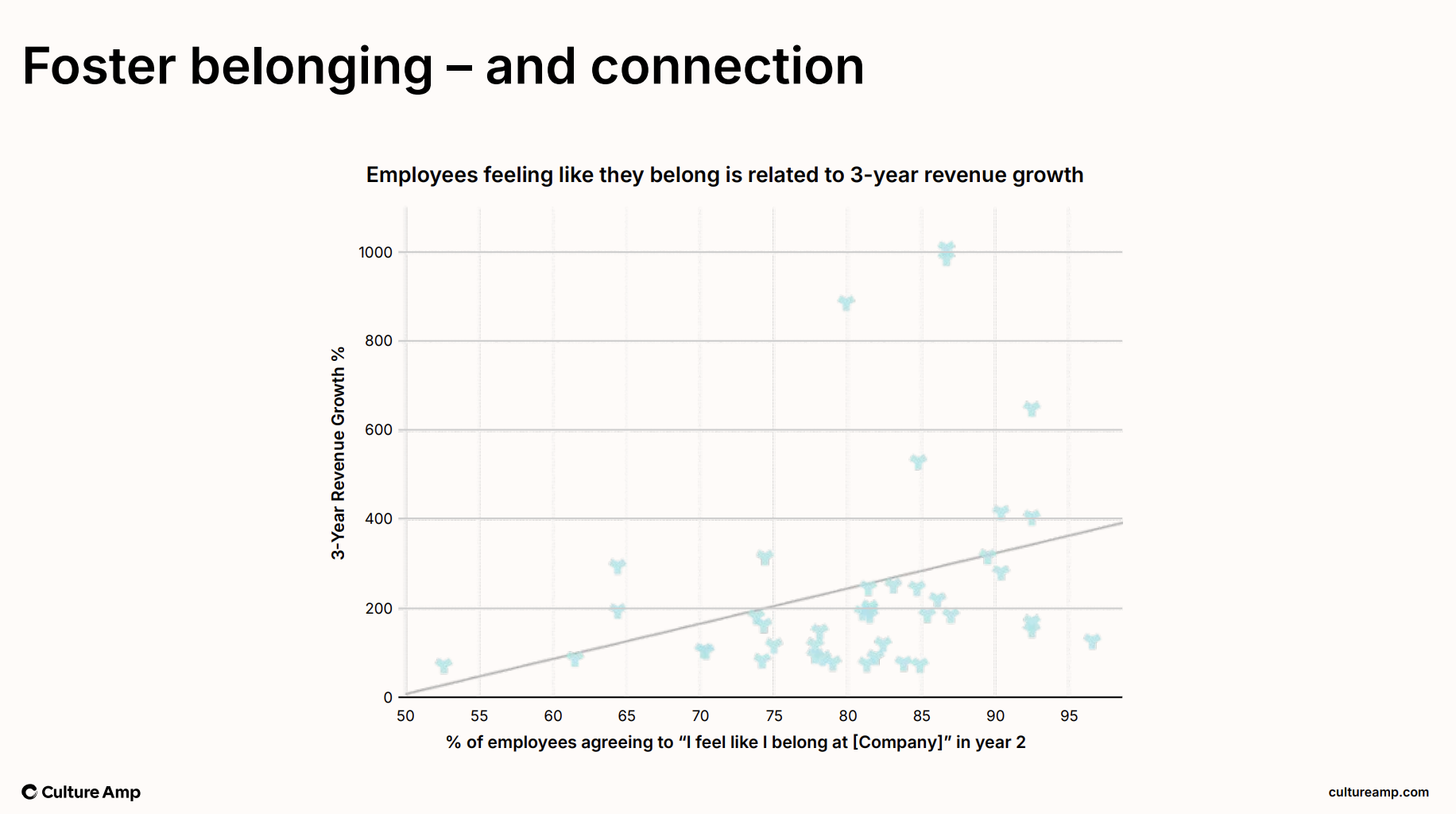
White also believes productivity gains can come from strengthening connection and belonging at work.
“I’m really passionate about the emotional culture of an organisation. We need to look at where people feel a sense of belonging and where they don’t. Then we can create rituals, habits and activities that build connection and capture the productivity gains that flow from that.”
She pointed to insights shared by Angsuwat in his session, which illustrated the measurable link between connection, belonging and organisational outcomes (see graphic below). As White notes, “there’s a very clear correlation.”
Stronger leaders
Motofumi Kotsuka FCPHR, Director of People, Culture and Administration at the Boddy Goldsmith Foundation, believes a key lever lies in stronger leadership practices.
“The world is changing rapidly and HR is at the forefront of this change. Effective leadership is key for the growth and sustainability of the organisation. I believe in human leadership – a style that prioritises wellbeing and individual development.
“Essentially, effective leadership, together with an aligned organisation, can definitely enhance national productivity levels.”
Building on this theme of leadership, Andrew Marshall CPHR, Vice President of Membership for AHRI’s ACT State Council, says many workplaces need to confront a lingering barrier – managers who are reluctant to tackle performance challenges.
“One of the things we’ve struggled with since COVID is manager paralysis – that is, not knowing how to deal with workplace and performance issues. We need to embolden and empower managers to have those frank and fearless conversations.
“Then we need to set and manage expectations around that and, hopefully, that increases levels of productivity.”
Taken together, the message from HR leaders is clear: productivity gains will not come from policy debate alone, but from day-to-day improvements in leadership, AI capabilities and full utilisation of organisational skills.
The risk of doing nothing is clear, says Bloxham.
“At the moment, our living standards are falling. On a per capita basis, our economy is going backwards. Yes, we’re growing by adding more people, but on a per capita basis our incomes are declining. This is the primary challenge we face.
“If we don’t lift productivity over time, our living standards will not increase in the future in the same way they have in the past.”