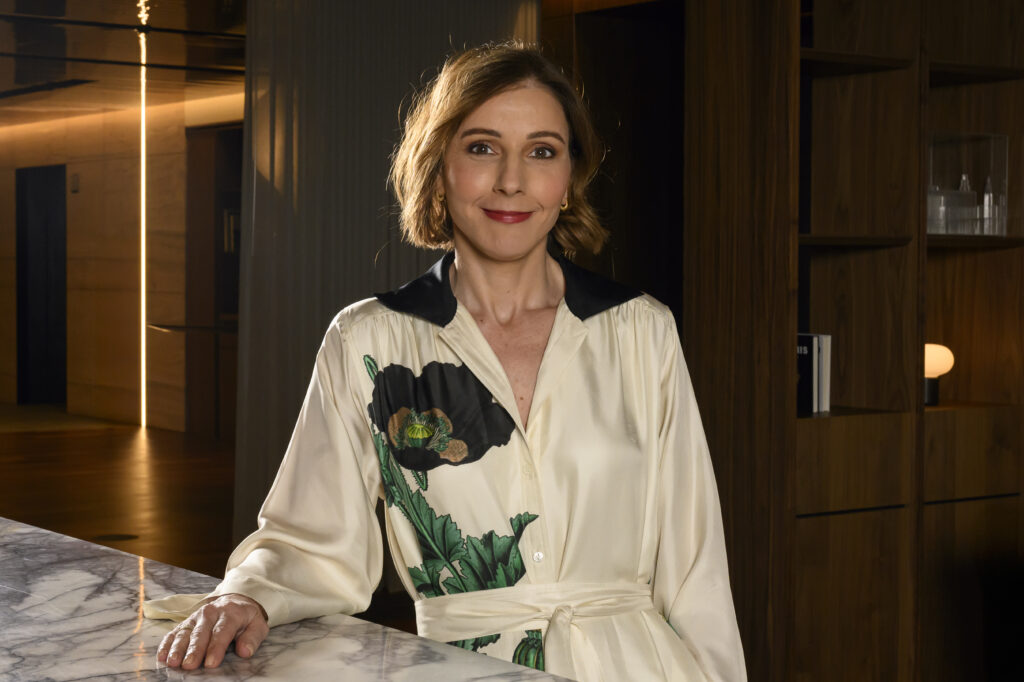
BHP’s Chief People Officer, Jad Vodopija, says today’s HR leaders must develop a vantage point that lets them see the business from above, understand it from within and anticipate what’s coming around the corner.
I never set out to be a Chief People Officer. For a long time, I didn’t even know what HR was. What I did know – from my earliest university days as a politics and economic history student – was that the world of work fascinated me. Not just “work” as a function inside companies, but work as a social, political and economic force.
The tension points between employees, unions and companies drew me in. I was raised in a working-class family, and I’ve always been hyper-aware of how access to decent work can open up whole new worlds for people.
My early career in industrial relations (IR) was my starting point, and from there, one opportunity after another nudged me into HR – a career I now love.

My early roles were in sectors where IR really mattered. Namely, auto manufacturing in the years following the Prices and Incomes Accord [a landmark agreement put in place in 1983 between the Hawke Labor government and Australian Council of Trade Unions to stabilise the economy and lift productivity during a period of high inflation].
There, I learned the important craft of negotiation, the role third parties play in driving productivity and how economic and political settings shape decisions at an individual, company and national level.
Those foundations helped me understand work from both the bottom-up – standing alongside workers on the manufacturing floor – and the top-down, as I later moved into broader roles. That ability to hold both perspectives has been critical for me as a CPO.
I’ve spent much of my career in industries where people work with their hands, whether manufacturing, resources or operations. That wasn’t a grand plan, but I realised I had an affinity with this type of work.
I am a first-generation Australian, and my parents worked extraordinarily hard so I could have opportunities they didn’t. I’ve always had deep respect for the kind of hard, physical work that underpins these sectors.
Some of my earliest HR roles were literally on the frontline. My desk sat beside the stamping plant, and it vibrated every time the press went down. Even now at BHP, being on site – underground or on the surface – reminds me of the dignity of the work.
That connection matters to me, and it has shaped the organisations I have chosen to be part of.
Based on these experiences, here are six lessons that have shaped my approach to leadership and building future-ready organisations.
1. Learning to see the whole system
For emerging leaders who want to think more strategically, my advice is to expand your view.
Understanding HR in isolation is never enough. You need to understand your sector, your competitors, the political and economic levers shaping decisions, and the technology that’s redefining work itself.
It takes time, and you only learn it through experience – immersing yourself in different parts of the business, and hoovering up knowledge from areas you know nothing about.
Yes, you can be deep and narrow in your expertise, and that’s valuable. But if you want to operate broadly, you must invest in building context and connecting the dots across the whole system.
Read HRM’s article on how systems thinking can help HR spot risks before they escalate.
2. Thinking across multiple time horizons
What I’ve learned from BHP is the importance of thinking in multiple time horizons. We operate assets with lifecycles that traverse multiple decades. When we make a capital investment, we’re effectively placing multi-billion-dollar bets on what we believe the future will look like decades from now.
That forces you to build a capability for long-term conviction; our job in HR is to look around corners to understand how the world is shifting and make decisions that might not pay off for many years.
At the same time, we can’t afford to be slow or rigid. Despite our long-dated planning, this organisation never stands still. Across my 20 years with BHP, with a brief break in the middle, the company has changed profoundly.
We’ve merged, divested, moved into and out of jurisdictions, sharpened our purpose and shifted our commodities mix more than once. We’ve modernised our technology, transformed the way we partner with Traditional Owners and made bold commitments on issues like gender diversity in mining.
That’s what makes BHP such an interesting place to grow up professionally. The foundations are rock solid – our values, our sense of purpose, our role in society – but the organisation always has its eye on what comes next. You’re expected to think long-term while also being responsive to the world around you.
What I’ve learned is that you need both a core you never compromise on and a willingness to evolve everything else. Effective leaders hold those tensions lightly. You build for the next 40 years, but you stay nimble enough to pivot when the world shifts. As HR leaders, we need to make sure there is fertile ground for future growth.
That ability to blend long-term discipline with short-term agility has been an important lesson for me.
“Understanding HR in isolation is never enough. You need to understand your sector, your competitors, the political and economic levers shaping decisions, and the technology that’s redefining work itself.”
3. The value of stepping away and coming back
In 2016, I temporarily stepped away from a 15-year career with BHP when I was working as the Vice President of HR. At the time, I didn’t know I’d be coming back. It was a formative experience.
When you grow up professionally in one organisation, you build intuition – you know how decisions get made, what the no-go zones are, where the influence points lie.
I wasn’t sure if I’d be any good at HR outside of BHP.
Stepping away was one of the best things I’ve ever done. I tested myself in a new environment, gained confidence in my capability beyond the familiar, and brought back a clearer perspective on BHP’s strengths and opportunities. Sometimes you need distance to see things clearly.
It also reminded me that good leaders never assume all the answers are within their own four walls. Coming back, I’ve been deliberate about staying outward-looking and learning from other organisations, other leaders, other sectors. It’s healthy, and it stops you becoming insulated or complacent.
4. Preparing for what comes next
We are going to experience more change in the next decade than we have in the past century. Technology, geopolitics, societal expectations – the tectonic plates are shifting constantly.
My job is to ensure the enterprise is ready for whatever comes next, regardless of what form that change takes. We focus heavily on work design, capability building, leadership, and, importantly, our values.
A few years ago, we refreshed our values to ensure they reflected what the next decade would require. Within that, there are attributes that we want to inspire in our workforce, including an openness to the world around them, the ability to both inspire and respectfully challenge others and our core safety and integrity values.
We are intentionally working on both the behaviours and the systems of work that enable us to bring that to life across the entire company.
One of our biggest enterprise-wide investments is the BHP Operating System, which is a continuous improvement approach that empowers decisions at the frontline.
When 90,000 employees and contractors can understand their work deeply, solve problems locally and adapt quickly, the organisation becomes more agile and more resilient to change. That’s essential for the future we’re walking into.
“Our job in HR is to look around corners to understand how the world is shifting and make decisions that might not pay off for many years.”
5. The ingredients for influential leadership
I’ve been fortunate to work with phenomenal leaders over my career.
It’s never been about one standout person for me. It’s the patterns, the traits, the hallmarks of great leadership that have stayed with me.
The leaders I admired most all had this combination of integrity and authenticity; you always knew exactly who you were dealing with. They were deeply prepared and fully invested in the work. They would come into a room ready, curious and across the detail.
What they also shared was an insatiable appetite for learning. These were people who were world-class at what they did, and yet they were always asking questions about what other companies were doing, what new ideas were emerging, what they could read or explore next. That breadth of thinking and hunger to keep improving made a huge impression on me.
And then there was their boldness. The leaders who shaped me most weren’t afraid to put a stake in the ground, even when no one else would. Sometimes they’d make calls that seemed impossible at first, but they backed themselves and they followed through. That courage, and the responsibility that comes with it, has been a powerful example.
Early in my career, I thought I had to model myself on people I admired; almost copy-and-paste their style. But over time I learned that authenticity matters more than anything. Your leadership only works if it’s grounded in who you genuinely are.
What I’ve carried with me are the ingredients of strong leadership: integrity, preparation, curiosity, courage. Those traits have become the compass points for how I try to lead today, in a way that’s true to me.
6. The importance of saying ‘yes’ to opportunity (even when you’re not sure you want to)
One of the most important principles I’ve learned is to say ‘yes’ to opportunities, especially when you’re not sure you’re ready. My transition from IR to HR is a perfect example of this. I didn’t know what I was walking into, but I said yes because I realised I’d learn something either way.
Not every role I’ve taken has been thrilling, but every one of them taught me something important.
Over time, I’ve developed the confidence to back myself, even when the path is unclear. It’s why I tell emerging leaders: your career won’t always move in a straight line. Sometimes you need to take the left turn when you desperately want to go right. That’s how you grow.
A longer version of this article first appeared in the Feb/March 2026 edition of HRM Magazine.
Sharpen your strategic apporach to HR leadership by exploring Certification. Take the next step in your career and showcase your capability with a nationally recognised mark of excellence. Pursue your CPHR.
Images by Mark Avellino.