Adoption rates tell you people are using AI. They tell you nothing about whether your workforce can create value with it – and that gap is about to decide which organisations thrive, writes Dr Sean Gallagher.
Seventy per cent of Australian knowledge workers now use AI at least weekly, according to our latest research. Only one in ten workers don’t use AI at work. By the metric most organisations track, we are winning the race.
We are not. Adoption tells you people are using AI. It cannot tell you whether they can create value with it – and only one in eight Australian workers can. That should reframe how HR thinks about AI: not as a technology rollout, but as a talent strategy.
The trouble is that adoption counts only frequency – how often someone opens a tool. Real capability needs depth: the time spent, the difficulty of the thinking. Mistake the first for the second, and you will badly misread your workforce.
Four ways your people are using AI
To see what adoption hides, stop thinking of AI as a tool and start treating it as a relationship with a digital colleague. Do that, and your workforce sorts into four types you will begin to recognise.
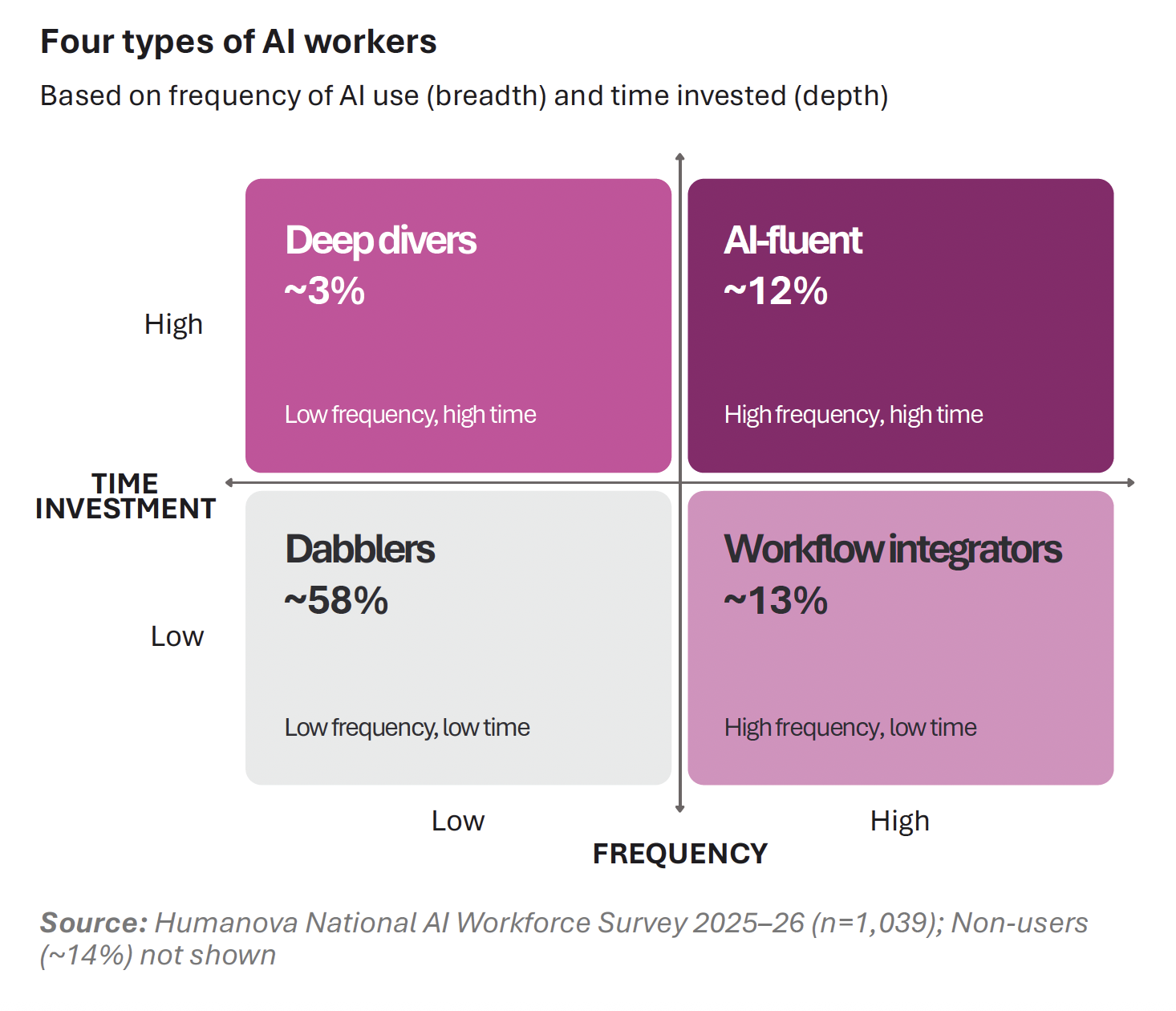
Four types of AI workers, by frequency of use and time invested. Source: Humanova National AI Workforce Survey 2025–26 (n=1,039).
The largest group by far — 58 per cent — are the dabblers, those ‘casually dating’ AI: occasional contact, no rhythm. They have tried the tool but rarely get past summarising an email. They are not resistant or lazy; they simply have not had the sustained, demanding contact that turns acquaintance into capability. This is the group the headline adoption number hides — counted as users, stalled as talent.
About one in eight are speed daters — what our research calls ‘workflow integrators’. They use AI constantly, but every encounter is brief: a quick draft, a fast summary, a fact check, on repeat. Frequency without depth. They are also the group most at risk of burnout, using AI as a treadmill rather than a partner.
A small group — around three per cent — are deep divers, in a long-distance relationship with AI. When they sit down with it they go deep, but rarely, so it never threads into daily work and never compounds. This is not a stage on the way to fluency, as it is described. It is a distinct way of working, with a ceiling.
And then there’s the AI-fluent — roughly one in eight — in a committed relationship with AI. They use it many times a day, on the hardest parts of their work, from analysis to cross-functional decisions. They are not just working faster; they are doing work that was previously out of reach. These are the people who will help your organisation evolve with AI — and today they are rare.
This is why adoption data fails you. A speed dater and an AI-fluent worker look identical on the dashboard — both use AI daily, so both count as “daily users”. Same frequency, completely different depth. And depth is where the value sits: the AI-fluent are far more likely to use AI for real decisions — 82 per cent of them, against 26 per cent of dabblers.
The difference is intuition
What separates the AI-fluent is something I call AI intuition: the judgement to know when to trust AI, what to hand it and how to direct it. It shows up as the habits you would use to describe any colleague you know well — their strengths and blind spots, what to delegate and what to keep, how to brief them properly with context, goal and constraints.
The foundation skills most AI training teaches – framing a task, writing a prompt, checking the output – can be taught in an afternoon. Intuition cannot. It builds the way trust with a colleague builds: through real work, over time. The right AI training accelerates it but cannot shortcut it. Our data shows 92 per cent of advanced intuition is driven by depth of engagement, not frequency of use. Speed dating never gets you there.
That shift is teachable, and it is what people remember. As one HR professional in a government agency we worked with put it: “Seeing AI as your digital colleague, and how to collaborate with it, is the most valuable thing I’ve learned about working with AI.”
“Adoption tells you people are using AI. It cannot tell you whether they can create value with it – and only one in eight Australian workers can.”
The structure trap
So why don’t more people move into a committed relationship with AI? The instinct is more training — and the right training matters; it is how intuition starts to build. But training alone won’t move people because something structural is in the way: the design of work itself.
One in four senior leaders are AI-fluent. Among office workers, it’s one in twenty. That’s not a gap in talent or appetite. Senior roles are discretionary — unstructured enough to leave room to experiment. Most roles are not. They are full of friction: redacting sensitive information, re-entering context, manually pasting information from systems that don’t talk to each other before AI can even start. For those workers, using AI costs more than it returns. They are stuck doing the most basic work with AI because their job design keeps them there. Senior leaders, who feel almost none of that friction, cannot see it.
Hear more from Dr Sean Gallagher at AHRI’S National Convention and Exhibition in Brisbane, where he will be unpacking this research in more depth.
What getting it right looks like
It can be done. ELMO Software, an HR technology company, treated AI as a culture change, not a technology rollout. Working with Humanova, it built capability through intuition-focused training set around real work, leadership alignment and group learning across its ANZ and Philippines teams.
Because the training built judgement rather than tool-specific tricks, capability held when ELMO later switched tools entirely. AI use is now universal, sales preparation that took ten hours takes fifteen minutes, and the conversation has shifted from risk to innovation.
“ELMO treated AI as a culture change. Not a tech rollout. Not a side project,” said its chief people officer, Anne Tosky.
None of this can wait, because AI agents — systems that plan and carry out multi-step work on their own — are arriving now. Picture your organisation’s work as a pyramid: routine tasks at the base, strategic judgement at the top. Agents will take the base. That sounds like relief, and partly it is. But the base is also the on-ramp — the routine work where people quietly build skill on the way to harder things. Remove it before you have built capability, and you are left with people who cannot direct, supervise or own what the technology produces.
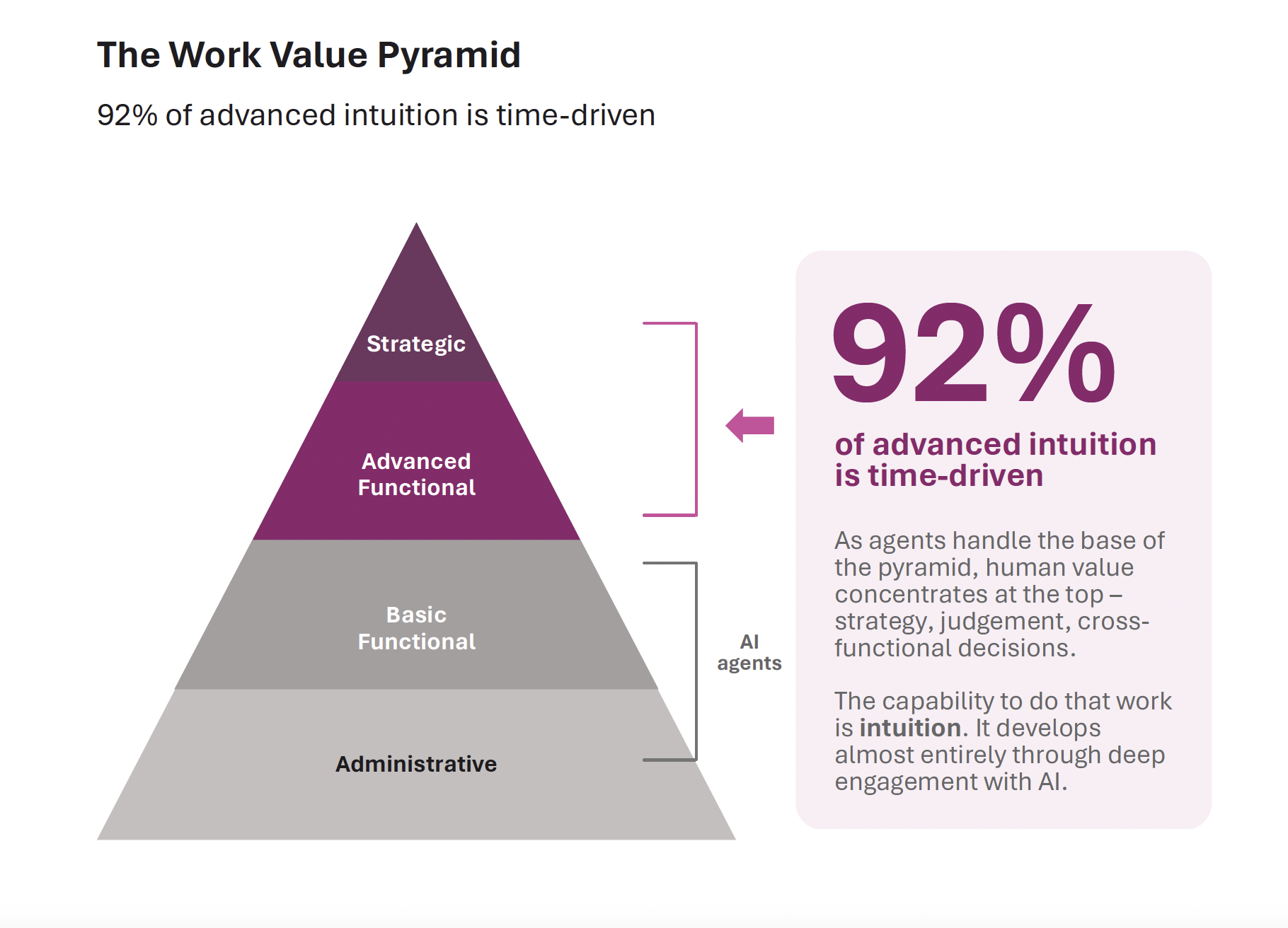
As agents absorb the routine work, human value concentrates at the top. Source: Humanova National AI Workforce Survey 2025–26.
Agents will make your business faster and cheaper. They will not make it smarter. Only your people can do that.
And the shift can happen overnight. In March 2026 Atlassian cut 1,600 roles — ten per cent of its workforce — only months after its chief executive predicted record engineering hiring. WiseTech Global moved its developers from writing code to overseeing it. Restructure before you build capability and you simply get fewer people doing harder work without the intuition to do it well. The lesson is not “don’t change”. It is “don’t be caught unprepared”.
Three questions only HR can answer
All of this makes this HR’s moment, not HR’s problem. If AI is a talent strategy — and the evidence says plainly that it is — then the function that owns talent owns the AI era. Leading it is not a training program; it is a strategic agenda built on three questions.
- Who is genuinely in a committed relationship with AI, and who is only dating? Login rates won’t tell you — you have to measure depth, not frequency. A real capability map lets you stop spending a flat budget on one-size-fits-all courses and invest where each group actually is: confidence for dabblers, depth for speed daters, frequency for deep divers.
- What in the design of our jobs is keeping people from going deeper? You cannot train someone out of a structural trap. This is HR’s mandate over job and process design — finding the friction that makes AI cost more than it returns, and working with the business to remove it.
- When agents take the routine work, how and where will our people build judgement instead? If the on-ramp begins to disappear, HR has to build a deliberate one — designing the stretch work, oversight roles and exposure with the complex work required to build AI intuition.
The organisations that thrive will not be the ones with the highest adoption, or the ones that cut fastest. They will be the ones whose people can figure out what comes next — who can direct the machine rather than be displaced by it. That is a talent strategy. HR is the only function with the mandate to lead it.
Dr Sean Gallagher will unpack this research in more depth at AHRI’s National Convention and Exhibition in August. Dr Gallagher is AHRI’s AI for HR expert and the founder of Humanova, an AI workforce consulting firm that helps organisations build their AI capability. He is the author of the Humanova National Workforce Report 2026, a longitudinal study of AI workforce capability.