While traditionally used to manage physical risks, task observation can provide a more reliable means of assessing and managing psychosocial risk, especially around job demands.
Organisations operating in Australia are aware, now more than ever, of the need to manage psychosocial risk in the workplace.
Of the 16,800 serious mental stress claims made in 2025, 24.2 per cent were related to work pressure, according to Safe Work Australia. The median compensation paid for a mental stress claim was $69,900. This is the highest of all the listed claim mechanisms.
In an attempt to gauge the level of work intensity in their workplace, many organisations are turning to employee surveys. However, surveys are often not a reliable indicator of the reality of psychosocial risk, says Karlie Cremin, CEO of DLPA.
“Surveys are governed by mood. If you send a survey and someone does it when they’re hungry, you’ve got a contaminated data source,” she says.
Instead, she encourages organisations to consider applying a practice known as task observation as a psychosocial risk management tool.
“If you knew your employees were working on a roof, would you ask them how they felt about working on that roof, and what they thought you should do [to stay safe], or would you observe the task and the ways of working, and come up with a control that was going to demarcate the risk?”
Below, Cremin unpacks how HR can use task observation to manage the psychosocial risk that can arise from poorly managed work intensity.
When does work intensity become a psychosocial hazard?
Before we unpack how task observation can be applied to assessing work intensity, it can be helpful to understand when work intensity becomes a psychosocial hazard.
“When we talk about intensity, there are different elements of it – there’s the pace of work, but then there’s also the cognitive load of work. That’s where work design is really important,” says Cremin.
One common misconception is that job demands become a hazard only when they are too high.
However, if an employee is coming to work every day and feeling as if they’re not being given the opportunity to stretch themselves, to work hard or to mentally wrestle with engaging and stimulating work, that can be just as psychosocially draining as being loaded up with too much complex work.
“It’s like any spectrum. You shouldn’t be on the end. You want to be in the middle,” says Cremin.
“You might start to see absenteeism go up. You start to see – particularly with the low job demands – error rates go up, because there’s lack of engagement. Productivity overall goes down.” – Karlie Cremin, CEO of DLPA.
Today, automation is driving much of the compression of high and low intensity work, she says.
For example, she recalls an insurance company’s call centre, where routine queries, such as requests to change addresses, were automated. After this, almost every call taken by a human worker became a high intensity, often emotionally charged, call.
“They were having these eight-hour continuous shifts where they had to think on their feet, deal with people in a highly emotional state and navigate complex challenges. They saw a spike of both stress claims and burnout,” says Cremin.
This pattern emerges in many organisations where the “low-hanging fruit” is automated, removing the “reset gaps” between high-intensity tasks, she adds.
On the other end of the spectrum, when a job isn’t consistently demanding enough, it also poses a psychosocial risk.
“For example, with AP [accounts payable] processing, we’re seeing that while entry level accountants used to look at where transactions are coming from, that’s now been automated in some organisations and they’re ending up with quite a ‘lumpy’ workflow,” she says.
“For entry level employees, there are often periods of time where they’ve got no tasks in the shoot. For the tasks they are doing, they often don’t have a high level of interest in them because they’re collation tasks with little to no learning involved.”
HR practitioners often see the signs of poorly managed job demands in stress claims, but Cremin says there are other concerning issues that arise before formal claims are made, which are important to keep an eye out for.
“You might start to see absenteeism go up. You start to see – particularly with the low job demands – error rates go up, because there’s lack of engagement. Productivity overall goes down.
“With high intensity work or high job demands, a lot of people just burn out and never make the [stress] claim, and so they’re making poor-quality decisions.”
But, not all stress is harmful, says Cremin.
“A little bit of stress is good. A little bit of stress makes you more productive. It’s just an issue when it crests into harm… which is different per individual.”
Resource: Read AHRI’s article, ‘How to differentiate between stress, stretch and strain’.
It can be difficult for an organisation to determine where stress will crest into harm, and this is where task observation can be helpful.
“What employers need to do is complete that risk assessment on a probability basis of where, on average, stress is going to be cresting into harm. That’s where the bulk of your controls are going to be.
“If you train your managers, they will be able to recognise when the risk profile is increasing for employees, and that’s how you can recognise harm on an individual basis.”
How can HR use task observation to address psychosocial risk?
Many organisations already have a task observation process in place for physical work, even if it’s a relatively basic one.
“It’s been traditionally only done by safety practitioners. There’s a real need for safety to partner with HR… because you need the expertise of both disciplines for it to be effective,” says Cremin.
Task observation – a structured process where a supervisor or peer watches an employee perform a specific job task to identify safe risks/hazards, and ensure work matches safety procedures – can help HR understand the reality and exact details of a specific task, so that they can determine where the risk controls are going to be most effective.
To assess psychosocial risk using task observation, Cremin recommends HR and the person responsible for safety in your organisation work together and take the following steps:
- Establish a risk register with risk ratings based on the duration, frequency and severity of consequence.
- Identify the tasks which are most likely to cause stress.
- Observe a range of employees undertaking the tasks and repeat this a few times to determine a reasonable average.
- Determine the controls to address the risk to prevent it from cresting into harm.
Wherever possible, she recommends being in the same physical space with the employee to observe their tasks.
“You have a safety obligation to assess that space, and there may be elements of the space which contribute to risk.”
If observing them in their physical working space is not possible because the workforce is too spread out, or for other operational reasons, then it may be that remote observance is enough.
For example having a “screen share and camera on” task observation, provided the employee has full knowledge of how it will work and has consented to the observation.
“Task observation is really important because the official way of working is very rarely the actual way of working, and so you have to see how people have come up with their own workarounds,” says Cremin.
Let’s use customer interaction as an example of a high-risk task. In healthcare, these interactions might occur at reception in the intake process, during treatment and at the discharge stage.
While observing these interactions, HR might notice escalation of customer aggression. This might prompt questions such as: what preceded that? What happened after that? How has this impacted the employee? How often is this happening? Do we have any formal processes to manage this if it becomes an ongoing issue? Have we trained our people to know how to manage this situation in a safe and effective manner?
The answers to these questions can help establish the source of risk and then outline potential controls that could be put in place.
A control is any intervention that can lower risk and often these are drawn from the hierarchy of controls, says Cremin.
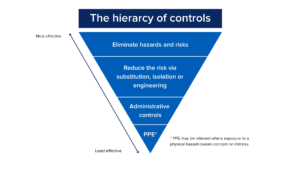
“The top is the most effective. The bottom is the least effective. All are important,” says Cremin.
A control might look like training employees on de-escalation techniques in the case of aggressive customer interactions.
Redesigning ways of working is another control which can be put in place, she says.
In the case of a health clinic, if they’ve identified that wait times are triggering patient aggression, a control might look like triaging more effectively to reduce long wait times.
“It doesn’t always have to consume more bandwidth either. We’ve seen a lot of GP clinics, for example, have brought in nurse practitioners to look after things that a doctor doesn’t need to see. That assists with reducing the risk of patients getting upset.”
This approach flows through to all types of businesses and ways of working, says Cremin. It’s about asking:
- What are the workflows which get us to a point of high risk?
- What can we do to manage that flow before it reaches high risk?
“For low job demand, for example, it might be a matter of asking where we can insert a little bit of interest. That could happen by adding in learning moments which don’t cost any money or take up any time,” says Cremin.
“Task observation is really important because the official way of working is very rarely the actual way of working.” – Karlie Cremin, CEO of DLPA.
Partnering to manage the load
Task observation shouldn’t fall on the shoulders of HR alone, says Cremin.
“That’s when we see it go really wrong, when some organisations go, ‘That’s a HR problem. HR can manage it’,” says Cremin.
“HR’s role in this is supporting people to change their ways of working, supporting other areas of the organisation to engage more effectively and ensuring the capability is there for them to do so.”
In terms of who they should partner with, Cremin recommends picking ambassadors from across the organisation to help champion the change.
“This could be someone in the SLT who controls operations. We’ve seen many organisations roll it out through a formal committee arrangement,” she says.
One of the biggest issues organisations are facing is around navigating the fear around legal exposure arising from psychosocial risk.
“The PR around psychosocial hazards has been really poor. I think people are frightened or completely disengaged, or sometimes both… but a lot of the work in remaining compliant can also build a competitive advantage for the organisation.
“When you’re doing it well, you’re more productive, you’re more profitable and you’re more sustainable and agile.”
🧰 HR’s career resource toolkit
- Reading: Use this guide to respond to workplace stress in the short, medium and long term.
- Reading: If you’re planning to conduct remote observation, read this article to understand 6 common questions around employee monitoring.
- Learning: Gain confidence in how to navigate the complex landscape of psychosocial wellbeing in the workplace with AHRI’s Psychosocial Code of Practice Course course.