Discover how HOYTS transformed its EVP from a list of employee perks into a meaningful, strategic contract – one that connects the daily experiences of employees with the expectations of customers and the priorities of business leaders.
We faced a unique collision of challenges at HOYTS coming off the back of the pandemic years. Our cinemas were reopening, but our talent pipelines had dried up. We had managers promoted during lockdowns who hadn’t had the chance to run a busy Saturday night. We weren’t just short on people – we were short on experience.
Rather than simply throwing the net wider in a bid to panic-hire the right talent, we took this as an opportunity to pause and consider two critical questions: why do people choose to work for HOYTS? And, importantly, what is it that makes them stay?
The answer wasn’t about pay or benefits. It was belonging, purpose and growth. And so began our journey to reposition the employee value proposition (EVP), not as a branding exercise, but as a critical business lever.
Why we refreshed our EVP
First, we shifted the narrative. Our EVP is no longer a list of things that we offer to employees. Instead, it’s a promise to our people about how they will feel working here – and what that enables them to deliver for our customers, who we refer to as guests. We redefined the EVP as an emotional experience, deeply tied to wellbeing, connection and purpose.
Our original EVP was structured around a lifecycle model – Beginning, Engagement, Support and Thanks (BEST). While useful at the time, it lacked emotional depth. It focused on what we gave people, not how we wanted them to feel when they came to work each day.

Jodi Paton
Coming out of the pandemic, wellbeing, growth and connection had become top priorities for employees, yet these weren’t central to our EVP at the time.
The old framework focused on process rather than experience. While we’d always offered training and support, we hadn’t elevated the emotional drivers that motivate our people to join, stay and grow with us. This gap became especially clear as we tried to engage a workforce that was largely casual, often in their first job, and deeply impacted by years of instability.
At the same time, we were repositioning our external customer brand by launching a new external identity: “See the big picture.”
This gave us a unique opportunity: to refresh our internal promise so it aligned with the business strategy, reflected our values and supported both customer and commercial outcomes. “See the big picture” became, internally, “We are big-picture people.” It was a simple, memorable line that helped unite the internal and external experience.
We wanted our EVP to do more than attract talent – we wanted it to create connection, consistency and pride across every level of the business.
Learn how to use data and human-centered design to create an effective EVP with AHRI’s short course.
Building the new EVP
We began by rethinking the purpose of the EVP entirely. Rather than a set of benefits or policies, we reframed it as an emotional contract.
To shape this contract, we ran focus groups and surveys across cinema teams and head office. We asked:
- Why do you work at HOYTS?
- What makes you proud to stay?
- How do you feel your role contributes to our guest experience?
The answers we received helped us distil the shared moments and values that made working at HOYTS meaningful.
It also helped highlight some key gaps. For instance, employees at the head office often felt far removed from the frontline. In one focus group, when asked what role they played for our guests, several team members said, “I don’t play a role because I don’t really interact with them.”
“Your EVP is not a comms campaign. It’s a business asset.”
That insight shifted our thinking. It wasn’t just about creating a new EVP language. It was about helping every employee, in every role, see how their work contributes to our guest experience.
For example, we showed our website developers that they weren’t just operating behind the scenes; they were the first touchpoint for many guests. That realisation shifted their mindset from back-end support to frontline experience.
Values as the foundation
When I first joined HOYTS, there wasn’t a formal EVP in place, and our values at the time lacked inspiration. One of them, memorably, was “Respect for the law” – important, of course, but hardly motivational. That highlighted just how much opportunity we had to create a values framework that people could connect with and live out day to day.
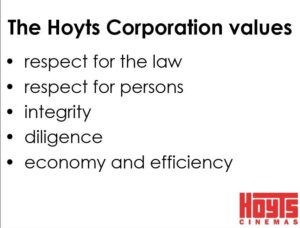
Old HOYTS corporate values that Paton refreshed
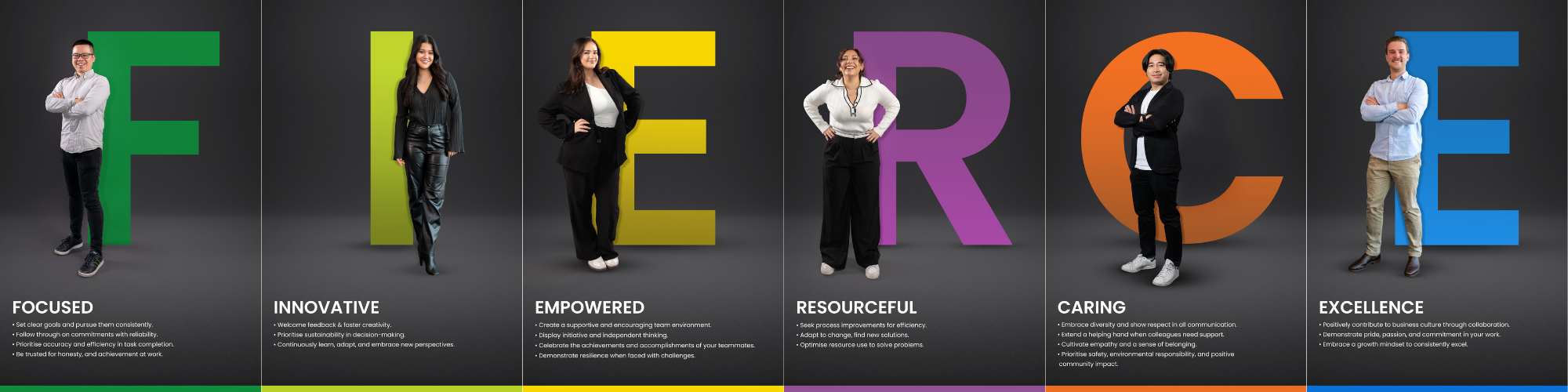
We already had an acronym – FIERCE (Focused, Innovative, Excellence, Resourceful, Caring, Empowered) – that had been embedded pre-COVID. Rather than scrap it, we refined the behaviours that sat beneath it.
We involved teams across the business in defining what each value looked like in practice, because we wanted to ensure every value was malleable to a different team’s needs.
For one team, “Innovative” might mean experimenting with new approaches to team rosters. For another, it might mean using guest feedback to improve a digital interface.
By making the values locally meaningful, we saw teams take greater ownership. We also introduced leadership behaviours aligned to these values, ensuring people leaders had a clear model to follow.
Next, we had to think about how to integrate this into our ways of working. We were clear from the outset that we didn’t want this to feel like another HR initiative. So we took a ‘quiet integration’ approach. We looked for opportunities to thread EVP language and behaviours into our existing processes and systems:
- Performance conversations: Values and EVP pillars are part of both feedback and formal reviews.
- Onboarding: New hires are introduced to our EVP and values from day one.
- Recognition: We linked values to our biannual awards – one round led by managers, one by peers.
- Training: People leaders participated in Lunch & Learn sessions about bringing the EVP pillars to life.
- Visual comms: Internal materials used real photos of HOYTS team members, helping people see themselves in the message.
Our operations leaders also played a critical role. By working with them to embed EVP language into site-level training and team rituals, we made it easier for leaders on the ground to bring it to life.
Because the EVP wasn’t owned solely by HR, we had more champions to carry the message across the business and more credibility in how it was delivered.
Results so far
The changes we made have reshaped our culture and delivered strong results. For example:
- Turnover is down, especially in the first 12 months, which is a critical window for frontline retention. Overall turnover has decreased by 16 per cent in the past 18 months and turnover in the first 12 months has decreased by 28 per cent over a 12-month period.
- Referral rates have increased as employees feel proud to recommend HOYTS.
- Customer NPS now consistently sits between 50 and 60, well above the retail/hospitality benchmark of 30-40.
- Revenue per FTE has lifted, suggesting a stronger link between engagement and performance.
- Engagement survey scores are improving, particularly in the areas of wellbeing, purpose and belonging.
One of our most encouraging data points is the link between early-stage connection and long-term tenure. If we can create a strong sense of purpose and belonging in the first 12 months, we’re much more likely to retain employees for three-to-five years.
“Our EVP is no longer a list of things we offer. It’s a promise to our people about how they will feel working here.”
What we’ve learned
This process wasn’t about launching something new. It was about evolving how we talk about the employee experience – and embedding it in how we work.
If I could share one insight, it’s this: your EVP is not a comms campaign. It’s a business asset.
Here are five principles that guided us:
- Start with how you want people to feel. EVP should be emotionally grounded.
- Listen to your people. They’ll tell you where the gaps are and what’s working (or not working).
- Make it practical. Integrate EVP language into systems and processes.
- Share ownership. Marketing, operations and people leaders must all play a role.
- Measure what matters. Link EVP outcomes to retention, NPS, performance and advocacy.
At HOYTS, our EVP has become more than a promise. It’s how we deliver our culture, build brand alignment and drive commercial outcomes. That’s when EVP shifts from HR strategy to business strategy.
Jodi Paton is the Chief People Officer at HOYTS.
Follow Jodi Paton along for part two of her case study in this HRM article, How to get stakeholder buy-in for a new employee value proposition.