
54 per cent of employees struggle to keep up with the work expected of them, finds new research. An Australian burnout expert offers three tips to help HR combat burnout rates.
In spite of the onslaught of corporate wellness initiatives, mental health days and flexible working policies, workplace burnout isn’t budging.
According to the newly released State of the Workplace 2026 report, national burnout rates remain stubbornly high, sitting at 36 per cent, with nearly half of Australian workers reporting their overall wellbeing has actively deteriorated over the past year.
Nearly one in four people also indicated needing professional mental health support, but did not receive it.
The economic implications are equally severe. Separate research found that workplace-driven mental ill-health is set to cost the Australian economy $27 billion a year by 2041, according to Australia’s Economic Case for Mentally Healthy and Safe Workplaces report.
This is a mounting operational and productivity risk for Australian businesses.
“The more we can tie this into [business outcomes], the more we see this is not a wellbeing issue. This is a business conversation,” says Dr John Chan, industrial/organisational psychologist and burnout expert, who authored the State of the Workplace report. .
Traditional workplace strategies are failing, he says, because they are built on a fundamental misdiagnosis.
“At the end of the day, healthier people are more productive… they are engaged and using all of their excitement about their job. That’s what we want, and that requires a very healthy workforce,” says Chan, who was also the recipient of the 2025 AHRI Scholarship, to help fund his research.
“We can’t [always] reduce work, but I think everyone agrees that we can make work easier for people to actually do,” – Dr John Chan, industrial/organisational psychologist and burnout expert .
His report also reveals a direct connection to performance: employees who are not burnt out are almost three times more likely to report higher productivity than those who are.
“We need to change the system and work from there, rather than waiting until someone is experiencing burnout and then seeing what we can do for them,” says Chan.
This requires HR leaders to look beyond reactive measures such as EAPs or mindfulness apps and instead to work directly with business leaders to identify where environmental stress can be reduced, says Chan.
He emphasises that while supporting employees currently experiencing burnout remains essential, treating it purely as an individual issue fails to address its root causes.
“We need to think more systematically,” says Chan. “The causes for burnout are problems within the [work] system – what’s going on that’s creating so much stress?”
Here are three factors Chan says could be driving burnout within your organisation:
1. System friction, not complexity
Chan suggests burnout isn’t staying high because the work itself is getting “too hard”. On the contrary, complex, intellectually stimulating work and professional growth act as what he calls a “protective barrier” against burnout.
“People are fine doing work,” says Chan. “If they feel like they’re [learning and growing], that feeling of [being challenged] at work – that’s actually what we all want to do, because that’s interesting.”
Conversely, the research indicates that “mundane [and continuous] type of work” and friction-heavy tasks pose a psychosocial risk to workers. The real danger of burnout, says Chan, isn’t the complexity of the job, but the system friction and cognitive fragmentation surrounding daily tasks.
While reducing core workload is often unfeasible in fast-paced commercial environments, Chan notes that addressing operational friction offers a clear alternative.
“We can’t [always] reduce work, but I think everyone agrees that we can make work easier for people to actually do. ”
“We can get rid of a lot of the frustrations – like [editing] things or needing to get routine permission for things, looking for information…and all those things that make work just harder to do.”
HR action points:
- Audit technology before you deploy it. Reassess the need to integrate AI within existing processes. Ask: will it streamline the process, or will layering it over a legacy process create a new bottleneck?
- Conduct quarterly work-redesign reviews, focusing on duplicated processes, unclear approvals meeting overboards
“Separate research shows that it takes about 15 minutes every time you get distracted to get back to where you were.”
2. The hidden cost of workarounds and distraction
Administrative friction forces employees to spend precious time and energy fighting against or working around systems rather than executing their actual jobs.
Chan’s study revealed that 71 per cent of respondents report having to use workarounds to navigate poorly designed internal processes.
Compounding this friction is task fragmentation, or “cognitive switching,” driven by constant digital communications, notifications and back-to-back meetings.
The report also found that fragmentation – interruptions, task switching and too many competing decisions – increased an individual’s odds of experiencing burnout by 53 per cent.
This isn’t merely an annoyance; it’s a major driver of mental fatigue. Chan highlights that every time a worker is interrupted, their brain incurs a heavy cognitive load.
“Separate research shows that it takes about 15 minutes every time you get distracted to get back to where you were.”
When multiplied across dozens of daily notifications, employees lose hours of productivity simply trying to regain their focus.
This forces workers into a state of perpetual hyper-reactivity, says Chan, in which their mental capacity is consumed not only by complex problem-solving, but by a continuous effort to pick up where they left off.
Chan believes the conversation for HR should focus equally on both time protection and reducing unnecessary friction.
Additionally, Chan warns against assuming that adding new technology into your workflows will automatically fix this issue.
“People are saying, AI will help you reduce your workload, but there’s a long journey before we get there.”
When AI and digital tools are layered over legacy processes without proper integration, they often add to employees’ sense of task friction and fragmentation rather than reducing it.
“Think about what adds to the friction when we have old processes trying to meet new technology. If we don’t do that correctly, we’re just adding more frustration to it.”
To counter this, he suggests organisations shift away from ‘adding without subtracting’ when managing employee capacity.
“We don’t have an infinite amount of resources,” says Chan. “Every time we add something new, we need to think about: is it actually beneficial, and what do we need to stop doing in order to do this new thing?”
HR action points:
- Reward friction reporting: Create clear, psychologically safe channels where flagging bad processes is recognised as a contribution toward efficiency rather than a complaint.
- Eliminate hidden workarounds: Ensure employees don’t feel compelled to hide or put up with messy workarounds. Give them space, perhaps every quarter or six months, to come together and talk through potential hidden workarounds that might be slowing them down.
- Protect focus on an organisational level: Establish norms around focus time e.g. creating “no-meeting” blocks to reduce cognitive switching load
“Leaders are really good about signing off on a new app – that’s really easy. But to say, ‘Let’s think about redesigning people’s jobs or how we do work’ – that is hard.”
3. Loneliness in the workplace
We’re not experiencing work in the same way we used to, says Chan.
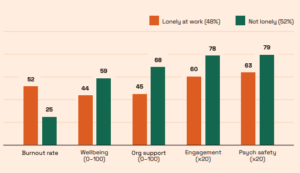
His research found that 48 per cent of employees report lacking companionship or feeling left out at least some of the time.
“If you have people who feel lonely in a workplace where you’ve got all these people around you, that’s a sign that something else is broken,” says Chan.
The research found that burnout, loneliness, declining wellbeing and mental health strain are all issues inextricably linked within the workplace, and a direct product of poor job design and unnecessary friction.
Chan also found that people who worked additional hours were most likely to experience not just burnout and lower wellbeing, but they were also more likely to feel lonely at work.
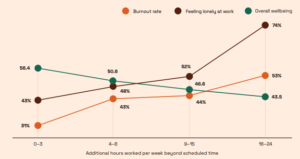
Source: State of the Workplace report, 2026, Dr John Chan
So what can HR practitioners properly support employees?
“Loneliness is a leading indicator of other bad things happening. If you have people who feel lonely in a workplace where you’ve got all these people around you…That’s a sign that something else is broken.”
HR action points:
- Understanding location won’t fix loneliness: The research noted there was no relationship between hybrid/remote working models and increased loneliness. Avoid assuming that a return-to-office mandate will work as a blanket fix for loneliness. HR need to encourage managers to be intentional about how they bring teams together to have meaningful, connected relationships.
- Bridge the organisational trust gap: Ensure senior managers visibly act on feedback about system frictions. Supporting structural changes can help managers build trust.
Redesigning systems over individual resilience
Lowering national burnout requires a decisive pivot, says Chan.
“We need to shift our mindset to go upstream. We can’t just focus on things like EAP programs, or a mindfulness app.”
While surface-level wellbeing initiatives are simple for executive leadership to approve, altering operational conditions will have a greater pay off.
“Leaders are really good about signing off on a new app – that’s really easy,” says Chan. “But to say, ‘Let’s think about redesigning people’s jobs or how we do work’ – that is hard.”
Ultimately, Chan believes that long-term productivity and wellbeing will not be achieved by asking employees to put up with inefficient systems, but by businesses having the courage to fix those processes.
🧰 HR’s career resource toolkit
- Course – Contemporary Workforce Redesign
- Course – Health, Safety and Wellbeing
- Article: Making your unmanageable workload manageable
- Article: Why AI-driven restructuring requires a shift in HR strategy
- Research: State of the Workplace Report 2026
- Article: What is ‘time confetti’ and how might it be impacting our wellbeing?’


