HR professionals hold the key to helping their organisations unlock workforce innovation by encouraging sustainable inclusion.
Addressing the complex challenges facing our organisations and societies requires freeing up the innovation potential of increasingly diverse workforces.
This responsibility sits with HR professionals and leaders who can strengthen organisational effectiveness by building inclusive cultures that fully utilise human capability.
By contrast, traditional hierarchical models, built on compliance and centralised decision making, often inhibit innovation and engagement.
Freedom-oriented leadership presents an alternative and transformational paradigm grounded in the assumption that individuals can be accountable and responsible, collaborate effectively and align their personal values with organisational purpose when provided psychological safety, trust and autonomy.
Chorus and freedom-oriented leadership
Our research presents a case study of how Chorus, a for-purpose organisation with over 700 employees and volunteers providing services in the aged care, disability and mental health sectors across Western Australia, has transformed into an ecosystem which embodies the following eight principles of freedom-oriented leadership:
- Empowerment – Trusting people to act with autonomy and take initiative without waiting for permission.
- Respectful relationships – Valuing everyone’s voice, regardless of role or status.
- Trusting relationships – Assuming good intent and supporting peers through mistakes without blame.
- Shared vision – Aligning decisions and actions with the organisation’s purpose of enabling local communities to thrive.
- Accountability and responsibility – Owning commitments and holding each other to them through agreements.
- Humility – Acknowledging limits, listening deeply and being open to feedback.
- Guardianship of liberated teams – Protecting the conditions for self-management and restraining from use of formal authority.
- Shared beliefs and values – Living the organisation’s values (responsive, practical, empowering and respectful) daily and weaving them into ways of working.
Chorus’s distinctive approach, in which local communities are supported by small, autonomous and independent local teams coached by enabling functions, has drawn attention both locally and nationally.
In 2024, it received the Australian Institute of Management Western Australia Pinnacle Award for People and Culture Excellence, in recognition of its co-designed approach to building a thriving and connected community.
Academics and practitioners have begun to cite Chorus as an Australian example of a ‘liberated company’ or ‘teal organisation’, borrowing language from management literature on self-management and freedom-based leadership.
“Freedom-oriented leadership presents an alternative and transformational paradigm grounded in the assumption that individuals can be accountable and responsible…when provided psychological safety, trust and autonomy.”
Sustainable versus performative diversity, equity and inclusion
While the business case for DEI is widely accepted, particularly its contribution to innovation in diverse teams, many DEI initiatives in Australian workplaces have faced growing criticism (some justified, others not).
Beyond concerns that DEI can feel exclusionary to some cohorts, much of the criticism focuses on initiatives that, while well intentioned, are seen as tokenistic and lacking real impact.
Countering this requires well-resourced systemic, strategic, cultural and behavioural change informed by evidence and inclusive co-design principles and with clearly defined accountabilities for leaders at all levels.
Frameworks such as maturity models can help with sustainable DEI by supporting a more systematic, holistic and integrated approach underpinned by evidence. Members of the research team have designed and used such models to help advance DEI maturity in a number of sectors including mining and local government.
Building inclusion, trust, respect and belonging
While immersing ourselves in the Chorus community and diving deep into the data, we saw strong evidence suggesting that the organisation, which did not have any formal DEI policies or roles, was highly inclusive and equitable for a very diverse workforce.
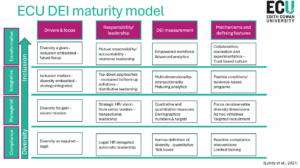
This suggested that Chorus was operating at or approaching level 4 (transformative) maturity on the Edith Cowan University DEI capability maturity model (ECU DEI CMM). This model has four levels of maturity across four dimensions, as summarised below.
| Theme | How operationalised |
| All employees had high levels of autonomy while also having a strong sense of mutual responsibility and accountability | Autonomy was promoted through ensuring ‘mistakes’ were treated as learning opportunities which was role-modelled by the CEO and strategic leaders. Staff were trusted to make decisions within their roles and beyond, with autonomy enabled rather than tightly controlled.
Mutual responsibility and accountability were supported through the use of agreements within and between teams and peers. Coaching was provided to help with managing broken agreements. |
| The organisational structure actively enabled employee empowerment | Empowerment showed up in everyday behaviours and ways of working. Employees’ contributions were openly recognised, which built confidence and reinforced a sense of value. The CEO actively encouraged open and honest conversations, creating space for people to share ideas and take part in discussions without hesitation.
Development was prioritised through formal training, leadership opportunities, and personalised mentoring, helping individuals grow and reach their potential. Flexibility in how work was approached, alongside open discussions, enabled people to contribute confidently and make decisions aligned with the best interests of their teams. |
| Services and business processes were co-created and agreed upon through collaborative decision making | A decision-making matrix in the Chorus playbook provided guidance about how to do collective, advice and consent-based decision-making. Decisions were made by decision-making forums which operated by consent, not command, and anyone in the organisation could put forward a proposal to have a decision made by a forum. The CEO retained veto authority over decisions but had never used it. |
| Employees demonstrated a strong sense of social purpose and a commitment to help create thriving communities | Local teams were actively supported and empowered to evolve their services to best support the communities they served to thrive, with success stories actively shared through platforms such as Trello boards and connection forums. |
| Leadership was inherently relational and helped create a high-trust culture which was further enhanced by high levels of transparency. | Leaders actively worked to reduce power differentials, e.g. by removing power artifacts (such as titles and offices) and by staying grounded through directly delivering services to customers. These ways of leading were supported with bespoke leadership development including horizontal and vertical development and coaching.
The organisations operating model and structure were designed to be inherently relational without any hierarchy. This was supported through the use of Peerdom, a dynamic, relational tool which mapped roles, accountabilities, and relationships across the organisation. The visibility of relationships and ways of working through tools like Trello boards, supported a high-trust culture. |
Collectively, these characteristics have created a highly relational way of working which values what it is to be human and helps people to thrive and feel they belong. This is the essence of a truly inclusive culture where people from diverse backgrounds can feel valued and add value.
Key takeaways for HR
There is a strong sense among HR/DEI practitioners that systemic change and impactful DEI are required to overcome backlash and create meaningful and sustainable change.
A maturity model, such as the ECU or AHRI models, helps provide a framework to guide the development of impactful DEI strategies.
Additionally, true inclusion and high levels of DEI maturity can be achieved through creating a culture of freedom-oriented leadership and creating more liberating organisational structures with high levels of autonomy and accountability.
Readers interested in knowing more about Chorus and its unique operating model can access the case study and accompanying teaching notes, which we have developed to help business students learn about freedom-oriented leadership.
Learn more about industry best practices for leading diverse, equitable and inclusive workplaces with AHRI’s new DEI for HR Leaders short course.
Dr Judy Lundy and Dr Rahatulaain Ahmad are academics with the School of Business and Law at Edith Cowan University in Perth. The authors would like to thank the Chorus community for their enthusiasm for our project and for making it easy for us to engage with them. In particular we’d like to acknowledge Donna Trebilcock, Enabling Leader – Coaching and Organisational Development, for all her support.